
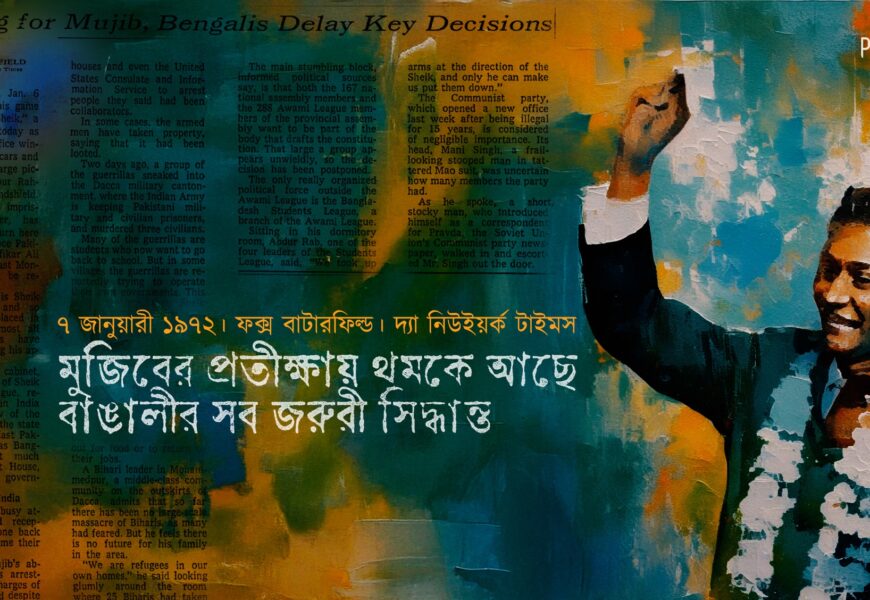
“Now everyone’s only task is to wait for the Sheikh,” said a diplomat while looking out of the window. The street outside was blocked with buses and cars, all with large images of Sheikh Mujibur Rahman hanging on the front.
The imprisoned Bengali leader, Sheikh Mujibur Rahman, is about to return to his homeland at any moment. This optimism arose after Pakistan’s President, Zulfikar Ali Bhutto, announced his release from prison last Monday. The popularity of Sheikh Mujib is sky-high, and the hope surrounding his return is so intense that all significant decisions are on hold, awaiting his arrival.
Two weeks ago, members of the Awami League’s cabinet, who had returned from exile in India, have been spending much of their time at their government residences. Some have been attending rallies and receptions, while others have gone to India to bring back their family members.
Since being imprisoned by Pakistan on charges of treason in March, no effective opposition to Sheikh Mujib or his political party has emerged despite the chaotic situation over the past nine months. In December 1970, in the national assembly elections, the Awami League won 167 out of 169 seats in East Pakistan. The smaller parties have only become weaker after the nine-month war.
However, several complex problems have arisen for the new Bengali state, and Sheikh Mujibur Rahman will have to solve them.
Disarming Guerrillas
Hundreds of thousands of guerrillas from the Mukti Bahini are still armed. Though the cabinet has called for them to surrender their weapons, only a few have responded. Armed individuals, claiming to be members of the Mukti Bahini, continue to raid houses in the name of arresting collaborators. They have even carried out operations at the U.S. consulate and the Information Service. Such incidents are happening daily. There have also been cases of property seizures, citing looting during the war.
A couple of days ago, a group of guerrillas entered the Dhaka Cantonment, where Pakistani soldiers and civilians are under the guard of Indian forces. The guerrillas killed three people there.
Many of the guerrillas are students who want to return to their studies. However, some groups in rural areas consider themselves the government.
This is a complex issue, and analysts believe that Sheikh Mujibur Rahman will have to handle it.
The Bihari Issue
Another deep-rooted problem is the two million Biharis. These ethnic minorities, who had fled from India, were allies of the Pakistani army during the Bengali genocide. After the war, they have been trapped, unable to venture out for food or employment.
A leader from the Bihari community in Mohammadpur, Dhaka, said, “As we feared, we have not yet been subjected to mass killings, but we believe there is no future for us in Bangladesh. We are now refugees in our own homes.” He seemed deeply distressed. Inside one house, 25 Biharis had taken shelter. He added, “There is no place left to live here. We must either go to West Pakistan or return to India.”
Both the security threat posed by the armed guerrillas and the plight of the Biharis will worsen after the withdrawal of Indian troops. Durga Prasad Dhar, India’s special representative engaged with the Bangladesh government, is working on these issues.
However, analysts believe that the final decision on these matters will ultimately rest with Sheikh Mujibur Rahman.
No Decision on the Constitution
The government is also unable to decide another important issue—how to call a constituent assembly for drafting a constitution. The expatriate government had formed a commission during the war to address this, but upon returning to the independent country, the commission was dissolved without any conclusive decisions.
According to political sources, the main problem is that all 167 members of the national assembly and 288 provincial assembly members are eager to be part of the constituent assembly. Having such a large number of members involved in drafting the constitution is unusual, and therefore, this decision also rests with Sheikh Mujibur Rahman.
Currently, the only truly organized political force, besides the Awami League, is the Awami League’s student wing, Chhatra League. One of its four main leaders, Abdur Rob, sitting in his office, said, “We took up arms on Sheikh Mujib’s command, and we will only lay them down when he gives the order.”
The Communist Party, which opened its office in Dhaka last week after being banned for 15 years, seems to hold little significance. In tattered Maoist suits, party leader Mani Singh could not even state the number of party members. While Mani Singh was speaking, a short, well-built man entered and introduced himself as a reporter from the Soviet Communist Party’s newspaper *Pravda*, and took Singh out of the room.

https://stapravda.ru/20221228/reyting_samyh_populyarnyh_hostingov_v_rossii_196445.html, рейтинг хостингов России подтверждает, что выбор надежного провайдера важен для бизнеса.