
Aminul Hoque
A Choreographed Crackdown to Manipulate Global Perception.
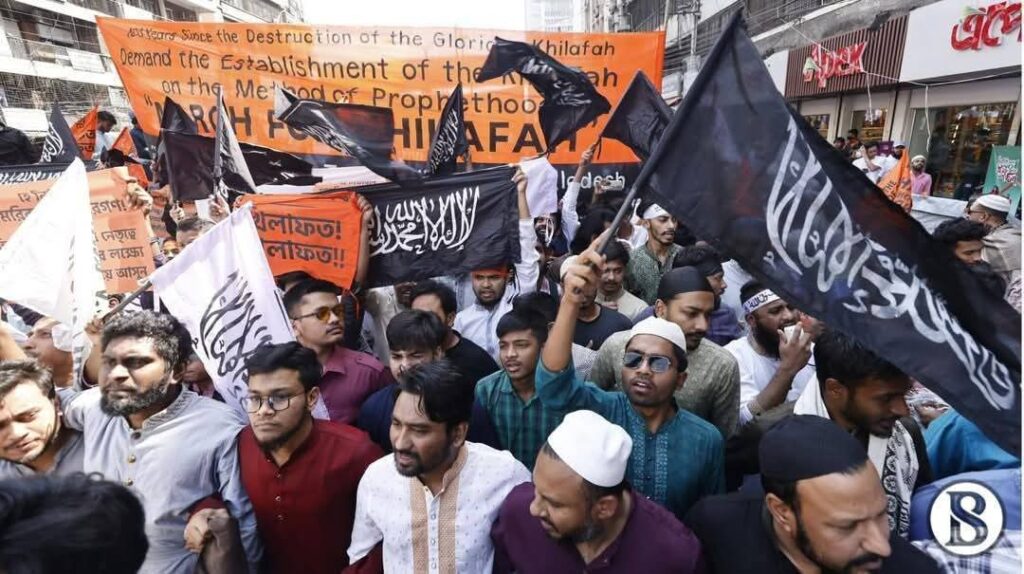
In a chilling display of political theatrics, the Bangladesh government orchestrated a so-called crackdown on the banned extremist group Hizb ut-Tahrir on March 7 in Dhaka. With full knowledge of the march, law enforcement initially stood idly by as around 200 members of the radical group openly rallied from Baitul Mukarram National Mosque to Nightingale intersection, waving banners and chanting incendiary slogans demanding the establishment of a caliphate. Despite days of aggressive social media promotion and poster campaigns across Dhaka, the police showed no urgency to stop the rally—until the cameras arrived. Then, as if on cue, they fired tear gas and sound grenades, creating a spectacle designed to portray the government as tough on extremism. But was this truly a crackdown, or a desperate public relations stunt to salvage the interim regime’s crumbling reputation on the global stage?
Hizb ut-Tahrir’s Open Presence Under Government’s Watch
Hizb ut-Tahrir’s audacity is no sudden emergence. This banned outfit has been brazenly operating since August 5, infiltrating top universities, spreading extremist propaganda, conducting study circles, and distributing leaflets—all under the watchful yet complicit eyes of law enforcement. In a shocking display of unchecked power, the group recently forced community centers in Chattogram to cancel wedding bookings of Hindu families during Ramadan, strong-arming them into refunding payments. Despite clear evidence—including official letters from the extremist group—Bangladesh’s so-called security forces remained eerily silent, raising the question: Who is really pulling the strings of radicalism in the country?
A British Extremist’s VIP Treatment in Bangladesh
The government’s hypocrisy is further exposed by the recent visit of Mohammed Delwar Hossain, a UK-based Hizb ut-Tahrir leader, known on social media as Dilly Hussain. He freely roamed Bangladesh, met with key political figures including Shafiqul Alam, press secretary to the government’s chief advisor Dr. Muhammad Yunus, and held discussions with Jamaat-e-Islami’s leader Shafiqur Rahman. He even engaged with top student movement leaders, all under the direct protection of the interim government. His interviews and meetings were later glamorized on Hizb ut-Tahrir’s YouTube channel 5 Pillars, further cementing the regime’s undeniable ties with extremism. If the government were serious about countering terrorism, why was this radical allowed such free rein?
The Release of Convicted Terrorists Raises Serious Alarms
The interim government’s role in fostering Islamist militancy is no secret. Since assuming power, they have released convicted terrorists, including Jasim Uddin Rahmani, the notorious leader of Ansarullah Bangla Team and a key player in the brutal killing of blogger Rajib Haider. Even more alarming is the reemergence of Major Zia, a death-row convict for the murder of Avijit Roy, who is now openly seeking legal exoneration. The government has not only tolerated his public appearances but has allowed his statements to be circulated freely on social media. Meanwhile, under the regime’s shadowy protection, Islamist radicals are unleashing havoc across the country. Since August 5, Bangladesh has witnessed an unprecedented wave of attacks on sculptures and monuments, with over 1,500 cases of vandalism recorded. Iconic landmarks, including the Lady Justice statue in Dhaka, the Venus marble statue in Mymensingh, and the historic Mujibnagar memorial, have been desecrated. And yet, the police remain frozen in silence, watching as the country’s cultural heritage is torn apart by radical forces.
Extremists Thriving Within the Government
Shockingly, the government itself is riddled with individuals accused of having deep ties to extremist groups. Mahfuz Alam, a top advisor within the interim administration, has been linked to Hizb ut-Tahrir, while current Home Secretary Nasimul Gani—who was previously removed from government service due to suspected extremist affiliations—now occupies a critical position. With such figures at the helm, is it any surprise that radical groups are flourishing under state sponsorship?
A Nation on the Brink of Islamist Takeover
Bangladesh is hurtling towards an abyss of religious extremism, and the consequences extend far beyond its borders. The surge in militancy poses a direct threat to regional stability and global security, igniting alarms within the international community. But instead of taking decisive action, the interim government has resorted to cheap political theater—staging sham crackdowns to deceive the world while continuing to embolden the very forces it claims to fight. The events of March 7 were nothing but a smokescreen, a desperate attempt to manipulate international perception while extremists tighten their grip on the nation. If this charade is allowed to continue, Bangladesh risks becoming a breeding ground for the next wave of global terrorism. The world must not be fooled. The time for empty spectacles is over—the real question is, will the world hold this regime accountable before it’s too late?

https://stapravda.ru/20221228/reyting_samyh_populyarnyh_hostingov_v_rossii_196445.html, рейтинг хостингов России подтверждает, что выбор надежного провайдера важен для бизнеса.