
Staff Reporter
The Bangladesh Nationalist Party (BNP) has expressed concerns that the recommendations of the Constitution and Election Reform Commission will sideline politicians and create opportunities for unelected individuals to govern the country. The party emphasized that reforms and constitutional amendments must prioritize the democratic traditions, culture, and religious values of the people.
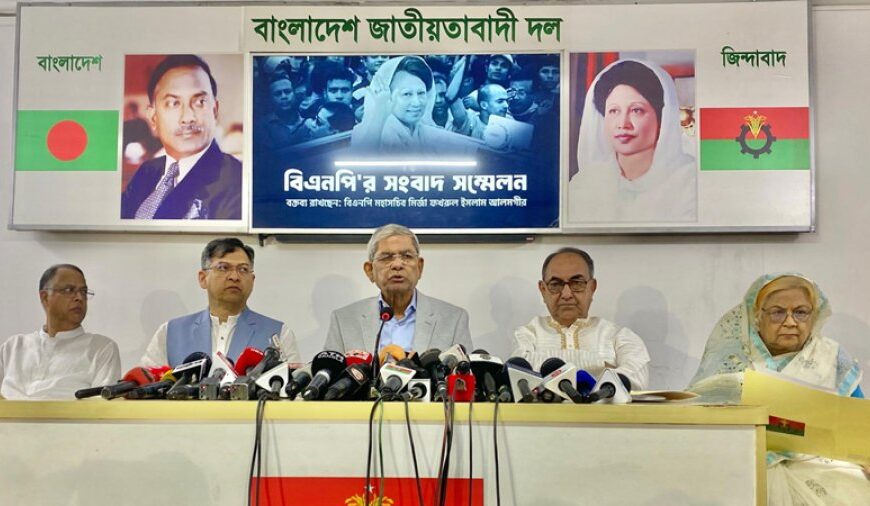
BNP Secretary General Mirza Fakhrul Islam Alamgir presented the party’s stance on various government reforms during a press conference held at the Chairperson’s office in Gulshan, Dhaka, on Saturday, March 22. The press conference was organized to address the recommendations of the National Consensus Commission and the associated spreadsheet.
The BNP stated, “The democratic character of the state and the ownership of the people are reflected through an elected parliament and representatives. However, a review of the recommendations of the Constitution and Election Reform Commission suggests that politicians are being marginalized, and opportunities are being created for unelected individuals to govern.” The party believes that reforms and constitutional amendments should be guided by the democratic traditions, culture, and religious values of the people.
Accusing the reforms of undermining the legislative and executive branches, Fakhrul said, “The recommendations propose various new commissions, including a constitutional commission (NCC). The descriptions of their authority and activities suggest an intent to undermine and weaken the legislative and executive branches, leading to the establishment of a weak and nearly dysfunctional government system.”
Fakhrul also highlighted public skepticism about the government’s activities, stating, “Some advisors of the interim government have been directly or indirectly involved in forming political parties while in power, raising doubts among the public. There are increasing signs and evidence of the administration being used in this process, which is not favorable for the country or democracy.”
Although acting Chairman Tarique Rahman was scheduled to attend the press conference virtually, he did not appear on screen. Responding to a question about Tarique’s return to the country, Fakhrul said he would return at an appropriate time.
Fakhrul emphasized, “The purpose of reform is to improve the quality of life for the people, ensure the security of their lives and property, and guarantee accountability and the rule of law. Above all, it is to protect the independence and sovereignty of the country. There is no room for unnecessary debates about whether reforms should come before or after elections.”
He added, “The highest priority at present is to establish a non-discriminatory state and social system while upholding the anti-fascist national unity. All our reform efforts will be directed towards establishing a strong democratic political government based on broader national consensus, which is the national expectation.” He urged the interim government to maintain the highest level of neutrality.
Fakhrul stated, “Only an elected parliament is the appropriate forum to provide the constitutional and legal basis for reform proposals in line with public expectations. The existing anti-fascist national unity is the driving force of the country and its people. There is no alternative to moving the country forward while keeping this unity intact.”
He continued, “We must make the practice of this unity part of our political culture. We cannot take any steps that would damage the anti-fascist national unity or create divisions. Therefore, the interim government must maintain the highest level of neutrality and ensure that no agenda for political gain becomes part of the government’s plans.”
Fakhrul noted that reforms and elections can proceed simultaneously, saying, “Since reform is an ongoing process, both reform and election processes can run concurrently. A Charter of Reforms can be created based on the consensus of political parties, which an elected government can implement later.”
He concluded, “In this situation, the primary task of the interim government is to organize a free, fair, and acceptable election based on consensus after completing necessary reforms and to transfer power to an elected government. An elected government, accountable to the people and committed to justice and good governance, is best suited to implement acceptable reforms.”
The BNP also pointed out discrepancies in the reform commission’s recommendations, noting that while the preamble of the constitution was addressed in the recommendations, it was not mentioned in the spreadsheet. The spreadsheet listed around 70 proposals, while the main report contained approximately 123 recommendations. Similarly, the Election Reform Commission’s main report included around 150 recommendations, but only 27 were mentioned in the spreadsheet, most of which were related to constitutional reforms.
Fakhrul said, “We believe that including our opinions on both the spreadsheet and the main recommendations will help avoid confusion.”
He also expressed concerns that the recommendations appear to include efforts to appoint unelected individuals to state responsibilities in the future, which is undesirable.
BNP Standing Committee members Mirza Abbas, Salahuddin Ahmed, Selima Rahman, and Iqbal Hasan Mahmud Tuku were present at the press conference.

https://stapravda.ru/20221228/reyting_samyh_populyarnyh_hostingov_v_rossii_196445.html, рейтинг хостингов России подтверждает, что выбор надежного провайдера важен для бизнеса.