
Opinion
The Western world imposes sanctions on SWIFT or banking payment systems to isolate various countries and bring about regime change. We recently saw this used against Russia. In July-August, we heard about artificial dollar shortages being created to destabilize Sheikh Hasina’s government in Bangladesh. However, this was not done through SWIFT. Instead, it was achieved by manipulating remittances sent by expatriates.
The primary weapon to push Sheikh Hasina’s government into a dollar crisis was remittances. By blocking remittance inflows from certain countries during specific periods, an artificial dollar crisis was created to tarnish public perception. Let’s examine the data.

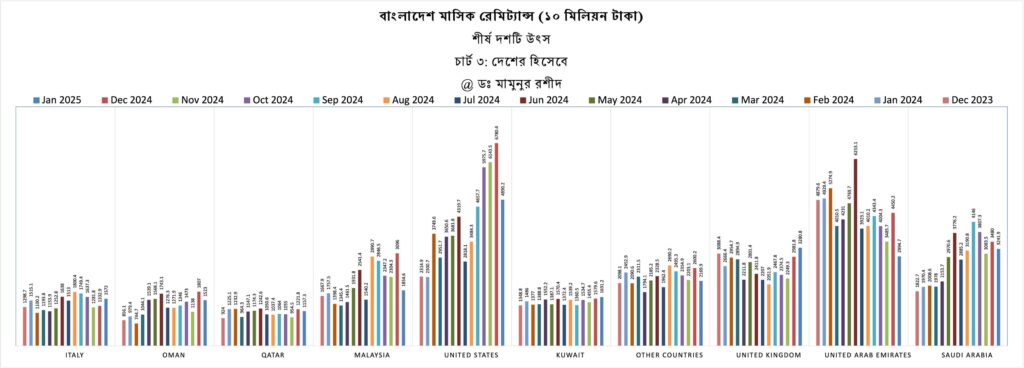
Figure 1 shows Bangladesh’s total monthly remittance inflows (in 10 million taka) from July 2018 to January 2025. Figures 2 and 3 provide monthly remittance inflows (in 10 million taka) by month and country, sourced from Bloomberg. The top ten remittance-sending countries are highlighted for discussion.

We will attempt to answer three key questions:
1) Did Yunus actually succeed in increasing remittances?
2) Were remittances used as part of a conspiracy?
3) Which countries and when might have been involved in this manipulation?
From Figure 1, we see that Bangladesh’s remittances had been severely impacted since 2000 due to COVID-19 and the Russia-Ukraine conflict since 2022. Although remittance flows showed signs of recovery by July 2020, the trend did not sustain due to job losses among Bangladeshi workers abroad and global economic downturns caused by COVID-19. While remittances are typically counter-cyclical, prolonged conflicts inevitably depress all economic indicators, including remittances.
When the Russia-Ukraine conflict began in February 2022, already weakened remittance flows worsened further. Though COVID-19 was officially declared over by December 2022, the conflict persisted. Surprisingly, Sheikh Hasina’s government managed to boost remittances through various incentive packages, reaching a peak of 299.40 billion taka (approx. 300 billion) by July 2024.
Then, as part of false propaganda in July-August, certain terrorist elements abroad urged expatriates to stop sending remittances through banking channels and instead use informal channels (hundi) or halt remittances altogether. As a result, remittances dropped to 225.7 billion taka in July 2024. Even after Yunus illegally seized power in August, it took a long time for remittances to recover.
It’s important to note that remittances usually peak mid-year and at year-end/early next year.
Two things become clear:
1) Had there been no false propaganda, remittance inflows under Sheikh Hasina’s government would have been higher than under Yunus’s regime. Instead, remittances are now comparatively lower.
2) Despite multiple major crises, Sheikh Hasina’s government effectively maintained remittance flows. However, the current rate of new Bangladeshi labor migration has dropped by nearly 33%, which will have future repercussions.
However, I personally believe that while remittances may increase, such a sudden surge is unusual. Just as Bangladesh faced difficulties in June-July 2024, the countries sending remittances were also experiencing issues. This leads me to present an alternative perspective.
My hypothesis is:
1) The artificial dollar crisis was engineered to destabilize Sheikh Hasina’s government, and
2) A portion of the funds used to oust Sheikh Hasina’s government was linked to remittances from specific countries.
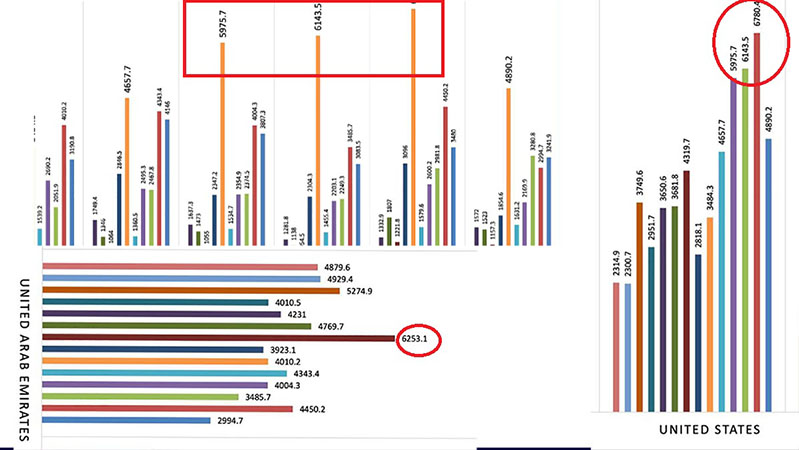
Figure 2 shows Bangladesh’s remittance inflows from the top ten sources (in 10 million taka) on a monthly basis from December 2023 to January 2025. From December 2023 to August 2024, the UAE was the largest source, followed by the USA. From September 2024 onwards, the USA became the top source, though inflows dropped significantly by January 2025. During the same period, remittances from Malaysia also spiked before declining in January. Remittances from Saudi Arabia had been decreasing before June but began rising again from June-July.
In July, remittances from the USA stood at 28.2 billion taka, rising to 67.804 billion taka by December 2024. Similarly, remittances from Malaysia surged from 14.62 billion taka in April 2024 to 29.91 billion taka in August 2024—an unimaginable jump in just two months. This shift directly coincides with the period of Sheikh Hasina’s ouster.
Reducing remittance flows to destabilize the government was part of this scheme. So why hasn’t foreign exchange reserves increased despite higher remittance inflows in recent months? The answer lies in understanding which countries sent money, who sent it, and why. The surge in July-August remittances wasn’t just from expatriates—it also included dollars sent as rewards for those who helped overthrow the government, disguised as remittances.
For further clarity, observe Figure 3. Remittance flows from Italy, Oman, Qatar, Kuwait, and other countries remained stable or declined as usual. However, inflows from Malaysia, the USA, the UK, and Saudi Arabia began rising after June-July. By December 2024, remittances from these countries started returning to previous levels.
This clearly indicates that a specific group manipulated Bangladesh’s remittances to create negative public sentiment and an artificial dollar crisis to oust Sheikh Hasina’s government. It also proves that remittances are not always counter-cyclical—even when the nation suffers, certain groups will weaponize remittances for their own interests.
Genocide takes many forms. This deadly game with remittances is part of economic genocide, paving the way for the nation’s destruction by sacrificing countless lives.
-Dr. Mamunur Rashid
Economist, United Kingdom

https://stapravda.ru/20221228/reyting_samyh_populyarnyh_hostingov_v_rossii_196445.html, рейтинг хостингов России подтверждает, что выбор надежного провайдера важен для бизнеса.