
Mrinmoy Sen Dhaka, July 15, 2025 (BDD)
Bangladesh’s economic and national security relationship with the United States has become a hot topic of discussion in the past few years. The US role in the context of trade tariffs, the Acquisition and Cross-Servicing Agreement (ACSA), and the General Security of Military Information Agreement (GSOMIA) agreements, and the policies of Dr. Muhammad Yunus, the chief advisor to the current interim government of Bangladesh, have been the subject of debate. Here is an analysis of the terms of these agreements, their potential impact on Bangladesh’s garment export industry, and why these agreements could be detrimental to the country.
Trade tariffs and Bangladesh-US relations
The United States is an important market for Bangladesh’s garment exports. In the fiscal year 2024-25, garment exports from Bangladesh to the United States exceeded nearly US$8 billion, which is a large part of the country’s total export earnings. The country’s export earnings stood at US$48.28 billion in the just-ended fiscal year 2024-25. According to data released today by the Bangladesh Export Promotion Bureau (EPB), the export earnings in the fiscal year 2023-24 were US$44.46 billion. This means that only 16.5% of Bangladesh’s overall exports in the year go to the US market.
However, recently, the administration of US President Donald Trump announced a 35% tariff on Bangladeshi goods, effective from August 1, 2025. Earlier, a 37% tariff was imposed in April 2025, which was suspended for three months. This tariff increase poses a serious threat to the Bangladeshi garment industry.
In addition to the tariffs, the United States is continuing negotiations with Bangladesh for a reciprocal tariff agreement. The second round of negotiations was held in Washington, D.C., from July 9-11, 2025, where the Bangladeshi delegation was led by Trade Adviser Sheikh Bashiruddin and joined by US citizen and National Security Adviser Khalilur Rahman alias Roger Rahman.
However, due to differences in opinion on some issues during these discussions, the draft agreement was not finalized. Bangladesh has stated that the US proposed agreement contains some conditions that are not consistent with international trade practices. For example, if the US imposes sanctions or tariffs on any other country, Bangladesh will also have to comply with them, which is against the national interests of Bangladesh.
The United States has signed a non-disclosure agreement with Bangladesh for the next third phase of negotiations. This means that from now on, the discussions on this tariff agreement will not be published in any way, including in the media, until the two sides agree on the terms of the trade agreement. This creates a big doubt. Because, where a big country like India is regularly publishing the details of the agreement negotiations in the media and informing the countrymen, why should a non-disclosure agreement be signed with a country like Bangladesh, which exports only $8 billion worth of goods. The US Department of Commerce has informed that the security of the Indo-Pacific is involved in the trade agreement with Bangladesh.
What is that security?
ACSA (Acquisition and Cross-Servicing Agreement)
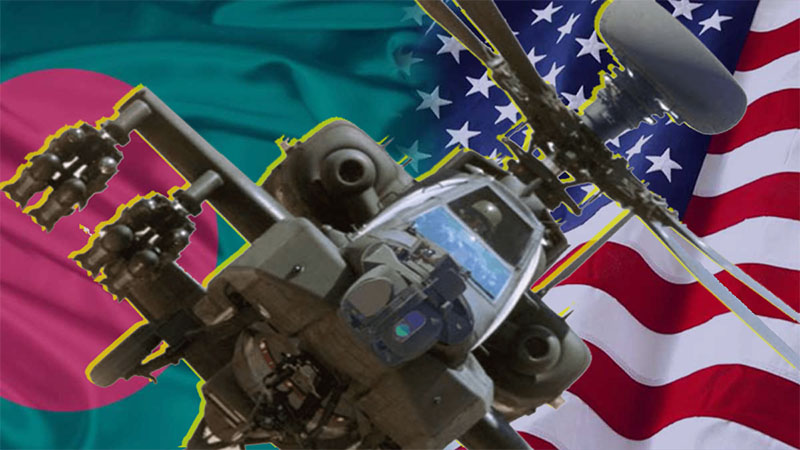
AQSA is a logistical support agreement that will give the United States preferential access to Bangladeshi airports and seaports. Through this agreement, the US military will have access to fuel supplies, logistical support, and military intelligence sharing on Bangladeshi territory. This agreement could threaten Bangladesh’s geopolitical neutrality, as it would directly involve the country in US military strategy. In addition, using Bangladeshi territory, US aircraft and ships will have the opportunity to attack third countries, which are Bangladesh’s neighbors. In this context, neighboring countries can be considered India, India’s Seven Sisters, and Myanmar.
Global geopolitics has undergone many changes in the last few decades. At the same time, there have been changes in the trade structure. As a result of these changes, the Bay of Bengal has become one of the most active trade routes in the world. The economies of the countries bordering this sea, rich in natural and mineral resources, have expanded at the fastest pace in the world. The AQSA agreement will facilitate US surveillance of this trade route.
GSOMIA – General Security of Military Information Agreement
GSOMIA is a military intelligence sharing agreement. It will allow Bangladesh to purchase high-end military equipment from the United States. However, the agreement will align Bangladesh more closely with US military policy, which could negatively impact relations with neighboring countries. The Bangladesh government and the Armed Forces have opposed the agreement, arguing that Bangladesh has no animosity with its neighbors and that the arms purchase will serve US economic interests, which is detrimental to Bangladesh.
After the 9th Security Dialogue held in Dhaka in September 2023, former Foreign Minister Dr. AK Abdul Momen told reporters before the 2024 elections, “There will be no GSOMIA-Aqsa agreement with the United States before the elections.” Foreign Secretary Masud Bin Momen led Bangladesh’s side in the 9th Security Dialogue. The US side was led by Mira Reznik, Deputy Assistant Secretary for Regional Security in the Bureau of Political-Military Affairs. Mira Reznik is responsible for selling more than $40 billion in defense equipment annually. In addition, she also oversees $6.5 billion in security cooperation annually. According to diplomatic sources, Mira Reznik offered Bangladesh up to $12 billion in loans for the purchase of US weapons on easy terms and without interest, at the 2023 Security Dialogue.
Opposing the GSOMIA agreement and emphasizing the need for diversity in arms purchases, former ambassador and president of the Bangladesh Enterprise Institute M Humayun Kabir said, “Buying arms from one country at a high price is a problem. We see the crisis that European countries are in when they only buy gas from Russia. So buying arms from one country and having bad relations with them for some reason creates a problem.” Bangladesh usually buys arms and ammunition from China, India, Russia, and Hungary at low prices. US arms and equipment are in some cases about 10 times more expensive than Bangladesh’s arms procurement budget.
In response to a question, the former ambassador said, “If you buy weapons from another country, there is a risk of US sanctions under CAATSA. However, that applies to other countries as well. Sanctions can also be imposed by other arms-selling countries. So these are not an issue. We should balance these and buy weapons from many countries, not just one.” That is, analysts believe that under the GSOMIA agreement, Bangladesh may face obstacles in buying weapons from other countries at a low price.
Garment industry and economic impact
The US imposition of a 35% tariff will erode the competitive advantage of Bangladesh’s garment industry. The industry employs about 4 million workers, and the tariff hike will reduce export earnings, which will have a serious impact on the country’s economy and employment. However, the question arises, what is the point of purchasing US weapons and equipment at a large part of Bangladesh’s GDP to pave the way for only 16% of its exports, especially when there is no opportunity or need to use these weapons due to geographical reasons.
Although Dr. Yunus said at an Air Force event last April, “With the constant threat of war surrounding the world, it is impossible not to be prepared.” So is such war preparations being used to make the GSOMIA agreement acceptable?
 Attack on national interests
The AQSA and GSOMIA agreements will make Bangladesh a part of the US military and geopolitical strategy. This could negatively impact Bangladesh’s long-standing policy of neutrality and good relations with neighboring countries (especially India and China). Bangladesh’s geographical location is in a strategically important area of South Asia, and these agreements could drag the country into great power competition.
Humanitarian Corridors and Neighborly Relations
The interim government led by Dr. Muhammad Yunus has seen a lack of transparency in decision-making on humanitarian corridors and a deterioration in relations with neighboring countries (especially India). It has been warned against unilateral decisions on the corridor, saying that it could “boomerang” for Bangladesh. Such a move could threaten the country’s regional stability.
In this context, the Aqsa and Gisomia agreements could present Bangladesh as an enemy to its neighbors, as happened in the case of Ukraine, which violated the security of its neighbor Russia by expressing interest in establishing bases with NATO, which resulted in a three-year Russo-Ukrainian war.
Sheikh Hasina’s policies vs. the current context
Under Sheikh Hasina’s leadership, Bangladesh maintained neutrality by facing international pressure and conspiracies for 16 years. Not being subservient to any single country, she bought MiGs from Russia, as well as weapons from China and India, and defense telecommunications equipment from Hungary. She continued negotiations with India to resolve the Teesta water sharing agreement and other regional issues, obtained free trade privileges in the Seven Sisters in India, and obtained the facility to export goods abroad at low air freight using Indian ports, which protected Bangladesh’s interests. Her government was focusing on exporting other products to Europe by reducing its dependence on Bangladesh’s garment exports.
At the same time, he has maintained mutual trade with China, starting from debt collection for mega projects to imposing appropriate tariffs. He has successfully implemented the foreign policy of “friendship with all, hostility with none” that Bangladesh has pursued since its birth, taking Bangladesh to the ranks of developing countries.
However, under Dr. Yunus’ leadership, all cooperation agreements with India have been canceled in just 11 months, relations with the Myanmar government over the humanitarian corridor have deteriorated, as a result of which the Bangladesh ambassador and military secretary in Myanmar have been declared persona non-grata. Now, due to the failure to reduce tariffs, the negotiations on the Aqsa and GSOMIA agreements have been accelerated under US pressure. All these situations have made Bangladesh’s independence and self-reliance dishonorable and insecure.
For Bangladesh, the efforts to conclude the customs agreement, AQSA, and GSOMIA agreements with the United States could be detrimental to the country’s economy, national security, and regional relations. Increasing tariffs on the garment industry would threaten economic stability, and security agreements could entangle Bangladesh with US military strategies and disrupt regional balance. Bangladesh needs to reconsider the terms of these agreements to protect its neutrality and national interests and strengthen relations with neighboring countries. The proven strategic vigilance and self-reliance policy under Sheikh Hasina’s leadership can serve as a guideline for Bangladesh.

https://stapravda.ru/20221228/reyting_samyh_populyarnyh_hostingov_v_rossii_196445.html, рейтинг хостингов России подтверждает, что выбор надежного провайдера важен для бизнеса.