

An aviator investigates and analyzes the cause of the fighter jet crash into Milestone College
Armaan Rashid
I’ve been seeing a lot of analysis online for the past two days, none of which is informative. That’s why I felt the need to write this article. First, let’s bust some myths:
1) The pilot wanted to land on the grounds of Milestone College. This is ridiculous, because even a 1 km long field is not enough for such a fighter jet to land. Moreover, just 1 km west of Milestone, there was plenty of open space on the banks of the Turag River.
2) Why train in densely populated areas? Actually, training maneuvers usually take place outside the city, but for takeoff and landing, you have to return to some runway.
3) The plane was very old and rusty. I assume the plane was fit. If it is fit, age does not matter in any plane. One thing many people may not know is that a plane is not a car or a tin bus. Each part of the plane has an age limit. Depending on the part, that age limit can be from 50 to 3000 hours. Depending on how many hours the plane has flown, the parts have to be replaced regularly or the plane’s fitness is canceled. Also, every plane has to be tested and certified after every 50 to 100 flights. That is why if you look at the second-hand plane market, you will see that as long as the plane is fit, you will not find much difference in price between a plane of the same model built in 1960 and a plane built in 2000. Even in the American Air Force itself, the T-35 Talon plane, which was built from 1961 to 1972, is still used in many places.
4) Why are there so many tall buildings so close to the airport, especially along the runway? This is a logical question and it has to do with urban planning. But don’t forget that the plane did not hit a tall building but crashed into a two-story building; therefore, tall buildings are not directly responsible for this accident.
Let’s analyze the facts of this accident.
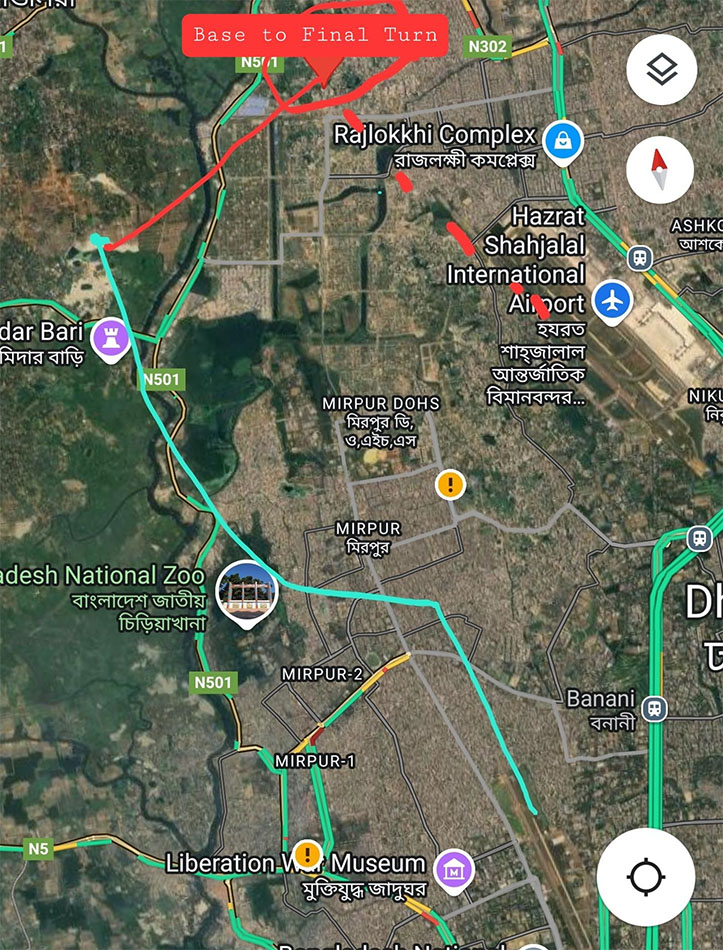
We have learnt from the ISPR that Flight Lieutenant Tauqir took off from Tejgaon Air Base at 1:06 pm. This was his first solo flight, meaning he flew without an instructor. We also learnt that shortly after take-off he reported a technical fault on the radio and the plane crashed while trying to return to the base.
A new pilot is allowed to fly solo only when he can fly an airplane, show minimal skills in route finding or navigation, and land the airplane safely. It is assumed that he gets permission to fly solo only after proving these three qualifications many times with an instructor. In fact, no pilot at this level has the skills to deal with emergencies or any difficult situation. That practice comes later.
Let me explain a few things for everyone’s ease of understanding.
Pilots are taught the three fundamental principles of flying from the very beginning. In order of priority, they are – Aviate, Navigate and then Communicate. That is, first focus on flying, then decide which direction to go and finally communicate with the tower or on the emergency frequency to inform them of your situation and plan. But no plane suddenly drops out of the sky. Not even if the engine fails completely.
Part of a pilot’s training is what to do if an engine fails or catches fire, although that all comes after solo flight. If the plane is not destroyed by a missile or severe weather, it is possible to control the engine even if it fails completely and land safely if there is a runway within gliding distance. In the event of a complete engine failure, the pilot has three main tasks:
1) Aviate: The speed of the aircraft is changed to a speed at which the aircraft will glide for the longest time. This speed is different for each aircraft. This is called the aircraft’s best glide speed.
2) Navigate: After this, keeping in mind the current altitude of the aircraft, the pilot has to calculate the maximum distance he can fly at this speed. If there is an airport within that range, then it is very good. If there is not one, he has to look for an open field or a place where the possibility of human casualties will be minimal.
3) Communicate: When the pilot has finally decided what he wants to do, he will communicate his decision and situation to the control tower so that they can take emergency measures or send help.
When an aircraft crashes, pilots usually divide the accident into two categories. The biggest reason for this is a stall spin accident, when an intact aircraft loses control and crashes despite the engine not working. This is mainly due to pilot error, including the inability to maintain minimum speed, taking turns too sharply or inconsistently with the radar. Even if control is lost in this way, it is possible to regain control if the aircraft has enough altitude, that is, enough time.
If the plane is too close to the ground, there is no escape from a stall or spin. When the plane is landing, the pilots always try to keep the control of the plane in the pilot’s hands until it touches the ground and comes to a complete stop. This is called controlled flight into terrain in the language of pilots. Recently, we saw this happen in the Air India accident in India. The plane did not appear to be in any kind of dive until the moment it hit the ground, the control was in the hands of the pilots, although since the engine was useless, they had nothing else to do and the plane glided to the ground.
Now let’s analyze the milestone accident in this light.
According to the information provided by the ISPR, the pilot realized that the plane was not working properly and wanted to turn back. Although I think he was not trying to land at Tejgaon Bej but at Shahjalal Airport because that runway was the closest to him. So the question arises, what did he do when he realized that it was not possible to glide to the airport from his current altitude and that the plane would crash before that? As a pilot, his duty was to abandon the attempt to reach the airport and try to land in an open field just one km west of Milestone on the banks of the Turag River or to drive the plane towards it and eject. If he had done that, so many children would not have been killed today and he himself might have survived because of the parachute.
I assume he was not that naive and thought it was possible to glide to the airport. Then the question arises why the plane crashed 3 km away from the runway. The only possibility that comes to mind is a stall-spin accident. Since it was a training flight, I assume the pilot was supposed to maneuver in the open area west of Diabari. From there, to reach Shahjalal Airport, he would first have to go east and while he was 3-4 km north of the runway (exactly where the Milestone School is located), he would have to make a 90-degree turn and line up with the runway.
In pilot parlance, this turn is called the base to final turn. During this turn, the aircraft’s speed is at its lowest and very close to stall speed, and historically, the world’s highest number of aircraft accidents have occurred during this base to final turn, resulting in a stall spin accident where the aircraft loses control and descends steeply and there is no time to recover.
It is easy to confirm whether a stall spin occurred by examining the exact direction from which the plane flew and hit the building, whether the plane was straight or tilted or upside down at the time of impact. It is possible that the pilot ejected when he lost control while making a turn, but it was too late to eject, or because the plane was tilted or upside down at the time of ejection, the ejection seat did not throw him upwards, but threw him sideways or downwards, which killed him.
Then we can come to the following conclusions that this tragedy occurred because one or more of these were true:
1) The pilot miscalculated whether he had enough altitude to glide to the airport. If that is the case, it is due to the pilot’s lack of experience.
2) When he realized he couldn’t reach the runway, he turned the plane’s nose slightly and chose an open field just 1 km to the west. I don’t want to believe this because if it’s true, the pilot would be a complete psycho.
3) The aircraft was estimated to have had sufficient altitude but the pilot lost control during the base to final turn. Recently obtained CCTV footage also shows the aircraft plummeting down, which points to a stall spin accident. If this is true, the sole reason for this is the pilot’s lack of skill and inexperience.
4) The last possibility is that the pilot deliberately aimed the plane towards the milestone or even though there was an alternative, he did not change direction from the milestone. There is a term called pilot suicide where the pilot intentionally kills himself. Such incidents have happened before and the recent Air India accident also points in that direction. The main reason behind such incidents is the mental health of the pilot.
This investigation can be easily completed by examining the GPS radar data obtained from the aircraft’s transponder, conversations with the control tower, its mission plan, information obtained from the flight data recorder (if any), and a proper examination of the wreckage.
Since we are talking about mechanical failure, of course the responsibility lies with the flight attendants and those who allowed the construction of such tall buildings along the airport runway. Although the plane did not hit a tall building but a two-story building. The accident could not have been prevented due to mechanical failure, but even then, if the pilot had not made any mistakes, so many lives would not have been lost due to that accident.
Arman Rashid
is an IT specialist and aviator.

https://stapravda.ru/20221228/reyting_samyh_populyarnyh_hostingov_v_rossii_196445.html, рейтинг хостингов России подтверждает, что выбор надежного провайдера важен для бизнеса.