
Staff Correspondent. Dhaka, July 30, 2025.
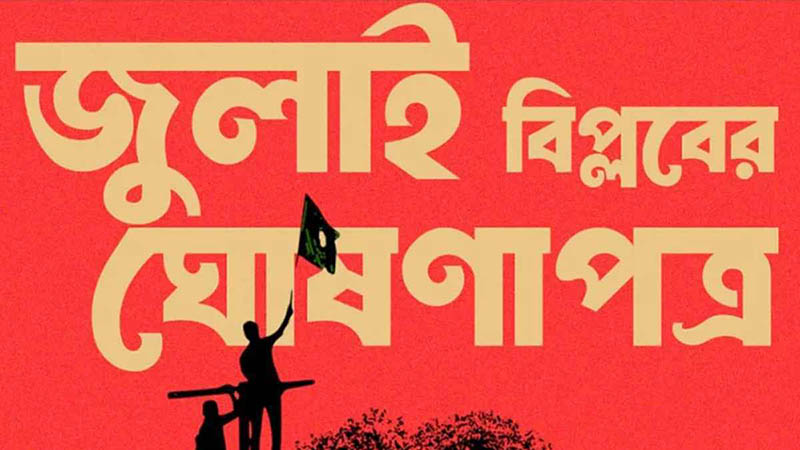
Following the release of the draft of the ‘July National Charter 2025’ prepared by the National Consensus Commission, there has been a sharp disagreement among political parties over its commitments and the proposal to keep the 1972 constitution in force without abrogating it. The draft charter includes 166 recommendations for reforming the constitution, electoral system, judiciary, public administration, police and the Anti-Corruption Commission, which set the goals of restoring democratic accountability, ensuring the rule of law and reforming state institutions. However, this commitment and the issue of not abrogating the constitution have given rise to debate among political parties.
Key commitments mentioned in the draft July Charter
The draft of the July Charter, prepared under the supervision of the National Consensus Commission, mentions several important commitments. These include:
Recognition of the 2024 mass uprising: A pledge to give due recognition in the constitution to the historical significance of the mass uprising of the students and the masses that took place in July-August.
Roadmap for Reform: A compelling roadmap for democratic accountability, the rule of law, and reform of institutions long plagued by authoritarianism and corruption.
Preserving the glory of the Liberation War: Expressing respect for the spirit and martyrs of the 1971 Liberation War, and incorporating its historical significance into the national charter.
Expansion of civil rights: Reforms such as changes to Article 70 of the Constitution, chairmanship of parliamentary committees, delimitation of constituencies, amendment of the provisions relating to presidential pardons, and decentralization of the High Court.
Prosecute genocide and crimes: A pledge to prosecute the genocide, crimes against humanity, and looting of state property committed by the Awami League government during the July Uprising.
Establishing a new democracy: The intention is to establish a new state system free from fascism and dictatorship, which will end oppression, exploitation, and discrimination.
Proposal to keep the 1972 constitution in force
Although the draft of the July Charter calls for amending or, if necessary, repealing the 1972 constitution, the interim government and the National Consensus Commission have voted in favor of reform while keeping the basic structure of the current constitution intact. The proposal states that the basic principles of the constitution, such as nationalism, socialism, democracy, and secularism, will be preserved, but the spirit of the July mass uprising will be reflected through necessary amendments.
Disagreements among political parties
Significant differences have emerged among political parties over the draft of the July Charter and the proposal to keep the 1972 constitution in force.
BNP’s position: BNP is in favor of maintaining the basic structure of the constitution, but they have proposed to accept the July Declaration as a ‘political document’ rather than making it part of the constitution. They have demanded that the Liberation War be given utmost importance in the draft and the context of the 1990 anti-dictatorship movement be included. BNP standing committee member Salah Uddin Ahmed said, “We are monitoring the draft and will comment in detail after July 31.”
Jamaat-e-Islami’s criticism: Jamaat-e-Islami’s assistant secretary general Rafiqul Islam Khan called the draft ‘vague’. He said, “The past movements and struggles of the opposition parties have not been mentioned. The two-year time frame is not reasonable, it is possible to implement reforms quickly.”
National Citizens Party (NCP): NCP member secretary Akhtar Hussain has stressed on fundamental reforms in the draft of the July Charter and demanded that its legal basis be ensured. He said, “The 1972 Constitution does not fully represent the spirit of 1971. The fundamental principles should be dropped.” He opposed the two-year deadline, saying it should not be a long-term process.
Anti-Discrimination Student Movement and National Citizens’ Committee: These two groups are in favor of comprehensive amendments or repeal of the constitution. They claim that the 1972 constitution is ‘Mujibist’ and fosters fascism and dictatorship. Sarwar Tushar, joint convener of the National Citizens’ Committee, said, “People did not just shed blood for elections, they also fought for reforms.”
Other parties: The Liberal Democratic Party (LDP) and the Communist Party of Bangladesh (CPB), while in favor of amending the constitution, have demanded recognition of the contributions of all past movements. CPB President Shah Alam said, “We should go for early elections, otherwise the crisis will increase.”
The main reason for disagreement
The main reason for the disagreement is the different views on the basic structure of the constitution and the legal basis of the July Charter. BNP and some parties are in favor of preserving the basic principles of the 1972 constitution, while the anti-discrimination student movement and the NCP have demanded its complete repeal or comprehensive revision. There are also differences over the two-year deadline for implementing the charter and the recognition of the contributions of past movements.
Role of the National Consensus Commission
National Consensus Commission Vice-Chairman Dr. Ali Riaz said the draft has been sent to political parties for their observation and the final charter will be formulated after concluding the dialogue by July 31. He said, “Out of 20 issues, consensus has already been reached on 10, while discussions are underway on seven.”
The National Consensus Commission said the draft will be revised based on the opinions of political parties before the final charter is published. However, analysts believe that implementing the July Charter through reforms rather than repealing the constitution will be a complex process, as there are deep differences among political parties. This disagreement could complicate the country’s political stability and the upcoming election process.

https://stapravda.ru/20221228/reyting_samyh_populyarnyh_hostingov_v_rossii_196445.html, рейтинг хостингов России подтверждает, что выбор надежного провайдера важен для бизнеса.