
-Jahanara Nuri
PART ONE.
I.
The walls of Dhaka Central Jail still stand, blood-soaked and unrepentant.
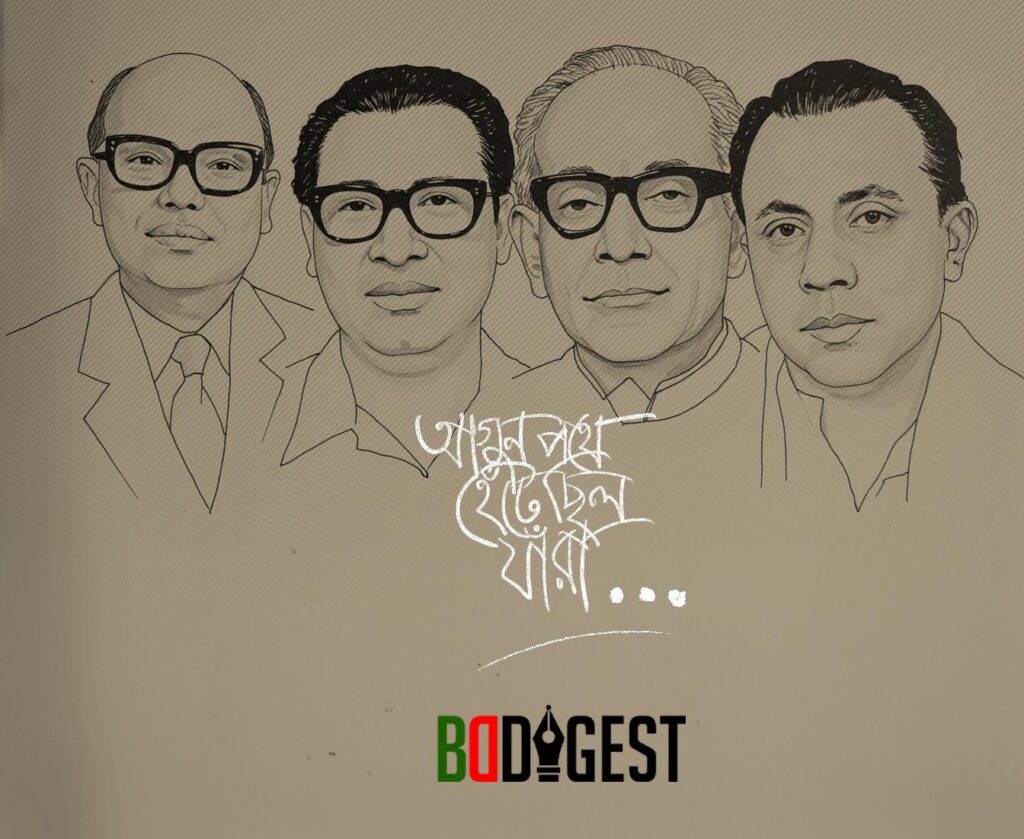
On stormy nights, the souls of Syed Nazrul Islam, Tajuddin Ahmad, M. Mansur Ali, and A. H. M. Qamaruzzaman walk the corridors — not seeking vengeance, only remembrance. They drift through tiny, airless cells once lit by kerosene lamps. Somewhere, the clang of chains still echoes. The red bricks sweat in the heat. Narrow corridors run like veins between the blocks, the air thick with dust, gun oil, and the faint rot of years.
Outside, rain hits the iron gates, heavy with rust, as if knocking to be let in. Seeing an imagined shadow, a guard shouts across the yard — his frightened voice breaks the stillness, then fades. The night turns toward November 3: the gunfire, the angry boots on stone, the silence that followed. Even now, the echo reminds the living — some blood cannot be erased.
The gunpowder that filled the air on the morning of November 3 sank into the bricks, spreading over our conscience like living moss. The smell never fades; it enters your breath and becomes part of you.
Children born decades later sometimes wake crying Joy Bangla, though no one taught them. The Bengali nation is a house full of many such echoes. And as long as someone listens, the shadows will wait, patient and unyielding, until memory is honoured — for the country forgets at its peril, and falls to pieces, as it has been for many months since July 2024.
To honour their memories, we must trace the murders of our heroes. We must watch and rewatch how the memories of Bengalis were gunned down in Bangladesh, beginning in November 1975.
II.
It was a rain-soaked morning. The walls of Dhaka Central Jail were built to hold prisoners, not history. Yet the history of a rising nation — was bayoneted to death.
Behind those high brick walls, four leaders of newborn Bangladesh — Syed Nazrul Islam, Tajuddin Ahmad, M. Mansur Ali, and A.H.M. Qamaruzzaman — founding architects of liberation, were trapped as prisoners of the state. They were supposed to be kept apart. Instead, they were gathered in a single cell, a calculated convergence for execution. Gunfire tore through their final hours; bayonets finished the work.
On November 3, 1975, with them the nation became victims of vengeance — state-sanctioned, premeditated, and absolute. Those who betrayed Bangladesh claimed their lives, but they could not erase their place in history.
The killing, which came barely three months after BangaBandhu Sheikh Mujibur Rahman’s assassination, was more than a coup’s clean up operation — it was an exorcism. Those who had dreamed of a secular, self-reliant nation were purged to make way for those who worked hand in hand with the ghost of Islamic Republic Pakistan. The Indemnity Ordinance that followed ensured that no one would be tried for these crimes, for twenty years.
On 5th August 2024, what Muhammad Yunus now proclaims as Bangladesh’s second birth, began not in freedom, but in the follow up erasure.
II.
The details of the morning of November 3, 1975 remain too grotesque to comfortably recount. Historical records — from The Daily Star, the BBC, and eyewitness accounts preserved in the Songramer Notebook — describe how prison officials were ordered to move the four leaders into one room “for a government envoy’s meeting.” Minutes later, five armed officers led by Moslem Uddin Khan stormed in. When the gunfire stopped, three men were dead. One, Mansur Ali, was still breathing — begging for water. The soldiers returned to finish the job with bayonets.
For decades, the armed forces ruled Bangladesh. Political parties such as the Bangladesh Nationalist Party born of generals, masked military rule behind a civilian-Islamic facade. The BNP allied itself with the revived Islamic group, a faction of Pakistan Jamaat-e-Islami, whose headquarters was in Pakistan and whose members had acted during the Liberation war of Bangladesh as militia group serving Pakistan’s armed forces, against Bengalis.
Awami League’s 20 years of rule was a battle against these group. They never integrated into the society. By 2025, they rose to claim full political power, having orchestrated a coup with BNP in July 2024, to overthrow the government that had stood for Bangladesh’s progress, liberation, and sovereignty.
For decades, justice hung in bureaucratic limbo and armed forces ruled the country. Files vanished, post-mortem reports disappeared, the investigation officer was never allowed to inspect the cell. Governments changed. But the will to prosecute the perpetrators did not die.
When the Awami League finally returned to power in 1996, the case was reopened. The 2013 Supreme Court verdict confirmed what was long known — that the state itself had killed its own midwives. Yet even today, key convicts remain abroad, sheltered in Canada and the United States.
Jamaat-e-Islami’s Ameer, Ghulam Azam, was a citizen of Pakistan. He fought for Pakistan in the Liberation War. Bangladesh won. He stayed behind, across the border, as if time itself had chosen to hold him there. Then he returned, carrying a Bangladeshi passport handed by the hand of a general — a living emblem of betrayal. They failed the nation’s memory. They began to rewrite its history. The generals lived lives like soldiers anywhere else, yet in their hearts they nurtured a vision of a Muslim Bangladesh, where votes came from Madrasas built under Pakistan and the minds of the uneducated were shaped to keep them in power. Victims silenced. Perpetrators free. Ghosts walked the streets. The past was forced to disappear.
Since then Bangladesh never buried its dead; it merely learned to live beside the ghosts and flying souls.
“It is undeniable that a massive genocide took place in the then East Pakistan,”Justice Anwarul Haque declared in Ghulam Azam’s July 2013 verdict. “This massacre can only be compared to the slaughter by Nazis under the leadership of Adolf Hitler.”He added.
III.
Half a century later, today Bangladesh stares into the mirror of 1975. The reflection is grim. From the blood-stained cells of its past to the farce of its current courtrooms, the story repeats itself.
In 2025, Sheikh Hasina — daughter of Sheikh Mujibur Rahman, and four-time prime minister — stands accused before the International Crimes Court. The charges are both implausible and predictable: she and her ministers are said to have conspired in the deaths of protesters during the July 2024 unrest.
It is the same story, with the same actors. In August 2024, those who killed to seize power, now call their vengeance justice. Those who overthrew a legitimate government, working to dismantle the constitution, now claim to ‘save the nation’.
The fall of Sheikh Hasina followed a long campaign of disinformation and external manipulation — a soft coup dressed in the language of “human rights,” “solidarity,” and “anti-corruption.” The wave of arrests, exiles, and show trials under Yunus’ unauthorized interim government recalls the institutional subservience that enabled the 1975 jail killings nearly fifty years ago.
In October 2025, the BBC reported: “Death Penalty Sought for Bangladesh’s Fugitive Ex-Leader.” Prosecutors are after Sheikh Hasina in absentia.
The irony is sharp: the daughter of the man who gave birth to the nation, whose killers were once protected by Army and some politicians, is now prosecuted under laws twisted—by the same forces—into political weapons.
To understand the repetition, you have to return to 1971 — again and again — to the genocide a cost paid by the nation to born. Pakistan’s military, with the help of its local militias — Razakar, Al-Badr, Al-Shams — carried out systematic atrocities: mass killings, executions of intellectuals, the weaponization of sexual violence against women on a mass scale.
Among the most devoted collaborators was Jamaat-e-Islami. Its student wing, Islami Chhatra Sangha, later, Islami Chhatra Shibir, evolved into a political force that would haunt the People’s Republic of Bangladesh for decades. It remains, even now, on regional lists of extremist organizations. They were not ideological auxiliaries. They were logistics, muscle, and method — the architecture of occupation itself, repurposed for politics in liberated Bangladesh.
IV.
The men who orchestrated the jail killings in 1975 were not strangers to that world. Many shared ideological sympathies with the networks that opposed Bangladesh’s birth. The killings in prison and the genocide of 1971 are chapters of the same book: both aimed to destroy the secular, pluralist vision of Bangladesh, a vision born to reject the Two-Nation Theory imposed by Jinnah and British India’s partition.
Islamic groups never stopped. Outside backers never stopped. They kept interfering. They wanted to prove Bangladesh’s policy — that all religions could live together — “wrong.” They attempted to tear at the nation’s fabric while the Awami League was in power. Bangladesh’s birth was meant to end the Two-Nation Theory. To prove, that Muslims, Hindus, Buddhists and Christians and all ethnic minorities could live in one country, that is secular, harmonious, safe for everyone. Instead, Islamist groups and collaborators, their opportunist alleys kept testing its limits.
And now, history loops again, with the daughter of the nation’s founder facing prosecution from the very forces that once tried to erase the Bengalis.
V.
This November, as Bangladesh marked Jail Killing Day, The Daily Ittefaq published a statement from Jamaat-e-Islami dismissing all allegations about its 1971 role as “politically motivated propaganda.” The statement reads like déjà vu — the familiar tone of self-victimization, the studied absence of morality, the lies disguised as amnesia.
“Crimes were never proven beyond doubt,” one can argue, “if you did not punish them yet.”
It is strategy. When a nation forgets who its killers were, those killers return as commentators. When collaborators reinvent themselves as reformers, they do not rehabilitate the past — they erase it.
That erasure now extends into the institutions that once defended secularism and the constitution. Universities have been purged; teachers suspended for “true or false political leanings”; pro-constitution academics jailed or dismissed, the army riven by factions; secular schools are closing; bank securities exchanges are instructed to form Sharia committees. The result is a quiet re-Islamization of public life — not by decree, but by attrition.
In 2025, the imprisonment of the academic and political intellect precedes the imprisonment of the body.
And so the history returns to the jail. The walls that once held Syed Nazrul Islam, Tajuddin Ahmad, M. Mansur Ali, and A.H.M. Qamaruzzaman now hold the souls of 180 million, lingering for all time, unyielding. Watching as history is hammered by the iron of hatred, bent and forced to forget its own truth, forging a falsified past. Watching the same hands that murdered their leaders now reaching for their children, manipulating memory, threatening massacre. The sound of gunfire never fades.
1975-2025: The sound of gunfire that never fades
PART TWO.
I.
Watch! The haunted walls of the jail trapped the cabinet ministers, leaders and a new generation of pro-liberation supporters. The past has been hammered and bent. Yet the rivers of Bangladesh keep flowing.
Let us ask a question: what were Sheikh Hasina’s arguments, and what were her crimes?
In her last terms, and in her occasional recent remarks, Sheikh Hasina outlined a world-view sharply at odds with her accusers’. She argued that Bangladesh must resist becoming a “pawn” in rival blocs — neither beholden to China nor dependent on the West. She defended her government’s insistence on economic sovereignty and regional peace, amplifying Sheikh Mujib’s non-aligned ideals and the enduring dream of a nation forged through blood, courage, and conviction.
Her focus on counter-extremism, supporting Islamic students to get into the University — particularly the attempt to reform of Islamic schools networks — earned her enemies among both Islamist groups and some foreign patrons who found in them useful instruments of “social mobilization.” Her push for self-reliant industry and cautious borrowing placed her outside the IMF’s good graces, just as Sri Lanka’s dependency was collapsing.
Sheikh Hasina’s greater crime, then, was political heresy: she refused to outsource Bangladesh’s sovereignty.
Now, her removal and trial must be read in that geopolitical light.
The same international networks that once overlooked the impunity of 1975 now applaud her prosecution as “restoring democracy.” It is a tragic inversion — one that reveals how easily moral language can be weaponized when power seeks a new client.
II.
To put the context in metaphorical meaning Bangladesh was South Asia’s Mirror. One, for Bangladesh’s historical trajectory has been unique — its liberation war, linguistic nationalism, and secular founding are unlike any other South Asian nation. Two. During her terms, Bangladesh’s economic rise (textiles, remittances, social development) differed sharply from Pakistan or Sri Lanka’s crises. So, let’s not think it is a try of an empirical generalization.
But what is happening in Dhaka is not unique. Across South Asia, democratic institutions are being hollowed out and rebranded as instruments of national purification. Fro example, Pakistan, most of the time ruled by, direct or indirect hands of the Army, elected leaders have been jailed through court orders. In Sri Lanka, debt has replaced dictatorship as the mechanism of control.
Each country writes its own version of the same fable: justice as vengeance, reform as repression.
Bangladesh’s tragedy, however, cuts deeper because it was born from a long struggle against oppression and a brutal genocide. To manipulate that legacy and denial of that genocide, is not just political opportunism — it is moral desecration.
So we must look at the unfinished Justice of 1971, 1975 August and November and all later killings that has similar patterns.
Twenty years of direct military rule preserved impunity for the murders of pro-liberation soldiers and leaders. The files of the Jail Killing case remained incomplete; two convicts live abroad under the protection of countries that preach accountability. The United States shelters Rashed Chowdhury; Canada houses Noor Chowdhury. The same governments that champion global justice, refused to extradite men convicted of executing political prisoners in their custody.
This hypocrisy corrodes faith not only in international law but in the very vocabulary of human rights. If the killing of unarmed legendary leaders, and the treatment of current leaders in custody can be excused by time, what meaning does justice have left?
What is more, the mirror turns inward in 2025. The daughter of those martyrs stands accused by an interim government calling itself “reformist.” It is led by a Nobel Peace Prize laureate and backed by a coalition of Islamic fundamentalists, their origin, the state of Pakistan, and Western actors — all against the will of the people. The parallels write themselves: prisoners once killed without trial; now leaders tried without evidence, punished for simply carrying out their duties, and threatened with capital sentences.
History, when suppressed, does not fade — it metastasizes.
III.
Bengalis in Bangladesh live with ghosts and flitting spirits at their door.
Every November, the Awami League and the people hold a vigil for the four slain leaders. Their portraits, half-lit by candles, stare back with unblinking calm. The disinformation of islamic fundamentalists never stops — revisionist social media posts, the moral fatigue, exploited without end.
Those who once tried to erase 1971 change their faces and words again and again. Now they speak of transparency, reform, and transitional governance. The language of virtue has become the architecture of impunity. They organize Hindu wings, claiming that refusal to join a fundamentalist Muslim party will invite massacre — turning fear into a tool to reshape allegiance and silence memory.
But history is stubborn. It remembers in silence — in the blood on a prison wall that never washes away; in classrooms where teachers no longer teach; in the faces of those who still say with thunderous voices ‘Joy Bangla’, and with a smiley face go to jail for it.
IV
At this point in history, does South Asia have any choice but to stand together behind its secular groups and leaders within nations? For the rest of South Asia, Bangladesh’s crisis is not a local tremor but a regional test. Whether in Colombo, or Kathmandu, the message is the same: if the most electorally successful woman leader in modern South Asia can be criminalized for resisting external dictates, then no democracy is safe from law fare.
The answer lies in reclaiming sovereignty — not as isolation, but as integrity; not as defiance, but as dignity.
For Bangladeshi’s, to remember 3 November 1975 is to remember the moment the state turned on its conscience. To remember 2024-2025 is to recognize whether that conscience has returned.
V.
Bangladesh’s story is always about memory — who claims it, who twists it, who dies defending it. Once, it was the guerrilla war-fields, the cantonments turned into stores of women used as weapons in Pakistan’s so-called jihad against who they called, ‘less Muslim’— the Bengalis. Today, jail cells, courtrooms, media, classrooms — all stages for the same ideological groups.
Sheikh Hasina, whatever one’s politics, embodies continuity: the struggle against erasure. Killers justified murder of Sheikh Mujib in the name of ‘order’; her accusers now justify persecution in the name of ‘reform’. The symmetry is precise, and that is what makes it horrifying.
When a nation punishes its founder, the liberators, and their living heir under the advice of those who once sheltered their killers, it does not merely betray its past. It rehearses it.
VI.
Since 1972, Pakistan’s influence has crept into Bangladesh like a slow fog, carried on the wings of ideological proxies such as Jamaat, selective diplomacy, and covert partnerships. The revival of Jamaat-e-Islami’s denial of the 1971 genocide is not a quirk of memory but a deliberate reshaping of history itself — a shadow of Islamabad’s decades-long effort to rewrite Bangladesh’s post-liberation reality. By 2025, this urgency is unmistakable: Pakistan, appointed Chair of the UNSC 1988 (Taliban) Sanctions Committee and Vice Chair of the UNSC 1373 Counter-Terrorism Committee alongside Russia and France, seeks not only to erase its own dark history but to shape the world’s memory of it.
From these global heights, the theater of counterterrorism twists into a stage of hypocrisy, where loyalty trumps security and the shadow of legitimacy shields the violent. In Dhaka, the same actors cloak interference as “regional cooperation,” turning state-to-state and military-to-military contacts into instruments of quiet coercion — a violation of both the UN Charter and the spirit of SAARC.
VII.
This is not new. Jamaat-e-Islami in Bangladesh was born as the ideological twin of Pakistan’s own party, a child of Maulana Maududi’s vision. In 1971, it breathed life into Al-Badr and Al-Shams, coordinated with the Army’s Directorate of Civil Affairs and ISI, and wove propaganda in Urdu and Arabic defending “the unity of Pakistan.” Independence changed geography, but not the bonds. Pakistan’s ISI quietly maintained influence through charities, schools, educational programs, and selective funding, ensuring that the whistle of the old masters still reach Dhaka’s corridors.
When today’s Jamaat leaders insist their role in 1971 was mere political propaganda, they speak not only to deny history but to extend a long, unbroken hand of interference — to delegitimize the liberation, weaken secular governance, and amplify Pakistan’s influence in Bangladesh and across South Asia.” Every diplomatic communique, every media column praising “strategic re-engagement,” every attempt to rehabilitate Jamaat narratives is another thread in the same web that first sought to unmake Bangladesh.
Sovereignty of Bangladesh here is not a line on a map; it is a living, contested frontier. Since Sheikh Mujibur Rahman’s assassination, Pakistan has tried to reclaim, softly, what it lost by force. Its grammar has changed — “strategic cooperation,” “religious fraternity,” “regional stability” — but the ambition is the same. The murmurs between Pakistani and Bangladeshi security and administrative circles after the July 2024 unrest, the media applause for Dhaka’s “reorientation,” the quiet legitimization of unelected authorities — all trace a familiar rhythm.
Half a century ago, tanks rolled across a newborn nation to erase it. Today, the method is subtler: party-to-party solidarities, selective diplomacy, and the rehabilitation of collaborators who once spilled Bengali blood. The means have shifted, but the aim endures: to ensure that the moral independence won in 1971 never grows into permanent political life. History here does not move forward. It waits. It watches. And the shadow of every interference bends, like iron against stone, against the nation that refuses to forget.
VIII.
The assassination of Sheikh Mujibur Rahman and the prison murders of his closest colleagues were not random cruelties; they were a calculated decapitation of a secular nation still in its infancy. Each killing thinned the moral backbone of a republic that believed liberation promised reason and rights, not revenge.
Today, that same vision stands trial in the body of Sheikh Hasina. Her removal and prosecution cannot be seen in isolation. They are the latest act in a long choreography of erasure. Bangladesh has seen this pattern before: when secular leadership rises to define sovereignty in its own terms, it is systematically undone — first by bullets in 1975, then by grenades and silence, and now by law.
Sheikh Hasina’s persecution is not personal; it is ideological. It continues the unfinished work of those who, since 1971, have sought to dismantle the concept of a sovereign Bengali state. Judicial theatrics, the free dance of collaborators, the “resetting” of liberation history — all point to one project: reversing the moral outcome of the war that created Bangladesh.
To the foreign observer, this may seem like another political cycle in a volatile state. But to those who know the country’s history, it is the repetition of an old plot — the systematic elimination of every figure who insisted Bangladesh’s identity was earned through resistance, sacrifice, and the defense of human rights, not inherited from faith.
And so history returns to the jail. The shadows of Syed Nazrul Islam, Tajuddin Ahmad, M. Mansur Ali, and A.H.M. Qamaruzzaman lean against the walls. Watching. Eyes fixed on the killers as bullets pierce their bodies. Their sorrowful patience spans generations. Every courtroom. Every cell. Every graveyard ritual. Under their gaze every rally of their children trembles, every attempt to rewrite history, to replace truth with lies bend — let it be like that.
Now, run from 2025 to 1975. The sound of gunfire that murdered your leaders could startle you. Its waves drift through whirling winds like smoke, over parliament buildings, courtrooms, graveyards, and rallies. It settles over you as clouds when you roar Joy Bangla — still standing tall, facing the old enemy. You, as them, reborn.
History does not move forward here; it circles. It returns. It waits for those brave enough to remember — to claim its grand prize through their labour.
Behold. Stand witness to their courage. Guard the pride of the memory for which they died. They died loving.
Author:
Jahanara Nuri
Journalist, Fiction Writer

https://stapravda.ru/20221228/reyting_samyh_populyarnyh_hostingov_v_rossii_196445.html, рейтинг хостингов России подтверждает, что выбор надежного провайдера важен для бизнеса.