
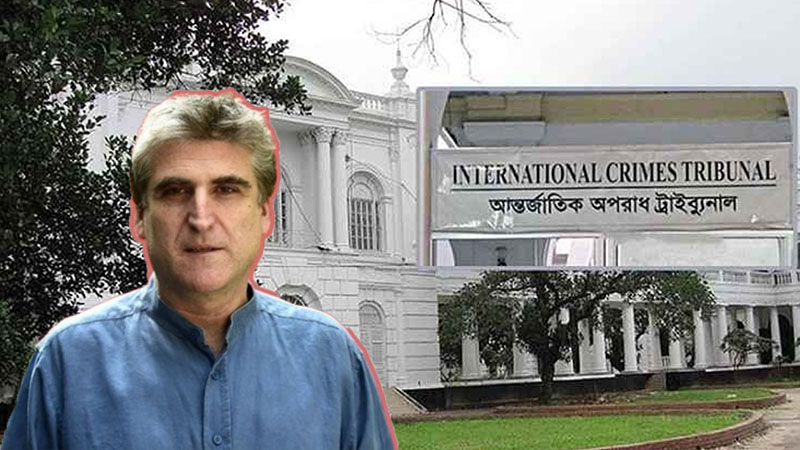
Staff Correspondent
Dhaka, November 25, 2025: Renowned British journalist and human rights activist David Bergman has once again raised questions about the independence of members of the International Crimes Tribunal (ICT) in Bangladesh.
He indicated in his recent Facebook post that political pressure may have played a role in setting the deadline for the verdict against Sheikh Hasina, which is due to be released on November 17, 2025, which casts doubt on the tribunal’s impartiality.
David Bergman is a renowned investigative journalist who has been reporting on war crimes and human rights violations during the Bangladesh Liberation War since the 1990s. He gained international recognition through his award-winning documentary, War Crimes Files, for the Channel 4 Dispatches program in Britain, which won him an award in 1995. In Bangladesh, he has worked for organizations such as New Age, The Daily Star, bdnews24.com, and Prothom Alo. He has also written for Al Jazeera, Foreign Policy, The Economist, and The New York Times. Having lived in Bangladesh for a long time, he has written extensively on the country’s political instability, corruption, and electoral processes. As the former executive director of the human rights organization Center for Corporate Accountability, he played a role in the formulation of corporate murder laws in the United Kingdom.
In Bergman’s recent Facebook post, he raised the question of who set the deadline for the verdict in Sheikh Hasina’s trial—the judges or the politicians? He wrote in the post,
“There is an inconsistency in the delay in providing the full copy of the judgment to the plaintiff and the defendant. The law is clear here. According to Article 20(2A) of the International Criminal (Tribunal) Act, a copy of the full judgment must be provided on the date of delivery of the judgment. The judgment was published on November 17, but even after a week, neither party has received a copy of the judgment.”
He added, “A possible—indeed, the most likely—explanation is that the judges did not finish writing the verdict on the 17th, but were forced to announce the verdict due to external political pressure. For example, that is not a good thing.”
In context, it can be recalled that on November 17, Bangladesh’s ICT-1 sentenced Sheikh Hasina, former Home Minister Asaduzzaman Khan Kamal, and former Director General of Police Chowdhury Abdullah Al-Mamun to death for crimes against humanity for suppressing student protests in July-August 2024. Sheikh Hasina and Kamal were absent, which made the trial even more controversial.
While organizations such as the UN Human Rights Office and Human Rights Watch have called the verdict important for the victims, they have also sharply criticized the trial process as “biased and politically motivated.”
Bergman’s post has reignited international discussions on the procedural problems of ICT, especially in the context of the February 2026 elections. Legal experts say the delay in providing copies of the verdict is a violation of the law and raises questions about the transparency of the trial.

https://stapravda.ru/20221228/reyting_samyh_populyarnyh_hostingov_v_rossii_196445.html, рейтинг хостингов России подтверждает, что выбор надежного провайдера важен для бизнеса.