
Staff Correspondent
In the context of prolonged political instability and a declining economy in Bangladesh, the crisis in the education sector is also deepening. Parents are no longer able to afford quality tuition, which has directly affected college and university students.
Especially students who were involved in tutoring professions along with their studies are now facing financial pressure and uncertainty on all sides.
Since August 5th of last year, economic disaster began across the country. The overall economy came to a standstill, hundreds of factories closed. Unemployment started increasing. Major institutions of the country, including Gazi Group, Beximco, and Globe Industrial Family, were destroyed by arson and looting.
According to the estimates of BGMEA and BKME, about 1.5 million people in the country have become unemployed in the last one and a half years. Earlier in 2020, after the Corona outbreak subsided, people of various professions returned to their workplaces.
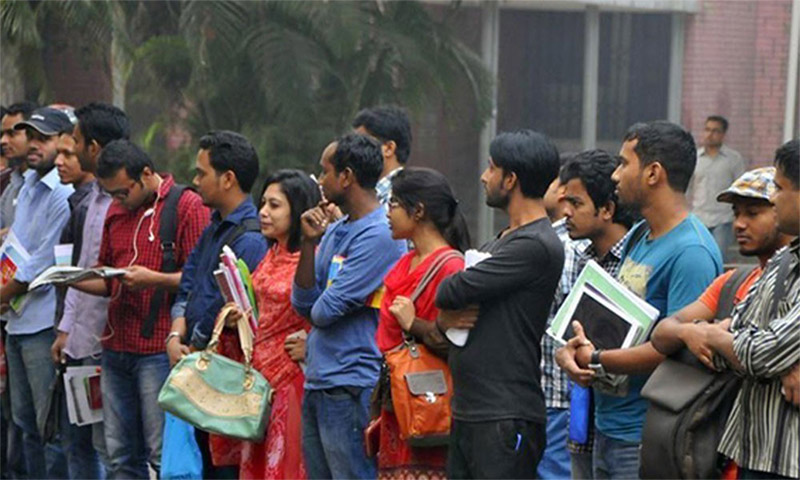
However, as many have lost their jobs, a tuition crisis has arisen for students. At that time, college and university students are being forced to enter part-time jobs to overcome the crisis.
The economic impact of political instability is already visible. The government’s economic policy decisions, reduced investment confidence, and reduced private sector activity are negatively impacting business and employment.
Economic crisis and social reality
In the current situation, Bangladesh’s economic growth has contracted, showing an exceptional decline compared to previous overall growth, raising concerns about a decline in employment and a potential increase in poverty.
Meanwhile, signs such as slow revenue collection, investor distrust, inflation, and trade contraction are further complicating the country’s economic situation.
This political and economic uncertainty is directly putting pressure on education costs and living standards. As parents’ incomes fall, they are unable to afford their children’s education, including tuition. A significant number of families are now forced to put pressure on primary school students to cover additional expenses such as tuition.
Students’ lives and future
Dhaka College student Sajeeb Hossain said, “We have not received any tuition for the last three months. Our parents are no longer able to bear the tuition costs; we have to request it ourselves.”
On the other hand, Dhaka University student Sadia Akhter said, “Earlier, I used to give three tuitions, which were used to pay for my studies and my own expenses. Now I only have one. I am looking for a part-time job.”
Shariful Hasan, who is preparing for a job at a bank, said that due to the closure of coaching, he is now working part-time for 6 days in an institution in the city; yet the income is not nearly as much as coaching. He has less time for studies.
These experiences show that students are the ones who are losing the least safe haven in the current crisis. Students are in crisis both in their studies and their livelihoods.
Experts say this situation has increased the mental stress of students. The political crisis has added to their studies, income, and future plans. As a result, uncertainty about exam results, careers, and financial security has spread anxiety among students.
Educationists believe that state support and policy initiatives are essential to address this crisis. Without scholarships, emergency support funds, and secure part-time work opportunities for low-income students, it will have a long-term impact on the education sector. Without political stability and economic recovery, it will be difficult to overcome the crisis for these tuition-dependent students.

https://stapravda.ru/20221228/reyting_samyh_populyarnyh_hostingov_v_rossii_196445.html, рейтинг хостингов России подтверждает, что выбор надежного провайдера важен для бизнеса.