
Staff Correspondent
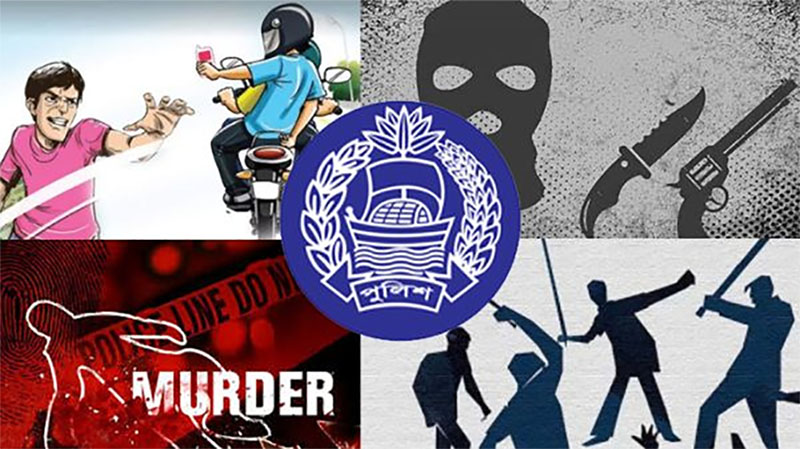
The World Economic Forum (WEF) has given a new uncomfortable message to the international arena about Bangladesh in the election year. The organization’s newly published ‘Global Risk Report-2026’ has identified ‘crime and illicit economic activities’ as the main risk for Bangladesh for the first time. While in the past few years, economic issues such as inflation, energy crisis or employment were at the top of the risk, this time the deterioration of law and order has surpassed them and emerged as number one.
A report released from Geneva on Wednesday identified geo-economic conflicts as the second major risk for Bangladesh—something that has never been in the country’s top five risks list in recent years.
The report reflects the global tensions that are now directly affecting Bangladesh’s economy, including sanctions, additional tariffs, and investment reviews. Other risks include inflation, economic slowdown, and debt.
The WEF’s risk assessment is not a statistical forecast; it is essentially the result of a conceptual assessment by the country’s top executives. The Executive Opinion Survey (EOS) asked participants to identify what the biggest threat to the country is over the next two years. In the case of Bangladesh, crime has emerged as the central theme.
Government’s discomfort, position at odds with reality
There is clear unease within the government over the WEF report’s identification of ‘crime’ as a major risk. Special Assistant to the Chief Advisor Dr. Anisuzzaman Chowdhury is not satisfied with this assessment. He claims that the law and order situation in Bangladesh is being presented in a negative light on an international level. He also argues that crime cannot be completely avoided due to high population density.
But the gap between the government’s explanation and the real picture is becoming increasingly clear. According to statistics from the Police Headquarters, there were 3,785 murder cases in the country in 2025, which is significantly more than the previous year. In the same year, there were 1,102 kidnapping cases, which is the highest in the last five years. Kidnappings have increased by 71.65 percent compared to the previous year. Incidents of violence against women and children are also at an alarming level.
These statistics are not just numbers; they are real evidence of the deteriorating law and order situation, which is directly questioning the country’s business and investment environment and social stability.
‘Mob violence’ and the illegal economy: a new dimension of risk
Dr. Fahmida Khatun, Executive Director of CPD, a WEF partner research organization in Bangladesh, believes that the recent rise in mob violence and social crime has deeply concerned people. In her words, this is a clear warning to the elected government. The combination of illegal economic activities with crime means that crime is now not only a social problem, but also a direct hit on the economy.
Increased crime creates uncertainty for investment, disrupts supply chains, and stalls economic activity. Survey participants likely identified this reality as a major risk.
Geo-economics and internal weaknesses
The report also shows that Bangladesh is increasingly being affected by global geopolitical tensions. There is growing concern that if geo-economic conflicts increase, Bangladesh’s exports, foreign investment, and the overall economy will be put under pressure. However, the situation could become more complicated if domestic governance is not strong enough to deal with such global risks.
The WEF report, citing the recent mass uprising in Bangladesh, says that people who feel deprived of political decision-making and have lost hope for an improvement in their standard of living have taken to the path of protest and demonstration. This is not just a political message; it is a reflection of the failure of governance and security systems.
This report by the World Economic Forum is not an isolated assessment. Rather, it is an international recognition of the instability, crime, and governance crisis that have built up within the country. Showing crime as the main risk means that Bangladesh’s development narrative is now running into a wall of insecurity.
There is no room for ignoring this warning in an election year. The biggest test for the government now is not denial of the deteriorating law and order situation, but effective action. Otherwise, the distance between the government’s claims of ‘development’ and ‘stability’ and reality will increase further—for which the entire economy and society will have to pay the price.

https://stapravda.ru/20221228/reyting_samyh_populyarnyh_hostingov_v_rossii_196445.html, рейтинг хостингов России подтверждает, что выбор надежного провайдера важен для бизнеса.