
Opinion
Do you know that in this referendum you are also voting to make Comilla and Faridpur separate divisions? I didn’t know. Not just me. Everyone from the uncle to the barrister friend is confused about this referendum! What is the reason?
The referendum, which voters will vote on on separate ballots on election day, will have only four very specific issues written on it. Voters will vote ‘yes’ or ‘no’ on the question of whether they support the implementation of this charter.
But this charter includes a total of 84 reform proposals. A little trick!?
The government has also announced that 47 of these proposals will be implemented through constitutional means and 37 through general laws or executive orders.
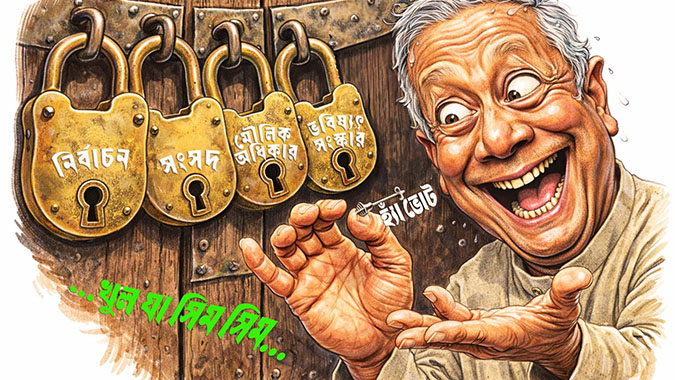
A yes vote is being proposed to approve multiple major constitutional changes at once – deep and long-term decisions such as the electoral system, the structure of constitutional institutions, a 30-point commitment binding on the future government, and the formation of a new Upper Chamber.
Tying all of this together into one question is taking away the voters’ real choice. Some may be in favor of reforming the Election Commission, but against the upper house. Some may agree on some points, but not on others. But there is no opportunity to express that dissent in this referendum.
On this, voters are being told again—”If you vote yes, change will come.” A few days ago, Chief Advisor Professor Muhammad Yunus also gave a video message to be broadcast on radio and television. In which, urging people to vote ‘yes’, Professor Yunus said, “If you vote ‘yes’, the country will be free from discrimination, exploitation and oppression and the door to building a new Bangladesh will open.”
This is a misleading and dishonest claim. No referendum on its own can ensure change. Change comes through political behavior, party reform, accountability, and practical implementation. Presenting a yes vote as the only condition for change is to impose understanding with false hope.
This referendum is telling voters what will be added to the constitution, but it is not telling them—
How much will it cost,
How will it work in reality,
And whether it will solve the existing problems at all. While I don’t object to many of these, I do object to this process and its lack of transparency and haste.
Consent in a democracy is only valid when it is based on understanding.
If voters don’t understand, and yet their consent is obtained—then it’s not consent, it’s just procedural approval.
For this reason, questioning this referendum is not opposition to change.
This is a rejection of a process based on confusion.
Although there are 84 reform proposals in the referendum, some of them have notes of dissent from other political parties, including BNP, some from Jamaat. Initially, the proposal was that if the political party that has a note of dissent comes to power, it will not be obliged to implement those proposals.
However, in the end, the government failed to resolve this issue and decided to hold a referendum. If the referendum results in a yes vote, the government will be obliged to implement these 84 articles in the next parliament. Here too, there is room for a post-election misunderstanding. And if the vote does not win, the July Charter will not be effective.
It is said that the key to the country is in your hands. Do you really know which lock you are going to open with which key?
– Asif Saleh
Visited 15 times, 1 visit(s) today

https://stapravda.ru/20221228/reyting_samyh_populyarnyh_hostingov_v_rossii_196445.html, рейтинг хостингов России подтверждает, что выбор надежного провайдера важен для бизнеса.