
Staff Correspondent
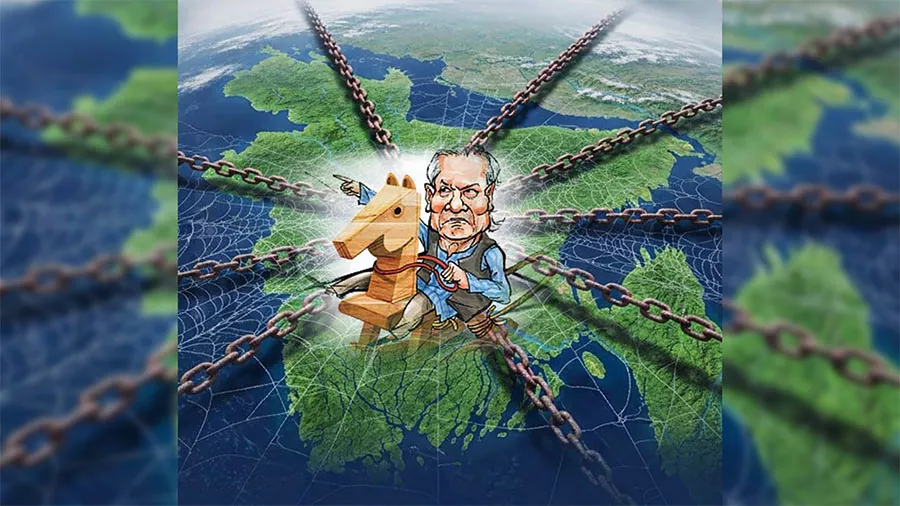
The Yunus government is leaning heavily on foreign debt, resulting in a rapidly growing foreign debt burden. In addition, due to the large depreciation of the taka, the country’s foreign debt has almost doubled in the space of 3 years. Meanwhile, a large part of the government’s operating expenses is now going to interest payments, which is becoming a major risk for the overall economy. Economists believe that Bangladesh’s economy is at risk due to this.
‘According to the latest data from the Ministry of Finance, Bangladesh’s total foreign debt stood at around Tk 951,000 crore at the end of September 2025. This is about 92 percent more than in June 2022, meaning foreign debt has almost doubled.
As revenue collection did not grow as expected and the budget deficit increased during the Yunus government, the government is turning to budget support loans instead of development project-based loans. Because while project loans have a long approval and implementation process, budget support is available quickly and can be used directly to meet the budget deficit.
From the fiscal year 2021-22 to the fiscal year 2024-25, Bangladesh received a total of $9.82 billion in budget support loans. Of this, $3.44 billion came in the fiscal year 2024-25 alone, which is 69 percent more than the previous year. At the same time, project loan waivers have decreased by more than 29 percent. This is why Bangladesh’s economy and stability are considered to be at risk.
The government’s total debt stood at Tk 21,49,000 crore in the first quarter of the 2025-26 fiscal year, which is 38.61 percent of GDP. Of this, Tk 1,197,000 crore is domestic debt and the rest is foreign debt. In the first three months of the current fiscal year, the government spent Tk 31,629 crore on interest, which is 27 percent more than the same period of the previous year.
In addition, interest on domestic debt increased by 19 percent. Interest on foreign debt increased by 80 percent. In addition, interest expenses on treasury securities increased by 21 percent and on savings bonds by 16 percent.
A large portion of the operating expenses is going towards interest payments. In the first three months of the current fiscal year, about 35.33 percent of the operating expenses, or about Tk 31,800 crore, went towards interest payments alone. This is the largest expenditure as a single sector.
Out of the current budget of 7 lakh 90 thousand crore taka, the operating budget is 5 lakh 44 thousand 391 crore taka. Of this, 1 lakh 22 thousand crore taka has been allocated for interest payments.
In the first three months of the fiscal year, the government’s income was Tk 1,17,800 crore and its expenditure was Tk 90,000 crore. After the development expenditure, the government was able to show a surplus of about Tk 3,000 crore. This surplus was created due to less development projects and less expenditure.
External debt exceeds $74 billion. At the end of the 2024-25 fiscal year, external debt in the public sector stood at $74.34 billion, which is about 8 percent more than the previous year.
Currency risk has also increased as the amount of borrowing in Japanese yen has increased. Foreign debt liabilities have increased by about $1 billion due to exchange rate changes.
Experts say that while budget support loans bring stability in the short term, they increase debt pressures in the long term. They believe that loans should be spent on sectors where the economic benefits outweigh the interest and principal.
According to analysts, to keep the debt situation under control, revenue collection must be increased, high-interest loans must be avoided, and limited borrowing must be made for quick-paying projects. Otherwise, interest payments may become the government’s largest expenditure item in the future, and development spending may be further curtailed.

https://stapravda.ru/20221228/reyting_samyh_populyarnyh_hostingov_v_rossii_196445.html, рейтинг хостингов России подтверждает, что выбор надежного провайдера важен для бизнеса.