

❐ BD Digest Desk
After the United Kingdom decided to recognize Bangladesh after the Bangladesh Liberation War, the then Prime Minister of Pakistan, Zulfikar Ali Bhutto, withdrew Pakistan from the Commonwealth in January 1972. Two years later, Bhutto warmly welcomed Bangladeshi Prime Minister Sheikh Mujibur Rahman at Lahore airport.
At Lahore Airport that day, the Bangladeshi delegation, including Sheikh Mujibur Rahman, was welcomed with a 21-gun salute and a ‘guard of honor’. The Bangladeshi flag was hoisted in accordance with diplomatic etiquette, and the national anthem of Bangladesh was played on loudspeakers.
The date was February 23, 1974. It was Sheikh Mujibur Rahman’s first visit to Pakistan after nine months in a Pakistani prison during the Bangladesh Liberation War. Sheikh Mujibur Rahman was leading a seven-member Bangladeshi delegation to attend the second summit of the Organization of the Islamic Conference, OIC, in Lahore.
Although the Bangladesh delegation went to Lahore to attend the OIC summit, they arrived in the conference city on the second day of the three-day conference – a day after the main conference formalities began.
Because Sheikh Mujib made the final decision to go to Lahore the day before, on February 22nd, after Zulfikar Ali Bhutto announced the formal recognition of Bangladesh.
The most talked about event of the OIC conference held in Lahore was Pakistan’s recognition of Bangladesh. The formalities of recognizing Bangladesh and the details related to it were widely covered in the international media.
But in what context did Pakistani Prime Minister Zulfikar Ali Bhutto, who was strongly opposed to recognizing Bangladesh, change his position? How important was Pakistan’s recognition for Bangladesh diplomatically?
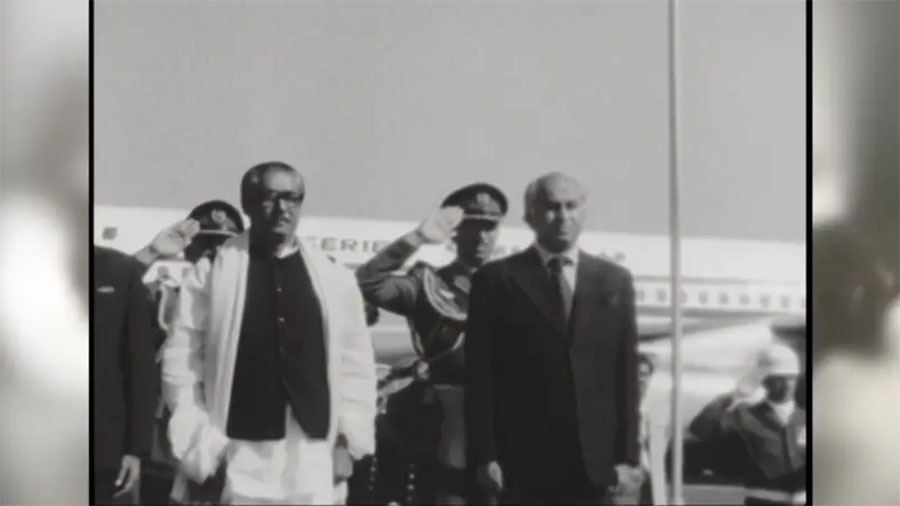
The Bangladesh delegation led by Sheikh Mujibur Rahman was given a guard of honour at Lahore airport.
Bhutto’s Digbaji
Bhutto was so stubborn about recognizing Bangladesh that he severed Pakistan’s diplomatic relations with several countries in January 1972.
That year, a report in the American newspaper The New York Times on January 14th reported that Pakistan had severed diplomatic relations with Bulgaria, Poland, and Mongolia after India for recognizing Bangladesh. He also announced that Pakistan would sever ties with any country that recognized Bangladesh.
One of the main reasons for Bhutto’s U-turn in attitude within two years was pressure from leaders of Muslim countries and Pakistan’s internal politics.
After the Bangladesh Liberation War, in accordance with the Geneva Convention, 93,000 prisoners of war in Bangladesh – including not only army officers but also civilians including women and children – were arrested and taken to India under the supervision of the Indian Army.
Pakistan also held about 400,000 Bangladeshis who were trapped in Bangladesh. The issue of handing over the Urdu-speaking Biharis who were trapped in Bangladesh was also not resolved at that time. The process of returning these prisoners of war to Pakistan was being delayed at that time due to the lack of direct diplomatic relations between Pakistan and Bangladesh.
In order to determine the policy for the return of these prisoners of war, the Simla Agreement was signed between Pakistan and India in July 1972, and its continuation was the Delhi Agreement in August 1973. Then, the process of handing over the prisoners of war began in September 1973.
There was pressure on Bhutto from the Pakistani public and Bhutto’s political opponents to expedite the process of returning these prisoners of war.
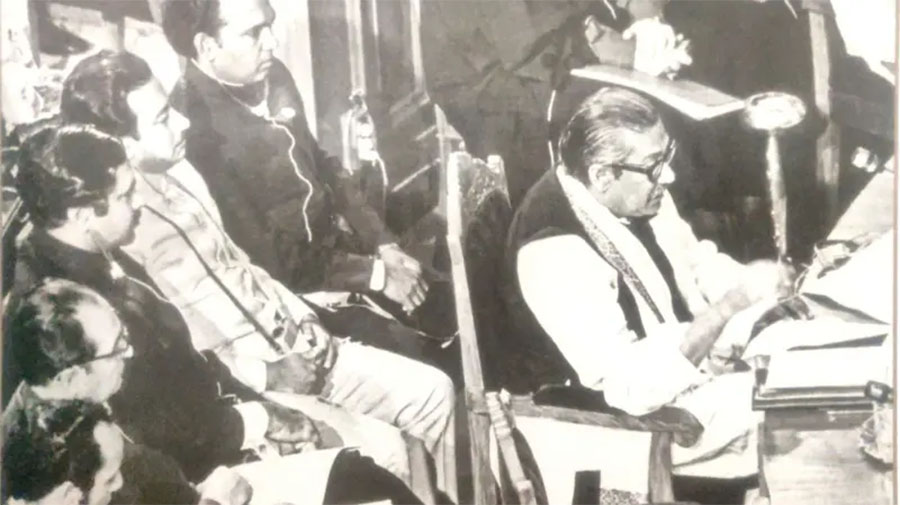
Sheikh Mujibur Rahman and Bangladesh delegation at OIC summit
That is why when Bhutto announced recognition of Bangladesh in 1974, a large section of the Pakistani public accepted the decision positively, said Pakistani journalist Hussain Naqi, who participated in the OIC conference in Lahore as a journalist.
Nakki claimed, “During the Bangladesh war in 1971, the common people of Pakistan did not know that this level of violence had been carried out there. Because at that time, TV channels and newspapers were all controlled by the government. After the war ended, when people gradually started to know, a kind of support for Bangladesh developed among them. That is why people welcomed Bhutto’s decision to recognize Bangladesh in 1974.”
In addition, influential leaders of the Muslim world at the time, focusing on the OIC conference, also exerted diplomatic pressure on Bhutto to recognize Bangladesh.
According to the New York Times, in a speech following the formal announcement of recognition on February 22, Bhutto said, “I will not say that I liked this decision. But the big countries advised us to recognize Bangladesh. It was not our opponents, but our friends and brothers who advised us to take this decision.”
Bhutto also mentioned the influence of Muslim countries in a press conference after the event in Lahore.
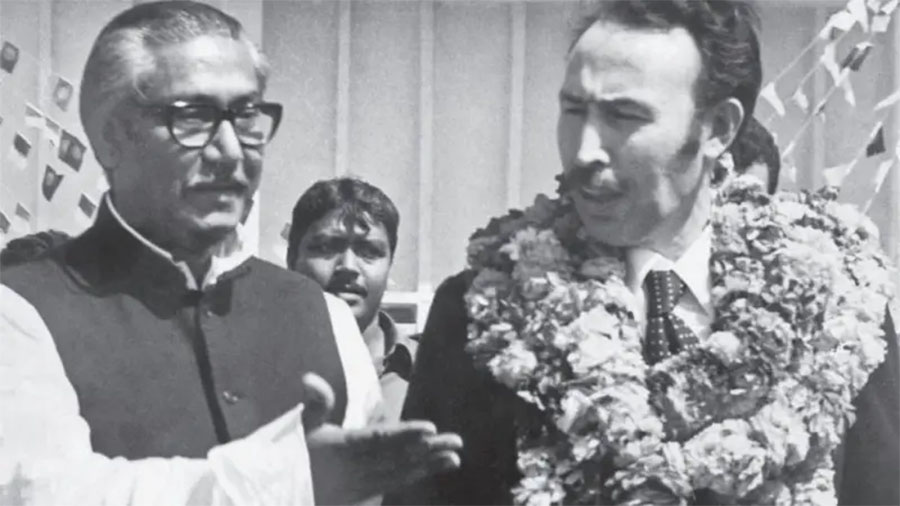
The influential leaders of the Muslim world at that time also exerted diplomatic pressure on Mr. Bhutto to recognize Bangladesh (March 1974, visit of Algerian President Horari Boumedienne to Dhaka)
Bangabandhu’s diplomatic foresight and masterstroke
Diplomats and analysts of the time believe that the diplomatic foresight of the Father of the Nation, Bangabandhu Sheikh Mujibur Rahman, played a major role in creating a friendly attitude towards Bangladesh among the influential leaders of the Muslim world at that time.
During the 1973 war between Syria, Egypt and Israel, Sheikh Mujib, with the help of Syria and Egypt, sent doctors from Bangladesh and tea as a gift. These gifts were brought from Bangladesh by diplomat Muhammad Zamir, who was working at the Pakistani embassy in Egypt in 1971.
He was saying, “After sending aid to Syria and Egypt, a positive attitude was created towards Bangladesh among influential leaders of the Muslim world. In light of which, Bangladesh was invited to the OIC conference in Lahore.”
However, despite being invited to the conference, no final decision has been made by Bangladesh on whether Bangladesh will participate in the event on Pakistani soil. A seven-member team led by the then Foreign Minister of Kuwait, Al-Jaber Al-Sabah, arrived in Bangladesh to convince the Bangladeshi representatives, including Bangabandhu Sheikh Mujibur Rahman, to take them to Lahore.
They arrived in Dhaka on the private plane of then-Algerian President Horari Boumedienne a few days before the start of the OIC conference.
Muhammad Zamir said that Sheikh Mujib entrusted him with the responsibility of maintaining communication with the OIC delegation because he was proficient in Arabic and French.

Horari Boumedienne and Sheikh Mujib at the OIC Summit. The Bangladesh delegation went to Lahore on Mr. Boumedienne’s plane.
“Bangabandhu told the OIC team led by Al-Sabah about his three conditions. He said that Bangladesh would go to Lahore if the Bangladesh flag was hoisted there, the Bangladesh national anthem was played, and Pakistan formally recognized Bangladesh in front of all Muslim countries,” said Muhammad Zamir.
“Without looking for a compromise, Al-Sabah assured Bangabandhu that all his conditions would be met. Then, on February 22, the day after Bhutto announced his recognition, the Bangladesh delegation flew to Lahore on Horari Boumedienne’s plane.”
Many analysts believe that Sheikh Mujibur Rahman understood the importance of gaining recognition from Pakistan at that time.
“If Pakistan recognizes Bangladesh, it will gain recognition from many Muslim countries, which in turn will make it easier to gain recognition from many other countries in the world – this is what Bangabandhu realized. That is why he took the issue of Pakistan’s recognition seriously at that time,” said Harun Habib, who was working as a journalist at the time and was present at the airport when the Bangladesh delegation left for Lahore on February 23.
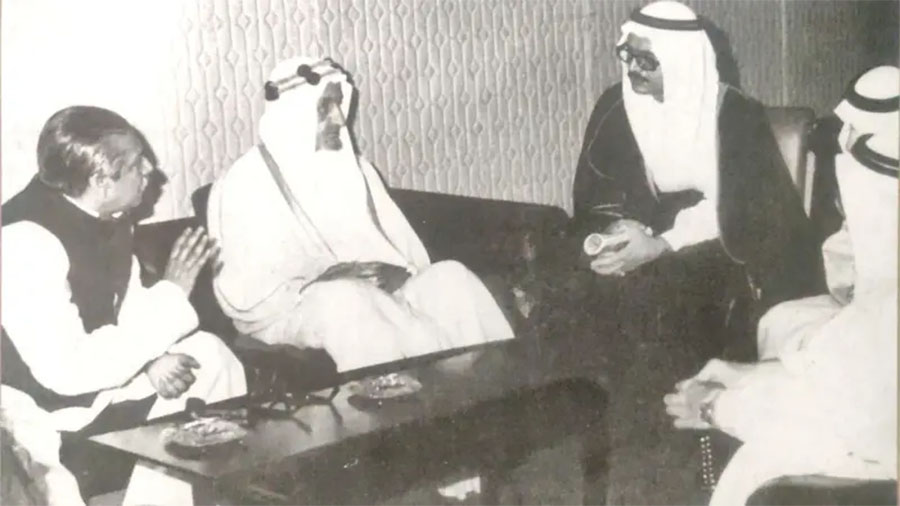
Sheikh Mujib’s meeting with Saudi King Faisal during his visit to Algeria, September 1973
The role of Muslim world leaders who supported Pakistan in the Liberation War
The leaders of Muslim countries at that time played a major role in inviting Bangladesh to the OIC conference in Lahore, influencing Zulfikar Ali Bhutto to ensure Bangladesh’s recognition, and normalizing relations between Pakistan and Bangladesh.
Despite supporting Pakistan during the Liberation War, Pakistan was cornered as human rights violations and genocide in Bangladesh became public knowledge around the world. Diplomats at the time believe that this led many Muslim world leaders to change their positions.
It emerged in the international press of the time that influential leaders like King Faisal of Saudi Arabia, Anwar El-Sadat of Egypt, and Horari Boumedienne of Algeria played a role in inviting Bangladesh to the OIC conference in Lahore.
However, the biggest role in the efforts to normalize relations between Pakistan and Bangladesh at that conference was played by Libyan leader Colonel Muammar Gaddafi – writes Javid Ali Khan, a journalist for Pakistan’s Friday Times newspaper, who was in charge of looking after Malaysian Prime Minister Tun Abdul Razak during the 1974 OIC conference in Lahore.
In his 2019 article “When Bhutto Skimmed with Gaddafi in 1974” in the Friday Times, he describes an incident at a dinner on the second day of the conference – February 23.
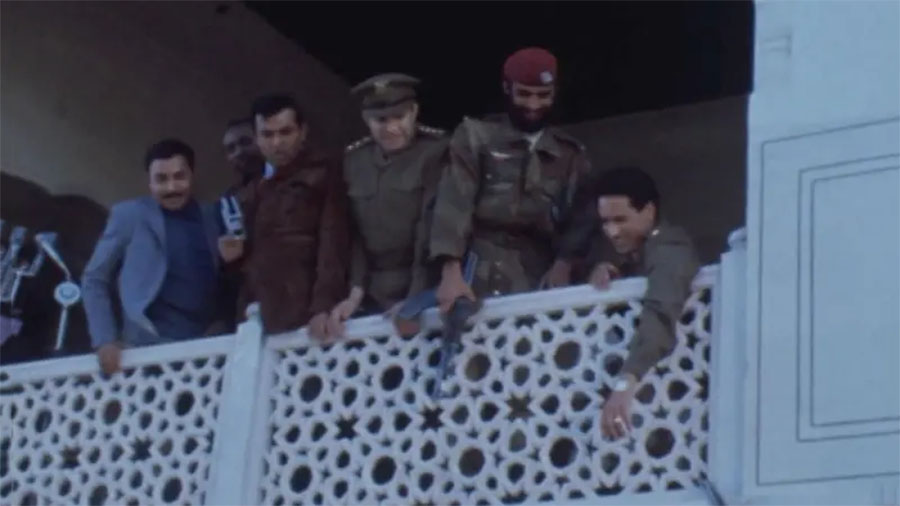
Muammar Gaddafi (far right) on the balcony of Shalimar Gardens. It was on this balcony that Mr. Gaddafi raised the hands of Sheikh Mujib and Zulfikar Ali Bhutto.
The dinner for the important state guests attending the conference was held at the royal Shalimar Gardens complex, built during the Mughal era. Shortly before the dinner began, Sheikh Mujibur Rahman and Bhutto appeared on the second-floor balcony of Shalimar with Gaddafi and Yasser Arafat. They were standing in a place where all the leaders present at the dinner could see them. Then Gaddafi held Sheikh Mujibur Rahman’s hand with one hand and Bhutto’s hand with the other and, putting both hands together, addressed the attendees and said, “Akhi, akhi,” which means “brother” in Arabic.
Javid Ali Khan’s writing suggests that this small incident was predestined to happen, and that Muammar Gaddafi himself convinced the two top leaders of Bangladesh and Pakistan to stage this small show of brotherhood.
Javid Ali Khan’s writing suggests that this little diplomatic etiquette, staged based on Gaddafi’s widespread popularity in the Muslim world, was resorted to in the hope that it would at least alleviate some of the post-war bitterness between the people of the two countries.
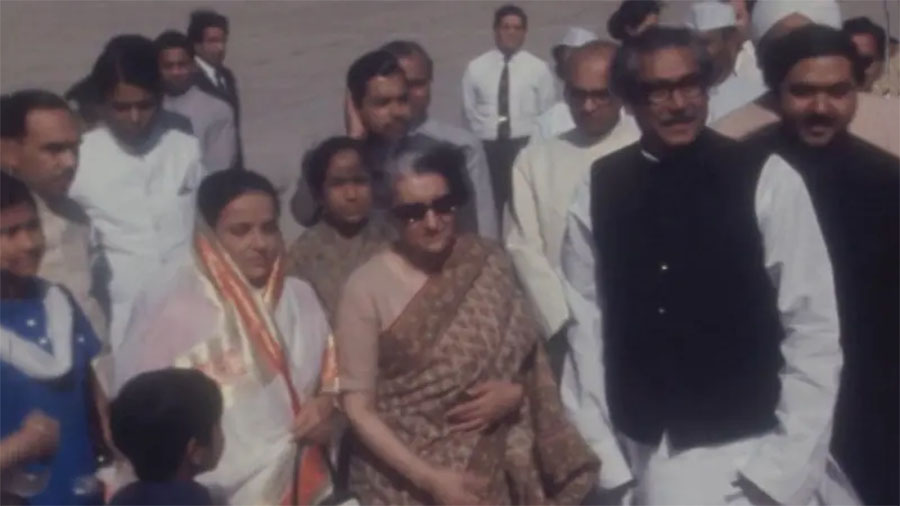
On April 10, 1974, after the signing of the Tripartite Agreement, Sheikh Mujib went to Delhi. He was received by Indian Prime Minister Indira Gandhi. On the right is the then Foreign Minister of Bangladesh, Dr. Kamal Hossain.
Bangladesh perspective
Journalist Harun Habib said that Sheikh Mujibur Rahman’s visit to Lahore and Pakistan’s recognition of Bangladesh created mixed reactions among the people of Bangladesh at the time.
He said, “While Pakistan’s recognition within two and a half years of the end of the war was viewed positively, some people were also angered by the fact that a delegation from Bangladesh had gone to Pakistan within such a short period of the bloody war. The mixed reactions among the people were evident when Bhutto came to Dhaka on his return visit in June 1974. At that time, just as some people were on the streets welcoming Bhutto, people were also seen raising slogans in protest against Bhutto’s visit, who was against the independence of Bangladesh.”
However, journalist Harun Habib said that the news of the 1974 Lahore OIC Conference and Pakistan’s recognition of Bangladesh were printed quite positively in Bangladeshi newspapers.
According to him, there was a mixed reaction in the political arena at that time regarding the issue of recognition from Pakistan. At that time, some people said that it did not matter to Bangladesh whether Pakistan recognized it or not, as some people still say. But Bangabandhu understood its long-term significance at that time, which is why he went to the OIC conference in Pakistan despite the prohibition of some parties.

https://stapravda.ru/20221228/reyting_samyh_populyarnyh_hostingov_v_rossii_196445.html, рейтинг хостингов России подтверждает, что выбор надежного провайдера важен для бизнеса.