
❐ Local correspondent
There have been allegations of widespread irregularities in the procurement of Boro paddy at a government warehouse in Nazirpur, Pirojpur. Several farmers in the upazila have alleged that the paddy is being collected from businessmen and politically influential people, while the genuine farmers’ paddy is being returned under various pretexts.
Unable to sell rice at the price set by the government, they are forced to sell rice at a lower price in the market.
Bimal Halder, a farmer from Sriramkathi area of the upazila, cultivated paddy on six bighas of land during the current Boro season. The yield has been good. But it has become difficult for him to make a profit due to the increase in production costs.
Bimal alleged that when he took the paddy to the government warehouse, he was refused to buy it on the pretext that it was wet or of low quality. At the same time, the paddy of influential people was being easily procured.
Many other farmers in the upazila, including Paritosh, Sudeb, Abul Fazal, Ratan Mia, and others, have raised the same allegations as Bimal Haldar.
They say that instead of collecting rice from genuine farmers in government warehouses, rice is being taken from businessmen and politically influential people. As a result, many farmers are being deprived of the opportunity to sell rice at the price set by the government.
Farmers said that even though they have taken their paddy to the Sriramkathi food warehouse in the upazila, they are being sent back on various pretexts. As there is no clear schedule for when the paddy will be deposited, the farmers are facing uncertainty. Many are forced to sell their paddy to market wholesalers at low prices.
Mizan Sardar, a farmer from Dirha Union, said that when he went to the warehouse with 25 maunds of paddy, he was turned away because of the long queue.
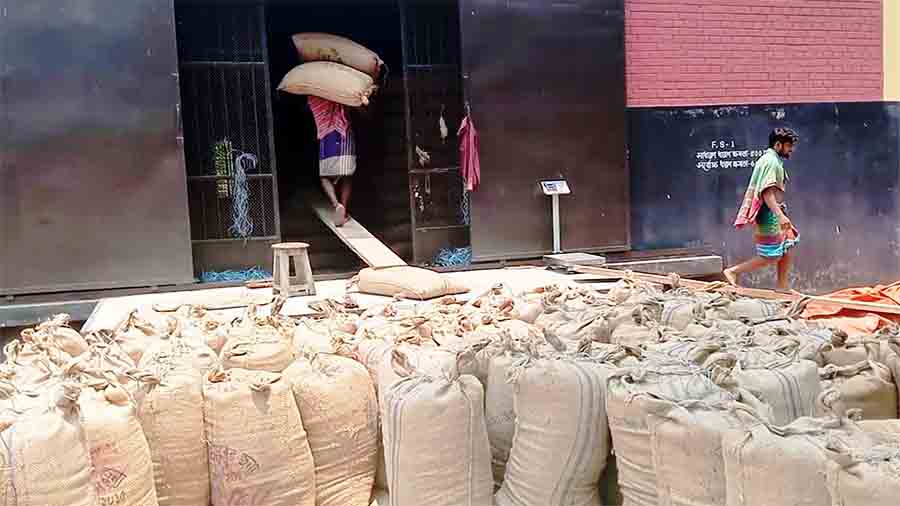
He alleged that the thousands of sacks of paddy are stored in front of the warehouse, effectively blocking the opportunity for ordinary farmers to bring in their paddy. As a result, many are forced to sell their paddy at a lower price in the market, unable to sell it at the government price.
On-site inspection of the warehouse area revealed that sacks of rice were piled up outside the warehouse. Some farmers present there complained that all arrangements had been made in a planned manner to prevent other farmers from supplying rice.
They also alleged that some farmers’ agricultural cards are being used to supply rice to others.
According to the farmers, this situation has been created due to the collusion of influential circles with some food warehouse officials, employees, and labor representatives.
Farmers recently staged a protest at the Nazirpur Upazila Parishad premises, protesting against the lack of opportunity to sell paddy in government warehouses. They claimed that while good quality paddy was being returned, low-quality paddy supplied by businessmen and political leaders was being purchased.
However, Mahima Akhtar, the officer-in-charge of Sriramkathi LSD, denied these allegations. She said that paddy is being collected in accordance with government policies and no one is turned away when they bring paddy.
He admitted that some complications had arisen due to a temporary shortage of sacks.
Mahima Akhter also said that she has no responsibility for the purchase and sale of rice outside the warehouse or who is storing it. She also mentioned that rice is accepted when brought by people with agricultural cards.
According to the Upazila Food Department, the government purchase price of paddy in Nazirpur Upazila has been set at Tk 1,440 per maund during the current Boro season. The government has set a target of collecting a total of 1,306 tons of Boro paddy in the Upazila this year.
Farmers have claimed that unless transparency is ensured in the government procurement process, genuine producers will continue to be deprived of fair prices and their interest in agricultural production will gradually decrease. They have demanded an investigation into the matter and necessary action against the culprits.

https://stapravda.ru/20221228/reyting_samyh_populyarnyh_hostingov_v_rossii_196445.html, рейтинг хостингов России подтверждает, что выбор надежного провайдера важен для бизнеса.