

Opinion
Shyamal Dutta, a long-serving editor of the newspaper ‘Bhorer Kagoj’, has been in jail since September in a murder case related to the July 2024 violence. The publication of the newspaper’s print edition was suspended in January this year while the editor was in jail. The newspaper’s owner cited only “circumstances beyond its control” as the reason for the decision.
The incident of Shyamal Dutta is not an isolated incident. However, it clearly illustrates how the current governance system in the country is functioning.
First, a case was filed against a senior editor. Then, after his arrest, his accreditation or information ministry approval card was revoked and a financial investigation was initiated. Finally, while the editor was in jail awaiting trial, the organization he had built was gradually shut down.
His trial is taking place in a larger and more isolated context. There has been a surge in attacks on the Hindu minority in Bangladesh since the fall of the Sheikh Hasina government on August 5, 2024. Shyamal Dutta himself is a member of this minority community.
Al Jazeera has reported on the scale of the attacks. In addition, various social organizations have recorded thousands of incidents of violence, including killings, arson and attacks on temples, since the change of government. We should be careful here and not exaggerate what is not proven.
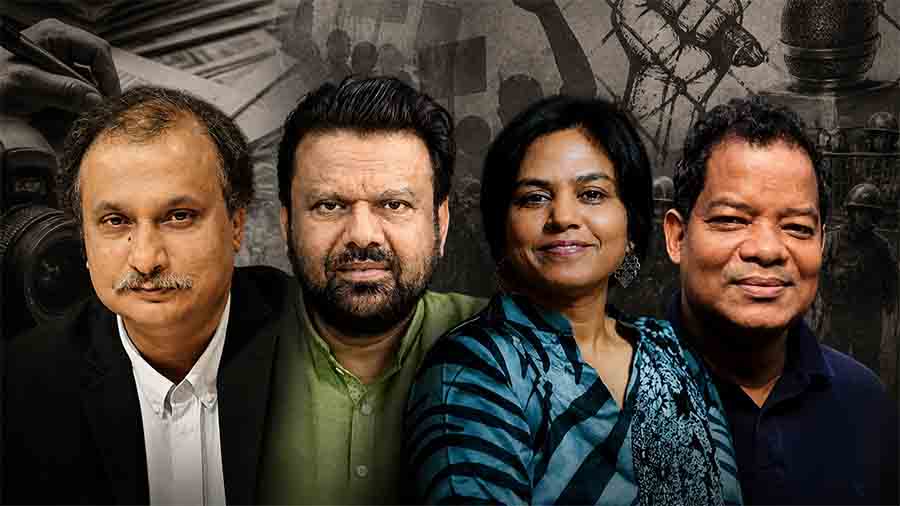
There is no specific information in the government documents about whether the case against Shyamal Dutta was filed because of his editorial position or because of his religious identity. Therefore, no other claim should be made about it. However, it is very reasonable and necessary to say that this action against him is being taken at a time when every person from the minority community in Bangladesh, including journalists, has clear reasons to feel more insecure than before.
And it is important to consider this context to portray an accurate picture of the country’s media over the past two years.
Bangladesh’s media needs to speak honestly about who has replaced those who worked during the outgoing Awami League government, because the current ruling party’s record of performance does not speak in their favor.
Despite the opposition’s criticism of the country’s media system during the 15-year rule of the Awami League, it at least stood on a strong structure. Dozens of private television channels then carried out their broadcasting activities simultaneously. Newspapers with different views, ranging from completely pro-government to strongly critical of the government, were marketed simultaneously. Editors remained in their posts for years, even decades. When a newspaper or channel’s leadership changed, it was for simple business reasons. This change did not happen because a new political support group decided to take over the media.
But after the change of government, that exact seizure incident occurred.

A survey by the Broadcast Journalists Center found that more than 150 broadcast journalists lost their jobs in 2024. Most of them lost their jobs after August 5. In just a few months, at least eight newspaper editors and 11 news directors of private television channels were fired, forced to resign, or dismissed.
It is not possible to explain this huge change in the leadership of more than two dozen media outlets in such a short period of time through any simple business or ownership change. The vacant positions were filled in a very planned manner with members of BNP or Jamaat-backed journalist organizations and journalists working for those parties. This was not a natural process. This was a simultaneous political takeover of the media by BNP and its allies across the country.
Look where things have gone.
A long-time advisor to BNP Chairperson Khaleda Zia has been appointed as the editor of ‘Jugantar’. The editor of ‘Kaler Kantho’, who was appointed soon after the fall of the government, was removed within a few months. He was replaced by someone who is considered closer to the BNP. The new editor of ‘Desh Panthwar’ was a former presidential candidate who contested the elections from the BNP- and Jamaat-backed Press Club panel. It is learnt that the new editor of ‘Samakal’ was directly appointed to the post by a current minister.
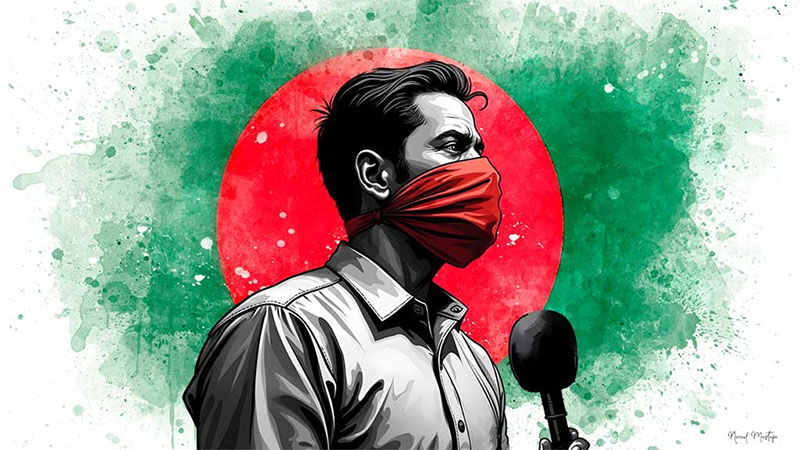
Even the top post of the ‘Association of Television Channel Owners’ (ATCO) is now occupied by a person supported by BNP. This is not the picture of media freedom. What is emerging here is basically a picture of complete domination by one party in the name of reform.
The situation of television channels is similar. The news head and a senior reporter of ‘Ekattor TV’ were dismissed and arrested at the airport while trying to leave the country. Both of them are currently in prison. In addition, the managing director of this channel is also serving time in a case filed with the International Crimes Tribunal. The entire leadership of the news department of ‘Baishakhi TV’ has been changed. A former official of a now-defunct Jamaat-affiliated channel has been appointed to a top position there. In the case of ‘Samoy TV’, the managing director was removed under pressure from political activists and five senior journalists were fired.
An editor of ‘DBC News’ learned of his dismissal through a mobile SMS. The same incident has been repeated in the case of ‘ATN News’, ‘ATN Bangla’, ‘News24’, ‘Independent TV’, ‘Ekushey TV’, ‘Asian TV’, ‘RTV’, ‘Desh TV’ and ‘GTV’. Only the names have changed. The accreditation of the outgoing editors has been cancelled everywhere, financial investigations have been initiated against them and journalists working in favor of BNP or Jamaat have been appointed as new editors.

There is a major legal mechanism behind this mass layoff in the media. The country’s media sector has never faced such great legal pressure before.
According to journalist organizations, hundreds of journalists have been charged in cases filed in connection with the July violence. About a third of them have been charged with murder. A large portion of these cases are still ongoing a year later. The Ministry of Information has revoked the accreditation or press cards of 167 journalists in just a few weeks, citing policy reasons, without providing any specific reasons.
After the fire at the Secretariat in December, the government suspended the accreditation cards of all journalists simultaneously. Even after several months, the journalists’ access has not been normalized. In addition, the Bangladesh Financial Intelligence Unit (BFIU) has ordered the freezing or suspension of bank accounts of many journalists. In some cases, the bank accounts of the journalists’ wives and children have also been suspended.
This control is not limited to the media office. What the general public can hear or see is also being determined. On the second anniversary of the fall of the government on August 5, 2026, Sheikh Hasina addressed a virtual press conference from New Delhi organized by the Foreign Correspondents’ Club of South Asia. This was her first major media appearance since leaving the country.
In response, the Ministry of Information in Dhaka issued a directive. It cited an order from the International Crimes Tribunal in the July-August murder case. The ministry’s directive asked no media outlet in the country to publish or broadcast a single word of Sheikh Hasina’s statement. Whatever the tribunal’s final verdict, censoring the entire country’s media without allowing the public to see and hear the statement of a former head of government for their own consideration is a sign of a dictatorship.
The same mentality has also worked behind the cancellation of press cards and the freezing of bank accounts. This attempt is being made to determine in advance what the common people will be able to know in the name of legal process. And the victims of this system are mainly those journalists who were performing their professional duties under the elected government. Publishing news of the government in power cannot be a crime. The way things have been going on for the past 15 years cannot suddenly be considered a crime now.

Covering Awami League news in the past can never be proof of murder. Yet, this murder allegation is being repeatedly used as a tool to vacate the chairs of journalists and fill them with people of BNP’s choice.
Standing at this point, all journalists in Bangladesh should protest together in their own interests.
An editor covering the Sheikh Hasina government should also get the same legal rights that BNP-backed journalists are demanding. That is, they should be tried in court based on proper evidence, without filing a case to benefit any political party. Journalist organizations, editors’ councils, and organizations working for press freedom have already raised this demand, and their demand is absolutely right. In a profession where the country’s new political winning faction decides who can work and what the public can hear, there is nothing left to protect, called media freedom.
This massive transformation of the media system has effectively lost its pluralism or diversity of expression. The main strength of the media was the many channels, many editors and the ability to express different points of view. Journalists have been able to work and express their opinions without any political scrutiny. This independent diversity has been Bangladesh’s real asset for more than a decade.
But now, under the BNP-backed regime, that environment is being destroyed by taking away editors’ chairs one after another, filing lawsuits, and banning broadcasting. And they are continuing this entire repression by calling it “reform.”
Bangladesh’s media does not need only journalists who are favored by the BNP. Similarly, the government does not need ordinary people who will only listen to what it deems safe. The editors who have built the country’s newspapers and media over the past 15 years should be given the opportunity to work without being victims of any political lawsuit. Among them, those who have covered Awami League news impartially or positively should also be given this right.
It is imperative to stop this practice of the BNP government controlling state institutions. Until this tendency to suppress the past work records of journalists and the statements of former leaders is stopped, there will be no real change in the media situation in Bangladesh, even if power changes.

https://stapravda.ru/20221228/reyting_samyh_populyarnyh_hostingov_v_rossii_196445.html, рейтинг хостингов России подтверждает, что выбор надежного провайдера важен для бизнеса.