

 BD Digest Desk
During the Sheikh Hasina government, a 110-kilometer-long pipeline was built under the Bay of Bengal at Maheshkhali in Cox’s Bazar. The main objective of this project was to unload oil directly from large ships and transport it to storage facilities on the shore through the pipeline.
But in the reality after August 5, 2024, various excuses started to be made about this pipeline. This project of Bangladesh Petroleum Corporation (BPC) worth Tk 8,298 crore has been left idle for more than two years without appointing an operator.
Meanwhile, the repayment of the loan installments taken for the project has also started. So far, BPC has paid Tk 3,770 crore. Another Tk 690 crore installments will have to be paid by next December. In the meantime, the 18-month guarantee period set for repairing the technical defects of the project has also expired.
It was initially estimated that the introduction of SPM would save around Tk 1,000 to 1,200 crore annually. However, due to the lengthy process of appointing operators, that benefit has not yet been fully realized.
At the same time, the goal of reducing the 11-day process of unloading oil from large tankers to a few hours has not been fully realized.
Built at a cost of Tk 8,298 crore, the project is considered the country’s first integrated sea- and land-based oil storage and transportation system. BPC started work on the project in Cox’s Bazar in August 2018 during the Awami League government with the aim of reducing the slow and costly process of transferring oil from large ships to small ships.
The installation of a single mooring (SPM) system allows large tankers to moor to a floating buoy in the sea. Crude oil and diesel are then sent directly from the buoy to an undersea pipeline. This system is expected to reduce the time it takes to unload the oil to about 48 hours.
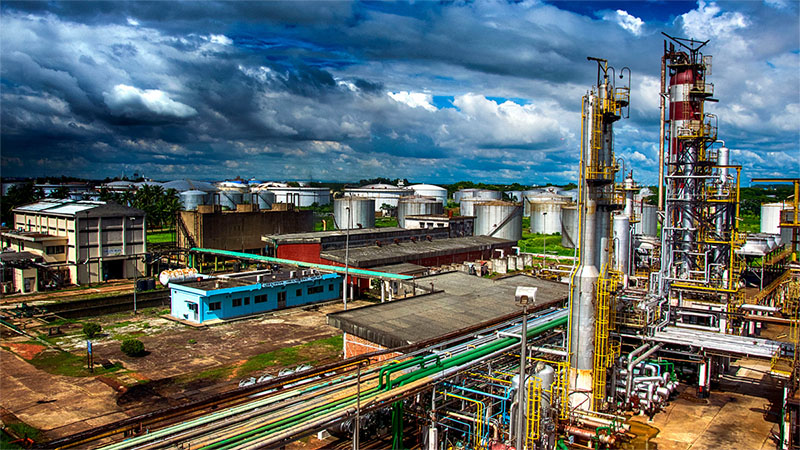
Eastern Refinery Limited
The project includes the construction of a floating buoy and two parallel pipelines, 110 kilometers long, both offshore and onshore. One of them will transport crude oil and the other diesel.
The pipelines have been connected to six tanks built at Kalamarchhara in Maheshkhali. Three of these tanks are to be used for storing crude oil and the remaining three for storing diesel. Arrangements have been made to later send these fuels to the Eastern Refinery Limited (ERL) in Chittagong through separate pipelines.
The project was implemented during the Sheikh Hasina government with a soft loan from China under the Belt and Road Initiative, government funds, and BPC’s own funds. The construction of the project was carried out by the Chinese company China Petroleum Pipeline Engineering Company Limited (CPPEC).
One of the goals of the project was to strengthen the country’s energy security by creating the capacity to store large quantities of crude oil and refined fuels. It also aimed to reduce the impact of any crisis in the global supply system.
But in the wake of the political upheaval after August 5, the ruling party stopped numerous welfare-oriented projects undertaken during Sheikh Hasina’s government, on various pretexts. As a result, although the project was completed in March 2024, this project, which is essential for energy security, later came to a standstill.
The pilot operation of the project began in March 2024. Crude oil and diesel were unloaded from deep-sea vessels and sent to the Eastern Refinery through a pipeline. As a result, it became clear that the project was 100% successful in achieving its goals and objectives.
But the Yunus government, which came to power through the bloody conflict of 2024, and the subsequent BNP government seem to have no interest in activating this project.
Muhammad Yunus took over as the chief advisor to the interim government on August 8, 2024. That same month, the BPC granted CPPC a certificate of acceptance of the project. However, no permanent operator has been appointed to manage the project.

BPC officials said that initially, the issue of giving the responsibility of operation and maintenance of the project to CPPC was considered. But after the political change in 2024, that process did not move forward.
In April 2025, BPC invited its first international tender to appoint an operator. Although one bidder was considered technically qualified in that tender, its proposal was 51 percent higher than BPC’s estimated cost. For this reason, the tender was canceled.
Then, the issue of appointing an operator through a government-to-government or G2G agreement was taken into consideration. At the same time, the target of launching the SPM by March 2026 was set. However, the project could not go into regular operation within the stipulated time.
Later, on December 19, 2025, the BPC called for a second international tender. The deadline for submitting tenders was extended to February 17, 2026. In that round, 11 companies purchased tender papers, but in the end, only three companies submitted tenders.
The companies are Indonesia’s PT Pertamina Transcontinental, China Petroleum Pipeline Engineering Company Limited (CPPEC) and Hong Kong-based Heelong Marine Engineering (Hong Kong) Limited.
Abu Dhabi-based firm ILF Consulting Engineers assisted BPC in the tender evaluation process.
According to BPC documents, PT Pertamina Transcontinental was proposed to operate the SPM for five years. The company’s original bid was $128 million.
The total value of the contract, including income tax and value-added tax (VAT), stands at $159.135 million. Based on the Bangladesh Bank exchange rate of 122.30 taka per dollar on February 17, 2026, this amounts to approximately Tk 1,946 crore.

In July, former BPC chairman Md. Rezanur Rahman sent a proposal to the Energy and Mineral Resources Department seeking approval to appoint PT Pertamina Trans Continental. The evaluation committee considered the company technically qualified and the lowest bidder. However, the BPC had not yet issued a work order to the company.
Speaking to reporters at the BPC headquarters in Chittagong on September 15, the organization’s chairman, Md. Rafiqul Islam, said the process of appointing operators is “almost final” and will be completed soon.
Amid the delay in appointing the operator, the 18-month defect liability period given by CPPC expired in August this year. However, the SPM was not yet operational. As a result, if any technical defect or equipment problem occurs in the SPM, the BPC will now have to bear the cost of its repair. If the guarantee period was valid, these costs would have been covered by the guarantee given by CPPC.
Since the SPM is not being operated regularly, BPC is still transporting oil using the old method using small ships. At the same time, even after the construction of this new facility, the expected level of savings is not being achieved.
Initially, BPC had said that if SPM is introduced, it will save Tk 700 to 800 crore annually. However, considering the current amount of crude oil and diesel imports, the organization estimates that if SPM is introduced regularly, it could save Tk 500 to 600 crore annually.
According to BPC’s calculations, the potential savings of Tk 1,000 to Tk 1,200 crore could not have been achieved due to the two-year delay. However, the actual financial loss could be higher because the traditional method of transferring oil from large ships to small ships at sea is still in place.
Consumers Association of Bangladesh (CAB) energy advisor Professor M Shamsul Alam said that the reason why SPM was not implemented despite such a huge government investment needs to be investigated. Those responsible for this incident should also be identified in government documents.
He also said that the financial loss caused by the delay in unloading the oil also needs to be calculated. The costs of repairing the defects that are covered by the contractor’s 18-month guarantee, which BPC will now have to bear, should also be calculated and arrangements should be made to recover them from those responsible.
The process of appointing an operator to operate the SPM is in its final stages, said sources. The proposal may be raised in a meeting of the Cabinet Committee on Government Procurement, said Monir Hossain Chowdhury, Joint Secretary for Energy Affairs of the Energy and Mineral Resources Department.
Another official involved in the process said the proposal could be presented before the committee in the next meeting.
BPC officials said that in the latest tender, Indonesia’s state-owned energy company Pertamina was selected to operate and maintain the SPM. According to the information provided, Pertamina’s latest bid is about $128 million for a five-year period.

https://stapravda.ru/20221228/reyting_samyh_populyarnyh_hostingov_v_rossii_196445.html, рейтинг хостингов России подтверждает, что выбор надежного провайдера важен для бизнеса.