

❐ Aynal Karigor
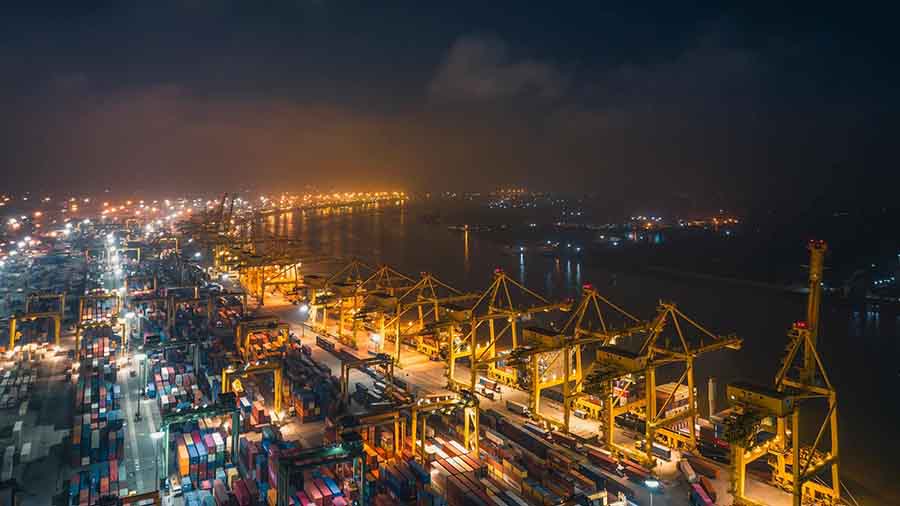
Chittagong Seaport is known as the heart of the country’s economy. A large part of foreign trade is completed through this port. However, recently discussions and debates have started surrounding the port. It has already been seen that one terminal after another of Chittagong Port is being handed over to foreign companies.
Starting with Patenga Container Terminal; now initiatives are underway to hire foreign operators for New Mooring Container Terminal (NCT), Chittagong Container Terminal (CCT) and General Cargo Berth (GCB).
The ruling government’s excuse is that the port’s efficiency will increase if foreign investment is combined with advanced technology.
However, labor organizations fear that such a decision could impact national sovereignty and the economy, as well as threaten the employment of many people.
So what is the real picture of the issue? What are the conditions in the proposed agreements, and why has the Chittagong Port Protection Committee launched a movement? Let’s review the issue.
Who manages which terminal of the port?
There are currently four major container terminals operating at Chittagong Port: NCT, CCT, GCB and Patenga Container Terminal (PCT). The Saudi company ‘Red Sea Gateway Terminal International’ (RSGTI) has been awarded the responsibility of operating the PCT under a 22-year contract. The company is now operating the terminal.
In addition, Switzerland’s Medlog has been given the responsibility of operating the Pangaon ICD near Dhaka. Denmark’s APM Terminals is going to be given the responsibility of Laldia Char for 30 years.
The port’s busiest and most important terminal is the Newmooring Container Terminal.
According to estimates by 2025, this terminal will handle about 44 percent of the port’s total container handling. Recently, a draft 15-year agreement with Dubai-based company ‘DP World’ has been approved to modernize and operate the terminal under a G-2G and PPP framework.
Meanwhile, Saudi company RSGTI has expressed interest in becoming the operator of CCT and GCB. The Ministry of Shipping has already sent a letter to take this process forward. As a result, almost all the major terminals of the port are in the process of being operated by some foreign company.
What is the government’s rationale for hiring foreign operators?
Asked why the government is turning to foreign companies, officials from the Ministry of Shipping and ports are talking about increasing efficiency and modernization.
The government believes that the addition of international-standard operators will introduce advanced technology and automated systems at the port. The waiting time for ships—that is, the ‘turnaround time’—could be reduced if experienced companies like DP World or RSGTI start operating, which currently takes time to unload containers from ships.
This will reduce import and export costs and increase Bangladesh’s competitiveness in international trade. The government expects that the state can also receive large concession fees and revenue in exchange for foreign investment.
Financial accounting of domestic and foreign proposals
Much of the controversy surrounding the decision revolves around the financial comparison of the proposals and the bids of other companies. The Port Protection Campaign Council and opponents of the decision say that several domestic and multinational companies offered to pay more revenue than DP World to operate the NCT.
Dubai-based DP World offered to pay $20 million as concession fee. In return, domestic multinational MGH Group offered to pay $25 million.
The company also promised to provide at least $5 more revenue per container than DP World’s offer.
However, the alliance of three domestic companies, ‘SAIF-Cosmos-Everest Port Services’, did not want to take the lease; they only wanted the responsibility of operating the terminal.
Their proposal was to pay $92 in revenue per container.
Sangram Parishad claims that the state-owned Chittagong Drydock Limited (CDDL) is currently successfully operating NCT and the port’s net income is also good.
They fear that if the long-term management responsibility is handed over to foreign state-owned or multinational companies, Bangladesh could lose huge revenues. At the same time, there is a risk of profits going outside the country.
In addition, security analysts are also considering the sovereignty and security risks posed by Chittagong Port, one of the country’s main entry points.
Workers’ movements and national security concerns
The situation at Chittagong Port has become heated after the initiative to appoint foreign operators in all terminals. Various organizations including the Chittagong Port Protection Committee, SCOP, and Nationalist Workers’ Party are continuously holding programs to protest this decision.
The concerns of labor leaders are mainly about three issues.
They fear that many local workers could lose their jobs if foreign operators introduce automated technology. In addition, if the country’s main seaport is completely foreign-run, it could create geopolitical risks and increase the risk of losing strategic control.
Labor leaders are also demanding that a full and transparent financial and technical evaluation should have been made public before such a sensitive agreement was signed.
In this situation, labor leaders have warned: If the government unilaterally signs an agreement without discussing it with the agitating workers, port operations from Chittagong Port to the outer anchorage of Kutubdia will be paralyzed.
What could happen next?
There is no doubt that the Chittagong Port needs to be modernized and its capacity increased to keep pace with the pace of international trade. But the government’s big challenge is to ensure that this development does not jeopardize the country’s economic sovereignty, the interests of workers, or national revenue.
It remains to be seen whether the government will reconsider the decision after holding discussions with the protesting labor leaders, or hand over the responsibility of managing this important driving force of the country’s economy to foreign operators.
Will the appointment of a foreign operator at Chittagong Port create new opportunities for development, or would it have been possible to move forward by further strengthening local management?

https://stapravda.ru/20221228/reyting_samyh_populyarnyh_hostingov_v_rossii_196445.html, рейтинг хостингов России подтверждает, что выбор надежного провайдера важен для бизнеса.