
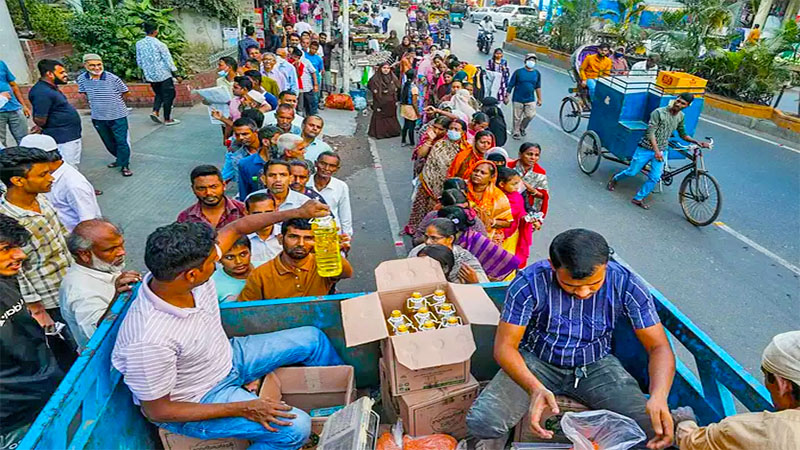
Until recently, the Trading Corporation of Bangladesh (TCB) and other government agencies’ truck sales were primarily frequented by the poor and lower-income groups who sought essential goods at affordable prices. However, this trend has shifted, and now people from all walks of life, including middle-class families, are lining up in front of the trucks. With anxious expressions and many wearing masks to hide their faces, the middle class is now a common sight at these sales.
This shift in behavior is a result of the political, economic, and social instability the country has faced in recent months. The escalating cost of essential goods has caused growing distress among both the lower and middle-income groups. At local markets, many middle-class individuals are visibly struggling to balance their spending, counting their money anxiously as they attempt to buy groceries. As prices soar, people are now flocking to TCB trucks, where goods are priced slightly lower than in the market. In addition to lower-income families, university and college students are also joining the lines.
In areas like Chittagong and Dhaka, long queues have formed at several TCB truck sales. Alongside the daily wage workers, housewives, students, office employees, and people from various professions were seen waiting patiently for hours. Some even arranged time off from their workplaces to stand in line.
At Chittagong’s Cheragi Hill area, one buyer named Farid (a pseudonym), an employee, spoke to reporters, saying, “I can’t take it anymore. At the market, just hearing the prices gives me a headache. I can’t afford to buy fish or meat anymore. I’m learning to survive on just greens and vegetables. I don’t even know if I will get the products I need from the truck.”
One elderly woman, Halima Khatun, waiting in line, was being given water by two younger women after standing in the scorching heat. She explained that she lives with her son, who works a small job, and that after dropping her grandson off at school, she had come to buy essentials from the TCB truck.
In a tired voice, she said, “A famine is coming to this country, I can tell. People today don’t understand this. Families like mine (middle class) never stood in line for goods before. But now, most of the people in line are just like us. A famine is coming, you will see.”
Other customers in line echoed her concerns, expressing that the prices of goods in the market are artificially inflated. “Vegetables that should be 30-35 taka are now selling for 70 taka or more. Everything has doubled in price. This is a sign that famine is on the horizon,” one elderly person remarked.
The TCB and the Department of Agricultural Marketing have set up several points in Chittagong and Dhaka to sell goods like rice, lentils, oil, potatoes, onions, and eggs at subsidized prices. Despite these efforts, demand far exceeds supply. People in the middle class, who don’t have access to family cards or whose cards have been canceled, are increasingly turning to these sales to make ends meet.
In Chittagong, on all days except Friday, around 7,000 people are able to purchase rice, lentils, and cooking oil from TCB trucks. The demand is so high that people often wait in line for hours, with some leaving empty-handed as stock runs out.
Through interviews with 100 customers in the line at different truck sale points, it was found that the majority of people earn less than 20,000 taka a month, with many earning as little as 15,000 taka. Even those earning between 30,000 and 45,000 taka a month are struggling.
Among the 100 customers, there were day laborers, housemaids, auto rickshaw drivers, garment workers, shopkeepers, retired officers, teachers, and even students. Everyone reported that they couldn’t balance their income and expenses, with many resorting to borrowing money or breaking into their savings to cover the gap.
Arif Hossain, a third-class government employee, waiting at the TCB truck in Dewanhat, said, “Before, we never had to wait in line for goods like this. But since last year, the prices have gone up so much that I can’t manage anymore. I have to borrow money every month to cover expenses.”
Abul Hossain, a retired government officer, echoed this sentiment, noting that the price of everyday goods has more than doubled in recent months. “Potatoes, onions, eggs—these prices were never this high. They used to go up and down, but now they just keep increasing,” he said.
According to officials managing the truck sales, the demand for goods exceeds the available stock, and people are often unable to buy everything they need, even after waiting for hours.
Middle-class buyers have expressed frustration over what they call “unnatural” and “man-made” price hikes. They argue that the long lines at TCB truck sales are a clear sign of the country’s looming instability.
Consumer rights advocates, like SM Najer Hossain, vice president of the Consumers Association of Bangladesh (CAB), have warned that unless prices are brought down, the lines at TCB truck sales will continue to grow. “People’s income hasn’t increased in proportion to their needs. As a result, they are flocking to where they can save money,” he said.
In addition to basic goods, many buyers are now urging TCB to include fish, meat, and vegetables in their offerings to further ease the financial strain on struggling families.
Fatima Cobra, a housewife waiting in line at Dhaka University, said, “If TCB could sell fish and meat, it would make life so much easier. The prices of everything are so high. The government needs to do something to make basic goods affordable again.”
Similarly, Morshed Alam, another middle-class shopper, recalled how his daughter had wanted to buy a fish when they went to the market, but the prices were too high. “As a father, there’s nothing worse than not being able to afford what your child needs,” he said, wiping his eyes.
Mohammad Hossain, a TCB vendor, mentioned that if the government decided to include fish, meat, and vegetables in their sales, they would have no problem selling them. “Our job is to deliver and sell whatever the authorities decide to provide,” he said.
For now, it remains clear that as the cost of living continues to rise, the lines at TCB truck sales will keep growing, a sign of the deepening financial struggles of Bangladesh’s middle class.

https://stapravda.ru/20221228/reyting_samyh_populyarnyh_hostingov_v_rossii_196445.html, рейтинг хостингов России подтверждает, что выбор надежного провайдера важен для бизнеса.