
Special Report
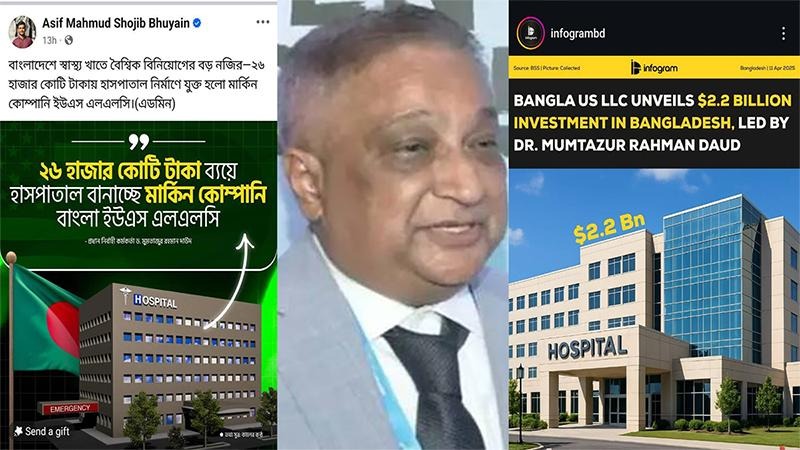
A news report about a foreign investor announcing a $2.2 billion investment at the Investment Summit 2025 has gone viral on social media, thanks to a broadcast by Somoy TV. Youth and Sports Advisor Asif Mahmud shared a post on his Facebook wall stating, “An American company is building a hospital with an investment of 260 billion taka.” Additionally, interim government-affiliated media partner “Infogram” posted detailed updates about the project on its Instagram handle.
The investor in question is Dr. Mumtazur Rahman Daud, a Bangladeshi expatriate in the United States who claims to be a doctor. In an interview aired on Somoy TV, he mentioned his intention to invest in a world-class hospital, a nursing university, and a fertilizer factory in Bangladesh. He claimed his company, Bengal US LLC, would invest around 200 billion taka in the proposed “Hope Hospital” and 60 billion taka in the fertilizer factory. He described plans for the hospital, including AI-based medical care, four helicopters for patient transport, a gym, a lake, and landscaped gardens. Daud also claimed that 200 bighas of land in Purbachal had been allocated for the project.
The interim government has been promoting this proposal as the largest investment to date, with BIDA Chairman Ashiq Chowdhury expressing optimism about its prospects. Various government advisors have touted this as the most significant success of the Investment Summit 2025.
Who is Dr. Mumtazur Rahman Daud?
The news of the 260 billion taka hospital construction first caught the attention of the BD Digest correspondent through a post by Youth and Sports Advisor Asif Mahmud Sajib Bhuiyan. Subsequently, a video interview on Somoy TV was found on LinkedIn, and detailed posts were discovered on Instagram. Following this, BD Digest began investigating Dr. Mumtazur Rahman and Bengal US LLC, leading to some startling findings.
Dr. Mumtazur Rahman is reportedly a Bangladeshi-American residing in California, who was known in the 1990s in Dhaka’s Dhanmondi area as “Munna.” There are extensive allegations of check fraud against him from that period. He reportedly emigrated to the United States with his family in the 1990s and is primarily an IT specialist.
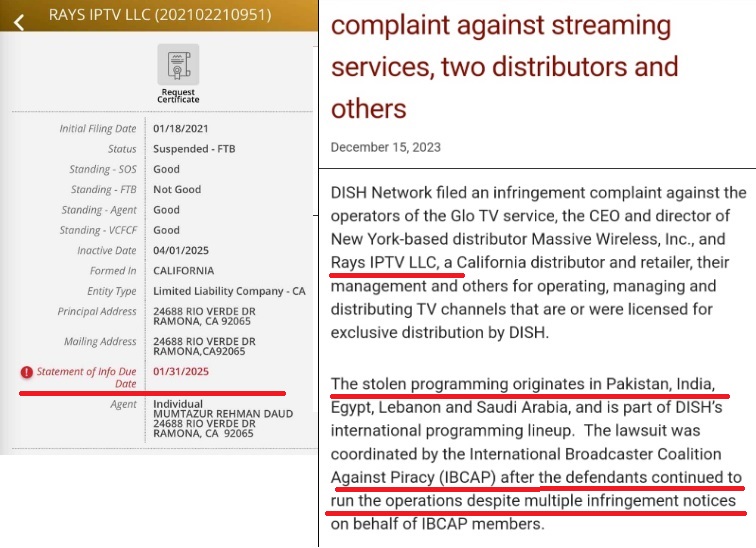
Two LinkedIn profiles were found under Mumtazur Rahman’s name. One had only four connections, while the other had 16. The company he claimed to be CEO of has no website or formal registration records. Further investigations revealed several companies linked to his name:
1.DAUD IT LTD – A company he claimed to have managed since 2003, but no registration details could be found.
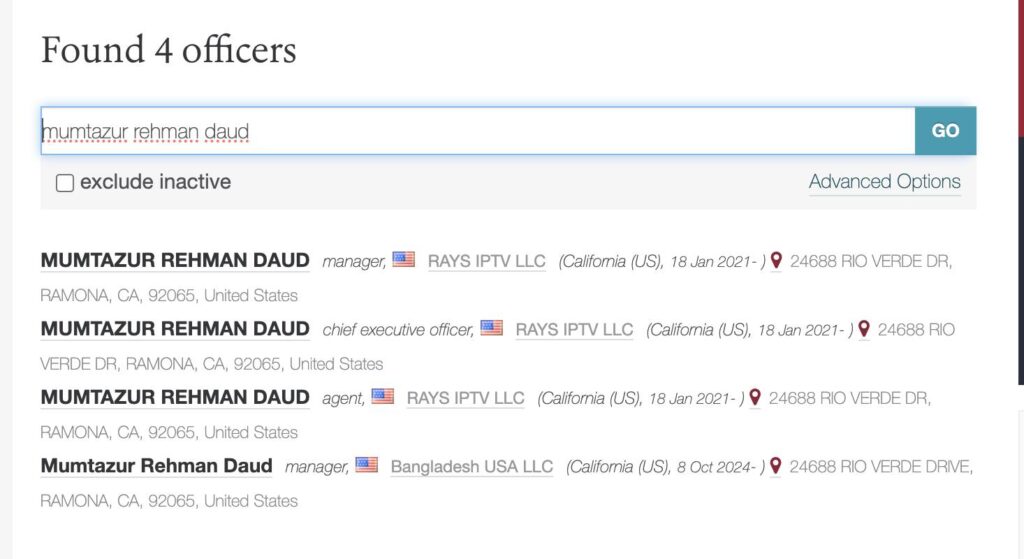
2.RAYS IPTV LLC – Registered in the U.S. in 2021, this company, where he is listed as manager, CEO, and agent, is currently suspended due to allegations of fraud.
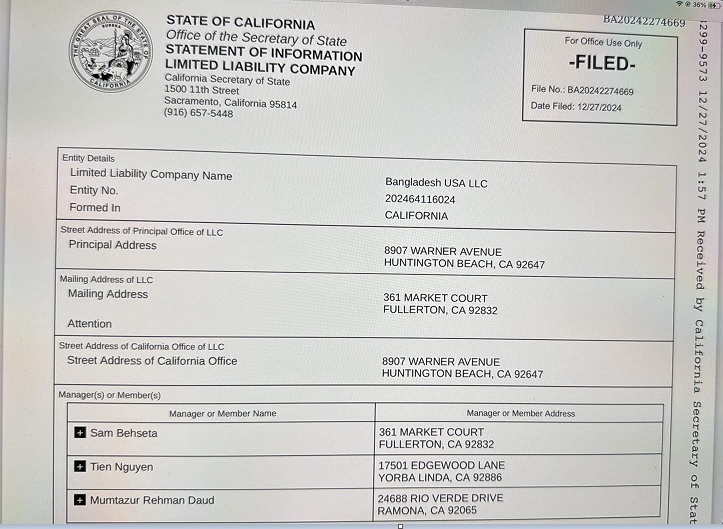
3.BANGLADESH USA LLC– Registered on October 8, 2024, in California, with Mumtazur Rahman as its manager.
Despite claiming to be a doctor, investigations revealed that Mumtazur Rahman is an IT specialist whose firm, Daud IT Ltd., was operational in Bangladesh before 2000. However, no records of its registration or operations in the last two decades could be verified.
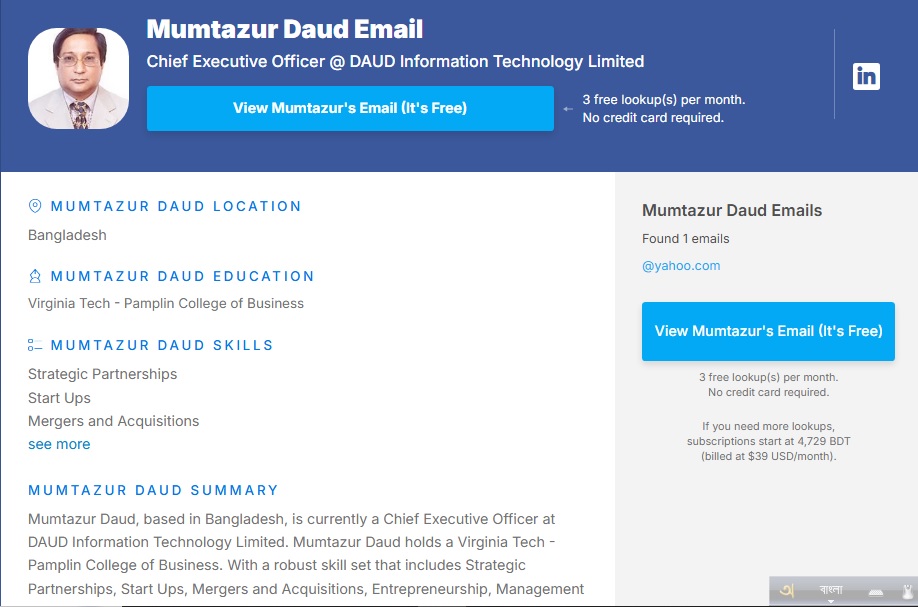
RAYS IPTV, a California-registered channel distributor, was found to be operating illegally by broadcasting channels from Pakistan, India, Egypt, Lebanon, and Saudi Arabia without authorization. Despite multiple warnings from Dish International and the International Broadcaster Coalition Against Piracy (IBCAP), RAYS IPTV continued unauthorized broadcasts, leading to legal action and its eventual suspension in January 2025.
Regarding Bengal US LLC, Dr. Daud claimed in the Somoy TV interview that his company had four partners, including Chairman Frank Chao, whom he described as a billionaire. He also mentioned partners named Sam Bohesta, a mathematician and former head of the Mathematics Department at Fullerton University, and Tien Nguyen, whom he claimed worked at NASA.
However, U.S. documents revealed no records of a Frank Chao as the chairman of Bengal US LLC or as a billionaire. A Frank Chao linked to Daud was identified as an IT professional associated with a mid-level startup named DTEN in California, unrelated to the medical or agricultural sectors.
Sam Bohesta was found on the Fullerton University website, where he worked until 2022. Tien Nguyen was identified as a Chief Engineer at NASA’s Jet Propulsion Laboratory. None of these individuals appeared to have connections to medical or agricultural fields, nor was there evidence of their affiliation with Daud or any billion-dollar investment capability.
BD Digest consulted investment experts at IDLC and several business professionals regarding Daud’s claims. All experts unanimously agreed that an individual proposing a $2.2 billion investment would need at least 50-60% equity, equivalent to assets of $1-1.5 billion. Daud’s business portfolio does not demonstrate such financial capacity, raising significant doubts.
Experts warned that such proposals often turn out to be scams aimed at securing government land at subsidized rates or obtaining specialized loans by showcasing fake projects. They emphasized the need for thorough scrutiny of investment proposals and investor credentials through embassy verification and credit reports.
Social media has been rife with skepticism and humor regarding this proposal. Many who knew Daud (formerly Munna) from the 1990s shared anecdotes about his past, while others mocked his poorly constructed English with a faux American accent.
Dr. Abdun Noor Tushar posted on social media:
“In today’s world, building a 500-bed hospital costs around $5 million. With construction and equipment, the maximum cost would be around 700 million taka. Let’s assume 1 billion taka, including all additional expenses. For 50,000 beds, it would cost 20 billion taka. Then what about this 260 billion taka hospital? You get the point. Stop spreading rumors and speak the truth.”
The lack of a proper feasibility study and the questionable plans for the proposed hospital have led many to doubt the credibility of this investment and the quality of care it would provide if built.
[With IT inputs from Saifur Mishu and Shuvo Kamal]

https://stapravda.ru/20221228/reyting_samyh_populyarnyh_hostingov_v_rossii_196445.html, рейтинг хостингов России подтверждает, что выбор надежного провайдера важен для бизнеса.