
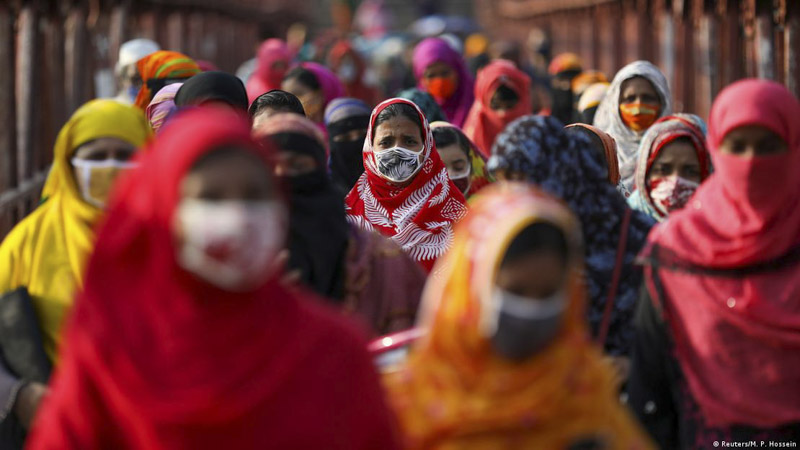

Special Correspondent. 5 October 2026. Dhaka
In the twenty years since 2006, Bangladesh has improved by 8.5 percentage points on the Global Gender Gap Inde , but in the past year alone, its score has dropped by 6.2 percentage points . Bangladesh is now ranked 79th out of 145 economies , with a gender gap of 71.2% .
This means that about 73% of the progress made in the gender gap over two decades has been erased in one year.
Global Gender Gap Index chart from 2019:
From 2019 to 2023, the score was between 71–72%, while the rank fluctuated between 50 and 71. The rank easily changes when the number of countries and the scores of other countries change. The biggest swings occurred in 2024 and 2025. 99th in 2024, 24th the next year, and then again 79th. Economic analysts say the score before the 2024 decline is the backdrop for the 2025 jump.
| Year | Rank | Score |
| 2019 | 50 | ~72.6% |
| 2020 | 50 | ~72.6% |
| 2021 | 65 | 71.9% |
| 2022 | 71 | 71.4% |
| 2023 | 59 | 72.2% |
| 2024 | 99 | 68.9% |
| 2025 | 24 | 77.5% |
| 2026 | 79 | 71.2% |
The rank has not risen consistently. In 2020, it was 50th, in 2022, 71st, and in 2025, it jumped 75 places to 24th. This time, it has fallen significantly. The number of countries in 2006 and 2026 was different (115 and 145), so the rank is not directly comparable, the score is the reliable measure.
The main reason for the decline is political empowerment. The report itself says that South Asia’s political score dropped by 1.4 points, mainly due to Bangladesh: women will make up just 2.4% of the seats in the new parliament formed after the parliament is dissolved in 2025.
Political Empowerment: 12th Place Stands on the Past
Bangladesh ranks 12th in the world in this sub-index, with a gap of 50.9%. But this is not a reflection of current politics. The picture can be understood by looking at the three indicators separately.
1. Head of State/Government: Full equality, but a thing of the past. This index is measured by the number of years in which women have been heads of state or government over the past 50 years. The global average is only 14.4%. 64 out of 145 economies have not had a female head of state during this period, and only Bangladesh and Iceland have achieved full equality. Bangladesh has maintained this full score since 2019. This score does not reflect the position of women in current parliaments or party structures.
2. Women’s participation in parliament: 2.4%, the lowest ever. The world average is 32% for parliamentary parity. The world’s middle 80% of economies score 10.8% to 76.5%, with Bangladesh now well below that range. Bolivia, Costa Rica, Mexico, Rwanda and the United Arab Emirates have reached full parity here.
3. Cabinet: 9.1% to 23.5% in 20 years. This is progress, but roughly the same as the global average (23.7%). Twelve countries, including Australia, Canada, Germany, Spain, Sweden and the UK, have achieved full parity in the cabinet.
One index has a full score (historical), one is equal to the global average, and one is the lowest. The “12” in the ranking is actually a reminder of past achievements. The answer to how much space women are now getting in the main structure of politics is 2.4% of parliament.
Economy: The biggest loss
Bangladesh ranks the weakest in economic participation and opportunity, with a gap of 41.9%.
- In one year, equality has decreased by 15 percentage points in estimated earned income, 5.7 in labor force participation, and 1.3 in senior leadership.
- Compared to 2006, equality in the labor force fell from 61.1% to 48% (−13.1) and income equality fell from 54.4% to 37.5% (−16.9).
- Women’s equality in professional and technical jobs from 33.3% to 26.2%.
Education: The most brilliant achievement of two decades
The score in education is 96.1%, the highest ever. The overall improvement is +9.3 points. Adult literacy has increased by +31.7 points and higher education enrolment has increased by +27.3 points. Parity remains in primary and secondary education, but parity in higher education is 77.1%, the largest educational gap. The score in health and survival is almost unchanged at 96.0%.
South Asia comparison
South Asia is seventh among the eight regions, closing the gap by 64.5%. The region has advanced 4.8 points since 2006, and at this rate, it will take 149 years to reach full parity.
| Bangladesh | India | Pakistan | |
|---|---|---|---|
| Overall rank | 79th | 131st | 143rd |
| Overall score | 71.2% | 64.5% | 59.5% |
| In a year | −6.2 points | Slight increase | +2.8 points |
| Since 2006 | +8.5 points | +4.3 points | +5.2 points |
| Economic participation | 41.9% | 41.2% | 36.4% |
| Education | 96.1% | 96.6% | 91.7% |
| Political empowerment | 50.9% (12th) | 24.5% (67th) | 14.1% (107th) |
Bangladesh is far ahead of India and Pakistan overall, but only Bangladesh has seen its score drop so dramatically. The entire region lags behind in terms of economy (40.9%, the lowest of the eight regions). Bangladesh’s 41.9% is slightly above the regional average.
In politics, Bangladesh has 50.9%, double that of India , but in parliament, India has 16.1% and Bangladesh has 2.4%. In terms of parliament, Bangladesh is now lagging behind its two neighbors.
The Maldives is the country with the highest score increase in the world (+4.4 points). Of the 97 economies that have been in the index since 2006, only Sri Lanka’s score did not improve from its starting position.
Bangladesh is still ahead overall compared to India and Pakistan in South Asia,
but only Bangladesh’s score has fallen so significantly.
There are achievements in education, but they are not translating into the labor market and income, on the contrary, they are being eroded. While the past presence of women in the highest positions in politics is shown in the index as bright, women are almost absent in the legislature. Bangladesh is still ahead in South Asia, but losing almost three-quarters of two decades of progress in one year shows how fragile the achievements are. The ranking cannot be sustained on past achievements; structural changes will be needed in parliament and the labor market.
This gap is the key question facing Bangladesh. The rankings fluctuate, but the 2.4% decline in parliament and the decline in the labor market are not statistical aberrations, they are the result of policies and structures. The same long-term and specific initiatives are needed to ensure women’s participation in politics and the economy that have paid off in the past two decades. Otherwise, the rankings cannot be sustained on the basis of past achievements, and the 149-year track record of South Asia reaching full equality could slip further.

https://stapravda.ru/20221228/reyting_samyh_populyarnyh_hostingov_v_rossii_196445.html, рейтинг хостингов России подтверждает, что выбор надежного провайдера важен для бизнеса.