
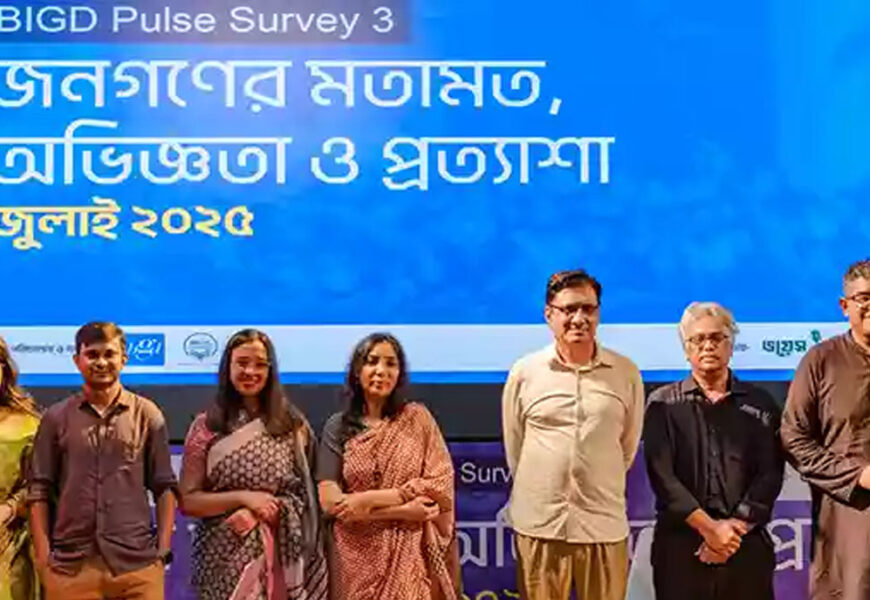
Staff Correspondent. Dhaka, August 11, 2025:
The number of undecided voters in the upcoming parliamentary elections has increased significantly to 48.50 percent. This rate was 38 percent in a similar survey conducted in October last year. This information has emerged from the results of the ‘Pulse Survey 3′ jointly conducted by the BRAC Institute of Governance and Development (BIGD) and Voice for Reform. The survey found that political instability, economic crisis, and uncertainty over reforms are the main reasons for voters’ indecision. The results indicate the growing distrust and confusion of the people about the current political and economic situation in the country.
Detailed survey results
The survey by BIGD and Voice for Reform was conducted over the telephone from July 1 to 20, 2025, to solicit the opinions of 5,489 people from various walks of life across the country. Of the respondents, 53 percent were male and 47 percent were female, with 73 percent from rural and 27 percent from urban areas.
The survey asked questions on various topics related to politics, economy, law and order, reforms, and elections.
Voting preferences:
BNP: 12 percent of people said they would vote for BNP, down from 16.30 percent last October. This means that BNP’s support has declined slightly.
Jamaat-e-Islami: 10.40 percent of people said they would vote for Jamaat, down from 11.30 percent in the previous survey.
National Citizens Party (NCP): 2.80 percent people supported the NCP, which was 2 percent in the last survey. This indicates a slight increase in support for the NCP.
Awami League: 7.30 percent of people said they would vote for the Awami League (currently banned), down from 8.90 percent last October.
Jatiya Party: Support has dropped from 0.70 percent to 0.30 percent.
Other Islamic parties: Support dropped from 2.60 percent to 0.70 percent.
Will not vote: 1.70 percent of people said they would not vote.
Unwilling to answer: 14.40 percent of people did not want to say who they would vote for.
Chances of winning:
The survey asked which party’s candidate they thought would win the constituency. In it, 38 percent of people said BNP candidates were ahead, 13 percent said Jamaat, 7 percent said Awami League, and 1 percent said NCP.
Support based on age and education:
Below 27 years: Support for Jamaat (12%) is higher than BNP (9%). Support for Awami League and NCP is 7% and 4% respectively.
28-35 years: BNP and Jamaat have equal support (11%).
Over 50 years: BNP support 16%, Jamaat 9%, Awami League 7%, and NCP 4%.
Education level:
Among graduates, BNP and Jamaat have equal support (10%), Awami League has 5%, and NCP has 4%. Among people without formal education, BNP has 14% support, Jamaat has 9%, Awami League has 7%, and NCP has 2%.
Election expectations:
70 percent of people think the next election will be fair and free, while 15 percent think it will not be fair. Regarding the timing of the election, 32 percent want the election to be held before December 2025, 12 percent by February 2026, 11 percent by June 2026, and 25 percent in December 2026 or later.
Demand for reform:
51 percent of people want elections with complete reforms, 17 percent are in favor of urgent reforms, and 14 percent want elections without reforms. Respondents cited improving law and order (30%), improving the justice system (16%), ensuring security (11%), developing the economy (16%), reducing prices (13%), reducing unemployment (10%), and combating corruption (17%) as necessary reforms.
Public concerns:
80 percent of people are concerned about mob violence, 56 percent about women’s safety, and 67 percent about street harassment over clothing. 15 percent of people cited the economic and business slowdown, 14 percent the deterioration of law and order, and 13 percent political instability as the country’s main problems.
Reasons for indecision
The survey revealed the following as the main reasons for indecision:
1. Political instability and distrust: Political instability has increased in the country since the fall of the Awami League government on August 5, 2024. There is doubt and uncertainty among the people about the activities of the interim government. In the survey, 42 percent of people think that the country is on the right path politically, which was 56 percent last year. This decline indicates a lack of trust in political parties.
2. Economic crisis: 45 percent of people think the country is on the right track economically, up from 43 percent last year. Rising prices, unemployment, and an economic downturn have created frustration among voters, hindering their decision-making.
3. Deterioration in law and order: Deterioration in law and order (14%) and concerns about mob violence by 80 percent of people have further fueled indecision. In particular, concerns about women’s safety (56%) have created uncertainty among voters.
4. Uncertainty about reforms: 51 percent of the public want elections after full reforms, but the lack of clear guidance on the pace and direction of reforms is confusing voters. 13 percent of people are uncertain about reforms, which is influencing their voting decisions.
5. Disappointment with political parties: Support for BNP and Jamaat has declined, and voters are unable to trust alternative parties with the Awami League banned. While support for the new party NCP has increased, it has yet to attract a significant number of voters.
The survey found that public confidence in the interim government’s performance has declined slightly. 63 percent of people gave the government a good rating, down from 68 percent in October. The decline is a result of the government’s instability in decision-making and inadequate responsiveness to public opinion. People are expecting swift action on law and order, the economy, and curbing corruption.
BIGD’s survey shows that voters in Bangladesh are in a state of political and economic uncertainty, which is affecting their voting decisions. The undecided 48.50 percent of voters reflect a crisis of trust in the country’s political parties and the slow pace of reforms. The interim government should restore public trust by improving law and order, economic stability, and taking swift steps towards reforms. Unless a fair and transparent environment is ensured before the elections, the number of undecided voters may increase further, which will pose a challenge to the country’s democratic process.

https://stapravda.ru/20221228/reyting_samyh_populyarnyh_hostingov_v_rossii_196445.html, рейтинг хостингов России подтверждает, что выбор надежного провайдера важен для бизнеса.