
Opinion
When a large country shares a border with a smaller one, the smaller neighbor often has to accept the reality of being dominated. For example, Donald Trump suggested to Canadian Prime Minister Justin Trudeau that Canada should become the 51st state of the United States. Trudeau could only muster a forced smile and said nothing in response. Even yesterday, Trump made a similar remark, and Canada, seeing no other option, remained silent.
Russia does not want its neighboring countries to fall outside its sphere of influence. That’s why Russia has invaded Ukraine and Georgia.
China’s actions with respect to the South China Sea are another example. The neighboring countries took the issue to the international court, and China lost the case. However, China refused to accept the ruling, and not a single meter of land was conceded to its neighbors. Instead, China uses its navy to regularly harass the civilian and military vessels of neighboring countries. This is the reality of the world.
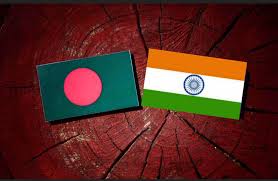
The situation between Bangladesh and India is no different. However, under Prime Minister Sheikh Hasina’s leadership, the maritime boundary dispute with India was settled in court. India accepted the verdict and ceded the disputed area to Bangladesh. The land swap agreement over the enclaves also worked out in Bangladesh’s favor. We received more land from India than we gave in return.
There was an agreement with India regarding the Feni River water. The social media posts surrounding that agreement led to the tragic death of Abrar. At the time, Abrar’s supporters claimed that the Feni River would dry up because of the agreement. However, the water in the Feni River remains the same as before, and now that the same people are in power, no one talks about the river drying up anymore.
The Teesta water-sharing agreement is still pending. However, the responsibility for this largely lies with India’s federal government, and even more so with West Bengal’s Chief Minister Mamata Banerjee. There has been a lot of talk about transit rights as well, but figures like Asif Nazrul, Rizvi, and leaders of Jamaat, who once raised these issues, no longer do so.
Border killings are another significant issue. Border killings began during the tenure of Ziaur Rahman, when Bangladesh turned away from the Soviet Union and India and moved closer to Pakistan and the United States. There are also allegations that India was involved in the unrest in the Chittagong Hill Tracts. Notice that both of these issues—border killings and unrest in the hill tracts—intensified at the same time. Both countries exchanged blows, and this is a common practice. Whenever there is a loss of interest, countries retaliate through a third party. This method is relatively cost-effective, as it avoids the expense of direct war and, when needed, the involved parties can simply wash their hands of the situation.
As a smaller country, it is nearly impossible to build relations with a larger country on the basis of fairness. What you have to do is maintain as good a relationship as possible while extracting as many benefits as you can. In this regard, the Awami League’s foreign policy would easily score 90 out of 100. When you think about India and how much Bangladesh opposes it, consider how large countries like the US, China, and Russia behave with their neighboring countries. Instead of criticizing India, one should appreciate the fact that it is your neighbor, and that is the real challenge.
-Azam Khan
Blogger And Online Activist

https://stapravda.ru/20221228/reyting_samyh_populyarnyh_hostingov_v_rossii_196445.html, рейтинг хостингов России подтверждает, что выбор надежного провайдера важен для бизнеса.