

Staff Correspondent. 14 November 2026
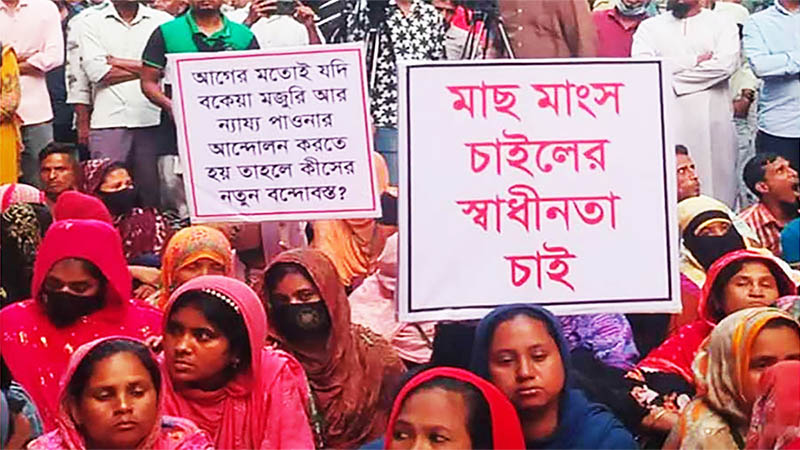
Amid ongoing labor unrest and instability in the country’s ready-made garment industry, production at 147 garment factories has stopped. Nearly 300,000 workers working in these factories have been unemployed again. The owners have announced that they will keep the factories closed indefinitely from tomorrow, Sunday (November 15) if the workers do not join work.
BGMEA President Mahmud Hasan Khan gave this information at a press conference after an emergency meeting of BGMEA and Bangladesh Knitwear Manufacturers and Exporters Association (BKMEA) at the Bangladesh Garment Manufacturers and Exporters Association (BGMEA) office in Uttara, Dhaka, on Saturday (November 14).
He said that as of Saturday, production activities in 147 factories were closed. Of these, 55 factories have already been officially declared closed under Section 13(1) of the Labor Act. Despite attempts to reopen the remaining 92 factories, they could not continue production as workers did not return to work.
According to the information provided by the BGMEA president, about three lakh workers are working in these closed and unproductive factories. This means that the employment and income of a large number of workers have been cut off at once due to the ongoing unrest.
No work, no wages.
The owners have said that Section 13(1) of the Labor Act will be applied in the event of factory closure. This section provides for non-payment of wages to workers while the factory is closed.
The BGMEA president said that for the past 12 to 14 days, at the request of the government and on behalf of the organization, the owners have tried their best to keep the factories running. But due to worker dissatisfaction, insecurity and disruption of production, it is not possible to keep many factories running.
According to the owners, a section of the workers are not only not working themselves, but are also obstructing others from working. They are even creating a frightening situation among the workers by leaving the factory and throwing bricks at the main gate of another factory.
However, the views of labor organizations regarding these allegations by the owners are also important.
Uncertainty also over wage board discussions
Meanwhile, amid the ongoing movement demanding a wage increase for workers, new uncertainty has arisen regarding the discussions on the Minimum Wage Board.
BGMEA and BKMEA leaders said that there are questions about the rationality of the wage board discussion if the overall safety of the factory cannot be ensured. However, the BGMEA president said that the owners will participate in the wage board meeting on November 16 and submit their written proposal.
The owners allege that a vested interest group is trying to create instability in the garment industry by exploiting the workers’ demand for a wage increase. On the other hand, the workers’ main demand is an increase in the minimum wage in line with the cost of living.
BGMEA and BKMEA leaders have sought government intervention to strengthen security in industrial areas.
New crisis in main export earning sector
The ready-made garment industry, one of Bangladesh’s major sources of foreign exchange earnings, employs about 4 million workers. Recent worker unrest, factory closures and production disruptions have already put pressure on the industry.
Earlier in early November, hundreds of garment factories in Dhaka, Gazipur and Ashulia were closed due to labor protests. After many factories returned to normal, 147 new factories closed, creating uncertainty about workers’ employment and income.
The livelihoods of nearly three lakh workers are now entangled in this crisis. New concerns have arisen over how long factories will remain closed, when workers will be able to return to work, and whether there will be an agreement between employers and workers on wage increases.

https://stapravda.ru/20221228/reyting_samyh_populyarnyh_hostingov_v_rossii_196445.html, рейтинг хостингов России подтверждает, что выбор надежного провайдера важен для бизнеса.