
Staff Correspondent
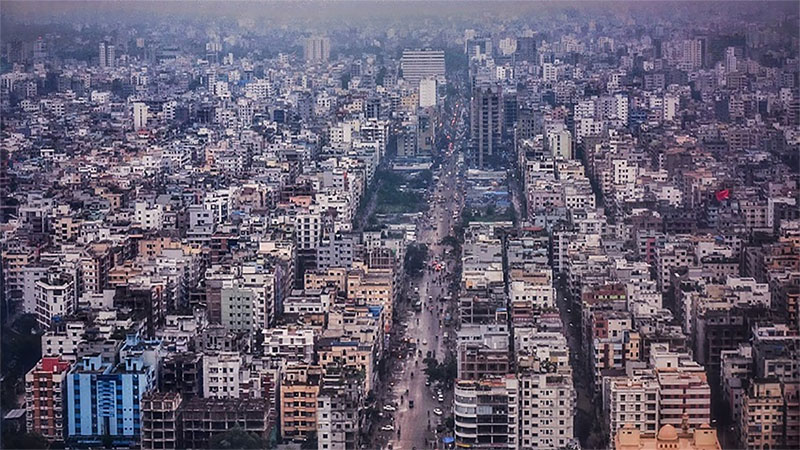
This year’s Eid-ul-Fitr came with a 9-day holiday, during which most factories in Dhaka were closed and traffic was significantly reduced. Despite the expected drop in pollution sources, residents did not experience clean air. Air quality remained unhealthy two days before Eid, on Eid day, and the day after. On average, air quality was unhealthy for five consecutive days during the holiday.
Experts say that even seven to eight years ago, air quality during Eid holidays was better than this year.
Urban planners and pollution researchers said the unhealthy air during holidays reflects the inadequacy of pollution control measures. The Center for Atmospheric Pollution Studies (CAPS) highlighted the air quality situation during Eid in its latest report.
According to the report, the average air quality index (AQI) for the five days of Eid holidays was 151. Though better than the 2024 record of 190, it still exceeds the safe threshold. The report is based on data from AirNow, a U.S.-based organization, analyzing air quality from 2016 to 2025.
Experts are now investigating why air quality remained poor despite the temporary reduction in pollution sources.
CAPS Chairman Ahmad Kamruzzaman Majumder said that although pollution during this year’s Eid was lower than last year’s, city dwellers were not protected from unhealthy air. He added that the AQI average of 151 proves sustainable and effective steps to control pollution have not been taken.
Air quality is considered good if the AQI is between 0 and 50. A range of 51 to 100 is moderate, while 101 to 150 is harmful to sensitive groups. An AQI between 151 and 200 is unhealthy, 201 to 300 is very unhealthy, and above 300 is hazardous. These thresholds are followed by both local and international organizations.
According to CAPS, Dhaka’s air quality during Eid holidays has fluctuated over the past decade. The report presented 45 days of data before and after Eid over ten years. In 2017, AQI was as low as 42 and 36 in the two days following Eid. In 2019, the AQI dropped to 37. In some years, the index exceeded 150, posing risks to the general public. On March 31, the day of Eid this year, the AQI was 151. Two days earlier, on March 29, it was 155, and the day after Eid, it stood at 150.
Air quality also varied across neighborhoods. Mirpur Eastern Housing recorded the worst AQI, followed by Kalyanpur, Moghbazar, and Mohakhali.
The primary sources of Dhaka’s pollution include factory emissions, vehicle exhaust, brick kilns, and waste burning. Although these were mostly inactive during Eid, poor air quality persisted.
Director of Air Quality Management at the Department of Environment, Md. Ziaul Haque, said that even though the main pollution sources were controlled during the holidays, the reasons behind the poor air quality must be investigated. He added that, along with local sources, cross-border airflows from neighboring regions play a major role.
Government officials frequently point to polluted air entering Bangladesh from India and Pakistan. Recently, environmental adviser Syeda Rizwana Hasan stated that 30 to 35 percent of Bangladesh’s polluted air originates from neighboring countries.
Urban planner Iqbal Habib said that Dhaka is an exposed city with widespread open construction, where sand and bricks are left uncovered. Vast areas lack greenery. So, even when people leave the city or factories close, it makes little difference in pollution levels.
Pollution in Dhaka is typically highest from November to March. In April, southern winds, nor’westers, and rain usually help reduce pollution. But meteorologists noted that this year, the pattern was different.

https://stapravda.ru/20221228/reyting_samyh_populyarnyh_hostingov_v_rossii_196445.html, рейтинг хостингов России подтверждает, что выбор надежного провайдера важен для бизнеса.