
Special Correspondent
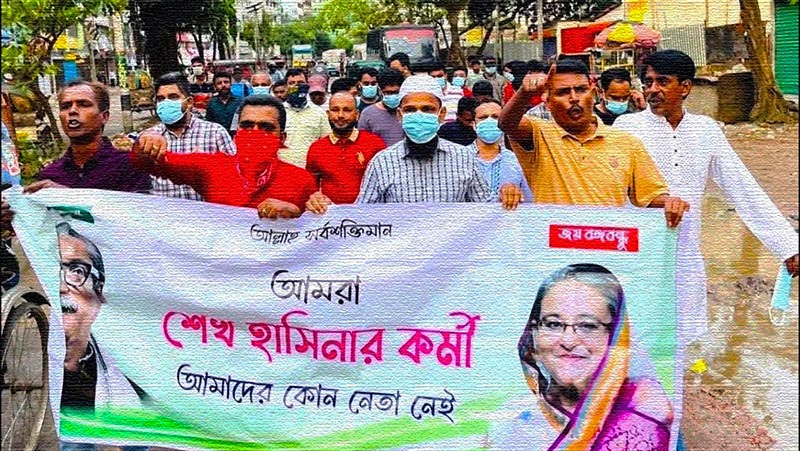
The same scene is seen on the streets of Dhaka every day—leaders and activists of the Awami League and its affiliates are marching, chanting slogans, shaking the streets with their chests. One after another, processions are taking place at different points in the capital—sometimes in Agargaon, sometimes in Dhanmondi, sometimes in Gulistan or Motijheel. The streets are filled with slogans: “Sheikh Hasina will return, Bangladesh will smile.”
Trinamool activists from different parts of the country are rushing to Dhaka to take part in these processions. Some are coming by early morning train, some by bus, some are walking or taking a lift even though they don’t have the money to pay for the fare. They are participating in the street fight without eating, without sleeping, and repeatedly crossing police barriers. Many are suffering from the fear of arrest, yet they are not backing down.
For them, this fight is not just political—it is an expression of faith in the party, loyalty to the leader, and a sense of responsibility towards the organization.
In different areas of the capital, grassroots leaders and activists of Chhatra League, Jubo League, Swechchhasebak League and Awami League are holding separate processions on their own initiative. Some are marching around specific areas, while others are doing so with their own political circles or known activists.
At the same time, followers of various central leaders are also taking out processions with banners in the names of their respective leaders. In some processions, slogans are being raised in the names of Jahangir Kabir Nanak, Bahauddin Nasim, Jubo League leader Mainul Hossain Khan Nikhil and other central leaders. However, no collective instructions, roadmap or message of standing by the field level workers is coming from any of these leaders.
As a result, these isolated marches are unable to create any effective political pressure. Instead, many activists who participate in them are being arrested and harassed, while no one is looking after them.
A former student leader who coordinated various processions in Dhaka told BD Digest, “We are constantly organizing processions in Dhaka. But we have no contact with the center. There is no way to contact us. We are organizing and holding processions ourselves.”
On the other hand, another student leader in Kolkata said, “On what basis should we go to the country? We have not been given any instructions.”
Many activists who took to the streets have been arrested, many have been sued, and some have even been injured. At the local level, many are taking up the organization’s flag despite the fear of losing their jobs, family pressure, or financial hardship. The general secretary of a union Awami League in Barisal said,
“We don’t know whether we will be arrested tomorrow, whether we will be able to return home, but we have come to stand by Sheikh Hasina. Whether the party stands by us in our troubles or not—we will be there.”
A ward-level Jubo League leader in Dhaka expressed his anger and said, “We are fighting for our lives, we are being beaten by the police, we are being sued. But nothing concrete is being said from the center, it is very difficult.”
Rabbani, a Chhatra League activist from Rajshahi, said, “My father said that the age of employment will end if you get involved in a lawsuit. But I said that you will have a job only if the country survives. That’s why I came.”
“I haven’t had a single rupee in my pocket for two days,” said Jafar, a Jubo League activist from Fatikchhari in Chittagong. “I borrowed money from a friend and came to Dhaka. We will not leave the streets for Sheikh Hasina, no matter what.” Many people gathered secretly during the procession, defying police barriers, and then quickly dispersed to avoid arrest. They developed this strategy themselves, without any central instructions.
In addition, the party’s central leadership does not seem to be interested in ensuring legal assistance to the arrested leaders and activists of the Awami League and its affiliated organizations. Recently, law enforcement agencies have arrested several leaders and activists from multiple processions of the Awami League and its affiliated organizations held in different parts of the country, including the capital. But various complications and sufferings have arisen in getting them legal assistance.
In this situation, some brave lawyers outside the formal party structure are taking their own initiative to help the arrested leaders and activists in their legal battles and fight their cases. However, they say that they are facing various types of pressure. They are being personally and professionally obstructed, threatened, and tried to create MBO (misbehavior) cases against them.
Nevertheless, these lawyers are trying to stand by the arrested leaders and activists out of responsibility to the party and humanitarian considerations. But the central leadership has not taken any initiative to stand by them or provide any kind of institutional support. This information has been learned from the lawyers.
As a result, a kind of dissatisfaction and frustration is building among the leaders and activists fighting in the field and protesting on the streets. Many feel that while the party’s central leadership is busy with political and strategic positions, their indifference to a fundamental and urgent issue like ensuring legal assistance to arrested leaders and activists is breaking the courage and morale of the grassroots.
A Supreme Court lawyer, on condition of anonymity, told BD Digest that a team of 25 lawyers is providing legal assistance to leaders and activists in the district court and a team of 12 in the High Court. He mentioned that they are running all the activities from their own personal funds. He also said that no central leader of the party has contacted them so far.
Meanwhile, the Canada-based human rights organization Global Justice Network has been standing by the persecuted Awami League workers since August 5, 2024. Kazi Mamun, a director of the organization, recently expressed his anger in a Facebook post, writing, “It is our extreme failure that we have not been able to arrange financial assistance for these children. They have been outside their homes for 15 months, not even a single fund has been made from the party. Yet how many people, such as the party editors and co-editors, are there who can fulfill their responsibilities in these matters? There are so many thousands of leaders and workers in jail. A legal support structure has not been created so far. All the help that is being provided is on private initiative. Doesn’t the leader repeatedly ask us to work? To go to the field? Where are the leaders of all the six organizations who are legally responsible for their responsibilities?” His comment makes it clear that coordinated financial and legal support has not yet been developed within the party structure, although the leadership has repeatedly called for an active role.
Political analysts believe that the Awami League’s internal organizational discipline and leadership structure are currently in a very loose state. There is a clear lack of coordination between the party’s central leadership and the grassroots.
According to them, if the top echelons of the party do not deal with this situation quickly and do not send a message of standing by the grassroots, then the morale of the grassroots may collapse, which will spell disaster for the entire organization.

https://stapravda.ru/20221228/reyting_samyh_populyarnyh_hostingov_v_rossii_196445.html, рейтинг хостингов России подтверждает, что выбор надежного провайдера важен для бизнеса.