
Opinion
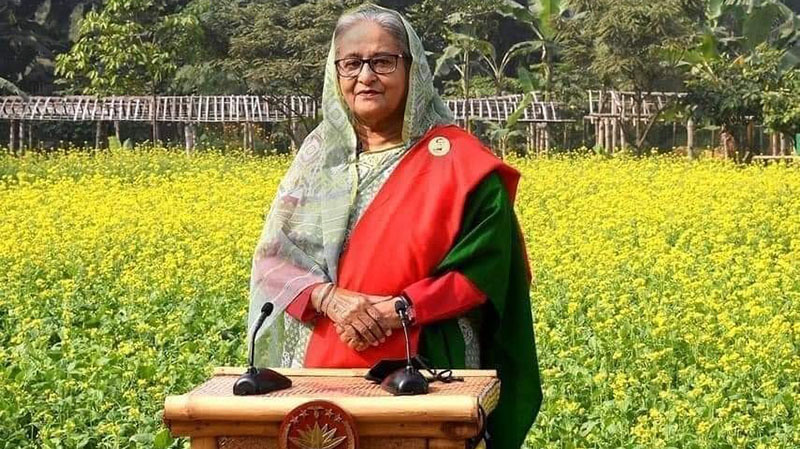
Today, September 28, is the birthday of Jananetri Sheikh Hasina. This day is not just the birth anniversary of a political leader; it is the birthday of an indomitable human being who symbolizes the struggle to change the fate of millions of ordinary people of Bangladesh, the birthday of an indomitable human being who dedicated her life to building a country with the bright glow of development, overcoming hardships. She is none other than the incarnation of the Father of the Bengali Nation, the architect of Bangladesh, Sheikh Mujibur Rahman.
When the Father of the Nation Bangabandhu and all his family members were brutally murdered by vampires on August 15, 1975, Sheikh Hasina went into exile with her only sister. Suddenly, at such a heartbreaking brutal murder and the loss of all her family members except her younger sister, Sheikh Hasina, the beloved of Bengalis, was shocked and distraught. But she did not break down.
After the assassination of Bangabandhu, the Bangladesh Krishak Sramik Awami League, built on the wisdom and experience of Bangabandhu’s lifetime, was banned. During this time, Sheikh Hasina had to face adventurous and political challenges, which later strengthened her leadership. Then in 1981, she took over the leadership of the Bangladesh Awami League, returned to the country and led the Awami League on the path of reconstruction and struggle.
After a long struggle, sacrifice and hardship, under her leadership, the Bangladesh Awami League came to power for the first time in 1996 after seventy-five years. As the Prime Minister of Bangladesh, she firmly accepted the promise of freedom from hunger and poverty. The main focus of Sheikh Hasina’s politics was to fulfill the dreams of the rural, working people. She not only built the country’s economy on a solid foundation, but also made arrangements so that the benefits of that economy reached the doorsteps of the most marginalized people.
At one time, the country’s poverty rate was about 60 percent. Under his consistent leadership in 1996 and thereafter, Bangladesh’s poverty rate came down to 18 percent. Among the South Asian countries, Bangladesh plays a unique role in poverty alleviation. This number is not small; it means that crores of people have been freed from the grip of extreme poverty today.
The Ashrayan project is one of his most humanitarian initiatives. Lakhs of homeless families have been provided with houses and land. This humanitarian reform has not only given the homeless people security, but also self-respect and self-confidence. Old age allowance, widow allowance, disability allowance, freedom fighter allowance—these social security programs have brought permanent relief and social justice to the lives of rural people.
Under Sheikh Hasina’s leadership, Bangladesh became known in the world as a “role model of development”. During her time, per capita income increased manifold, surpassing even India. Under her far-reaching plans and leadership, Bangladesh achieved the recognition of transitioning from a least developed country to a developing country by the United Nations. Due to Sheikh Hasina’s unwavering conviction, today almost every family is illuminated by the light of electricity, which has brought new momentum to the rural economy and education environment.
Many thought that the project would be halted when the World Bank withdrew funding on the eve of the construction of the Padma Bridge. But Sheikh Hasina has proved that Bangladesh can do it, that Bangladesh is self-reliant by building the Padma Bridge with her own funds. It is a symbol of national pride.
Sheikh Hasina brought this incredible revolution to the communication system across the country. Metrorail, expressways, and the development of road systems across the country have enabled Bangladesh to stand on the same footing as a modern nation in the modern world.
Under Sheikh Hasina’s leadership, Bangladesh has revolutionized the health sector. One of Sheikh Hasina’s major healthcare initiatives is the re-introduction and expansion of community clinics at the village level. She launched this project in 1998. Today, more than 14,000 community clinics are operational in the country. The World Health Organization has cited the community clinic model as an example for developing countries. The maternal mortality rate has decreased from 488 per lakh in 2000 to about 161 today (UNFPA, WHO). The infant mortality rate has also decreased significantly; currently, the infant mortality rate has dropped below 21 per thousand. Bangladesh has provided more than 300 million doses of vaccines during the COVID-19 pandemic, which is one of the biggest successes in South Asia.
Through the ‘Digital Bangladesh’ vision, Sheikh Hasina started the work of building a modern foundation for the future generations of the country. As a result, today, people in villages outside the cities are also getting government services from home, freelancers are earning foreign currency, the communication system has been greatly improved due to the internet and mobile phones, and the younger generation is moving forward with technology. To further advance this success, she expressed her determination to build a ‘Smart Bangladesh’. Sheikh Hasina set a goal of making Bangladesh a developed nation by 2041.
When we judge Sheikh Hasina’s work through facts and data, we see that the numbers here are not just statistics, but the realization of the cherished intentions, hopes, and dreams of the 180 million people of Bangladesh.
Bangladesh is going through a complex political and social turmoil today. Since the removal of the country’s heroine Sheikh Hasina from power on August 5 last year through domestic and international conspiracies, extreme anarchy has descended on Bangladesh. The illegal interim government led by Dr. Muhammad Yunus is leading a reign of undemocratic, oppression and mob terrorism in Bangladesh. The continuity of development during Sheikh Hasina’s time has stopped, the fundamental rights of the people have been curtailed and the future of the nation has been plunged into an uncertain darkness.
The economic picture is even more worrying. Under Sheikh Hasina’s leadership, Bangladesh maintained a growth rate of 6-7%, foreign reserves once reached $48 billion, and the poverty rate fell below 19 percent. Today, all those achievements have faded. The value of the currency has decreased, and the rise in commodity prices has made life unbearable for the common man.
Reactionary and defeated forces of the liberation war have formed an alliance to prevent the liberation war, constitution and fundamental principles of Bangladesh. The leading party of independence, Bangladesh Awami League and its affiliated organizations have been banned. Numerous leaders and activists have been killed. Thousands of leaders and activists have been arrested, tortured, evicted from their homes and subjected to repression. Democracy is practically stagnant due to suppression of opposition views, censorship in the media and extrajudicial killings. Religious extremists and conspirators are using a politically empty Bangladesh as an opportunity. Immense torture and suppression against Hindus and people of other religions and beliefs are daily occurrences.
The education and health sectors are also on the verge of collapse. Sheikh Hasina’s once successful “community clinic model”, free textbooks, and stipend programs have collapsed today. Radical student politics and budget cuts have jeopardized the quality of education. Healthcare is falling beyond the reach of the common man.
Not only for the continuity of development, but also for stability, security of every citizen and democratic governance, there is no alternative to a visionary leadership like Sheikh Hasina. She is not just a political leader, but also a guide for the progress of the nation. Sheikh Hasina’s return is essential to resolve the current great crisis in Bangladesh. Sheikh Hasina dedicated her political life to the well-being of the common people of Bangladesh. Therefore, the common people of the country, i.e. the grassroots, have united with a strong conviction to thwart the evil plans of the conspirators. The collective slogan of their collective aspirations is “Sheikh Hasina will come, Bangladesh will laugh”.
Happy birthday, the beacon of Bangladesh, our beloved “Sheikh’s daughter”! Joy Bangla.
-Ejaz Mamun

https://stapravda.ru/20221228/reyting_samyh_populyarnyh_hostingov_v_rossii_196445.html, рейтинг хостингов России подтверждает, что выбор надежного провайдера важен для бизнеса.