

❐ BD Digest Desk
A key debate is escalating in the recent discussions on the effectiveness and modernization of Chittagong Port—will hiring a foreign global operator solve the port’s problems? Citing examples of some internationally successful ports such as Singapore, Colombo, or Kai Maep, it is being said that only foreign operators can guarantee efficiency. But an analysis of the limitations of Chittagong Port shows that the source of the problems is structural, geographical, and managerial—which cannot be solved by simply changing the operator.
The navigability crisis of Chittagong Port is a long-standing problem due to its location. Due to the accumulation of silt in the channel, even with regular dredging, the maximum depth of nine and a half meters can be ensured during high tide, but during low tide it decreases to six to seven meters. As a result, large ships cannot enter the port.
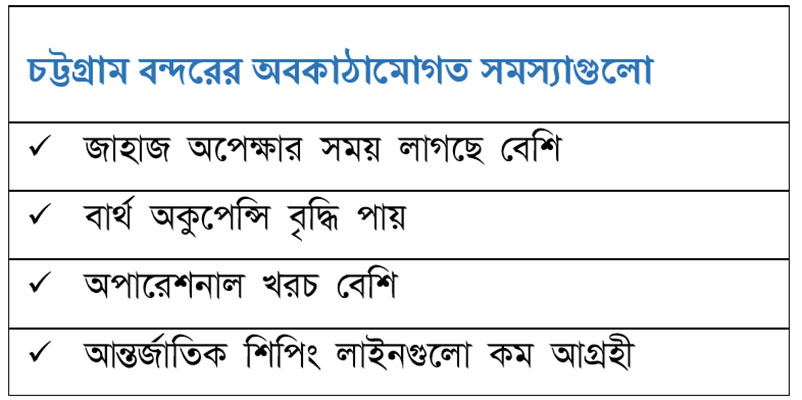
On the other hand, modern ports of international standard have a guaranteed draft of 16 to 18 meters, compared to which Chittagong is naturally lagging behind. Along with the complexity of customs procedures, weak rail-road connectivity with the country’s economic centers, and lack of adequate yards and jetties. For these reasons, the overall efficiency of Chittagong Port is not reaching the desired level.
| Port | Maximum draft |
|---|---|
| Singapore | 16 meters |
| Colombo | 18 meters |
| Kai Mep (Vietnam) | 16–18 meters |
| Saigon | 11.5 meters |
| Chittagong | 9–9.5 meters (only at high tide) |
The question is—can foreign operators overcome these geographical constraints or customs reforms or develop national-level infrastructure connectivity? The answer is clear—no. Therefore, it is not realistic to present the appointment of foreign operators as a ‘magic solution’.
In this context, another important issue has come to the fore—the leasing of Laldia Terminal to Denmark’s APM Terminals for 48 years and the questions raised about the financial structure and confidentiality of this agreement. In exchange for an investment of Tk 6,700 crore over three years, Bangladesh will give the operator the opportunity to collect fees for 45 years. However, Bangladesh could have made this investment itself, in which case the income would have been entirely for the country.
Experts say that Bangladesh was easily able to invest in the Tk 6,700 crore project from government or joint sources. In that case:
- The entire revenue from the toll would have belonged to the state.
- In the long term, port assets would remain under national control.
- The security of strategic assets would be maintained.
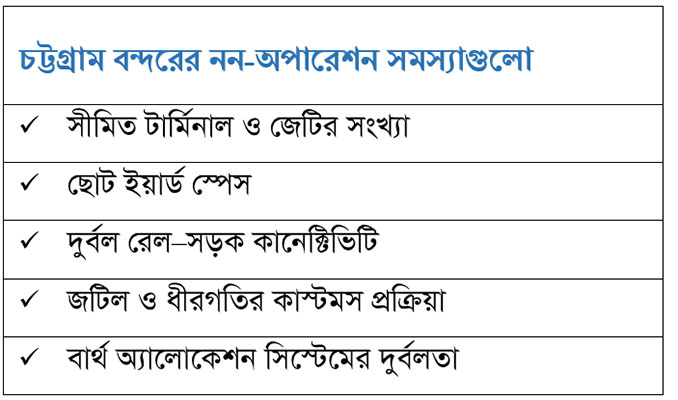
But the biggest concern is that the specific rate of fee sharing in the lease agreement and the terms of future fee increases have not been made public. The signing of such a long-term agreement by the interim government during the pre-election period has raised debates on ethical and national interest grounds.
The fears do not stop here. Recalling the experience of the previous Adani contract, many are saying that if the cancellation option in this contract is not favorable, or if conditions are included that prioritize the operator’s profits, then the situation could become complicated for the state.
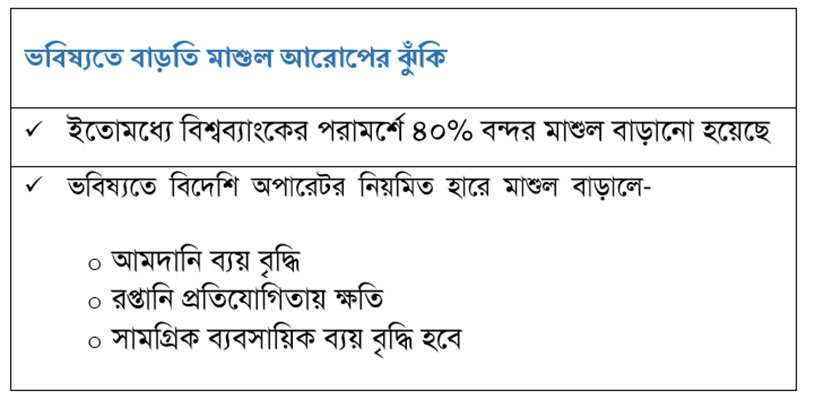
Port fees have already been increased by 40 percent on the World Bank’s recommendation, which could have an adverse impact on both import costs and export competitiveness. It is impossible to ignore that long-term leases are not only economically, but also politically and strategically serious decisions.
Dr. Yunus’ interim government claims that they are completing the agreement in accordance with the G2G procedure. But the information received suggests that the standards of democratic oversight or protection of national interests that should be followed in such an important agreement have not been met.
There are allegations that the decision on the two terminals was finalized on the same day in a hurry during a weekend. Most members of the evaluation committee were not informed in advance of the decision.
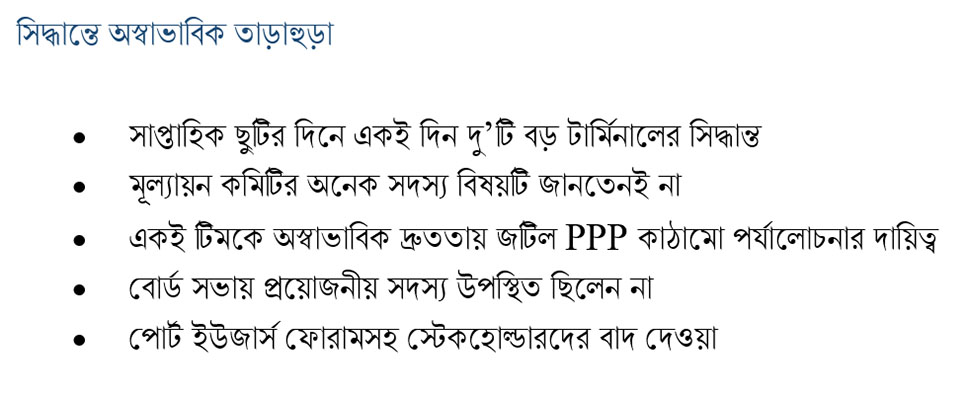
The full team meeting required to review the complex PPP concession agreement has not taken place. Port user organizations have been kept out of the entire process. Even documents have been sent through the Ministry of Shipping and the Ministry of Law with such speed that normal administrative procedures are questioned.
A real-world example of the potential risks of entrusting a multinational operator with strategic port management is the case of the East African country of Djibouti, where a 30-year concession agreement with DP World posed a threat to sovereignty; the operator controlled the board despite being a minority shareholder and imposed conditions preventing Djibouti from developing other ports.
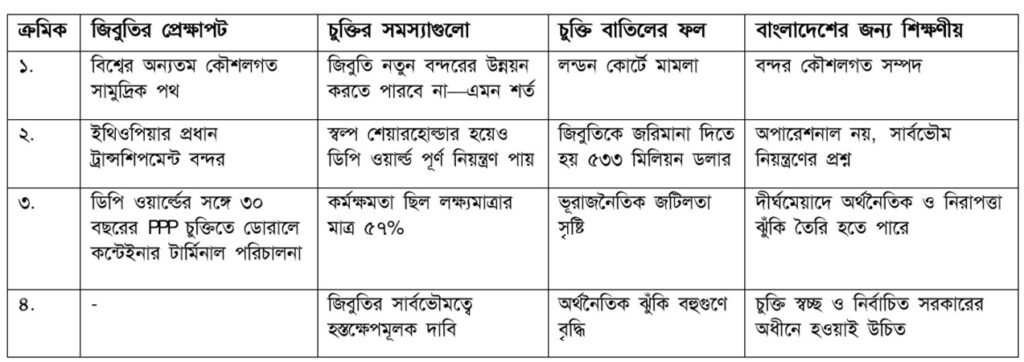
The situation became so complicated that Djibouti had to pay a fine of $533 million in an international court to cancel the agreement. The main lesson is clear—foreign companies gaining control of strategic port infrastructure creates legal, financial, and geopolitical risks that can jeopardize long-term national interests.
This experience also warns Bangladesh. Long-term strategic decisions should be made through discussions in an elected parliament, based on national consensus. With elections just months away, the haste and opacity of an unelected interim government to sign important agreements raises questions about policy, accountability, and national security—all in all areas.
Chittagong Port reform is certainly necessary, but that reform must be done considering geographical realities, infrastructure development, customs modernization, port-economic hub connectivity, and long-term national strategic interests. Foreign operators may be a component, but they are never the overall solution. The solution is state planning, transparency, capacity building, and policy continuity.
Bangladesh’s port policy is not just a matter of economic calculations—it is a question of sovereignty, strategic location, and the security of future generations. Therefore, any agreement should be reached through full disclosure, public consultation, and democratic accountability. Secrecy and haste can in no way be a legitimate basis for such a decision in the national interest.

https://stapravda.ru/20221228/reyting_samyh_populyarnyh_hostingov_v_rossii_196445.html, рейтинг хостингов России подтверждает, что выбор надежного провайдера важен для бизнеса.