
Ezaz Mamun
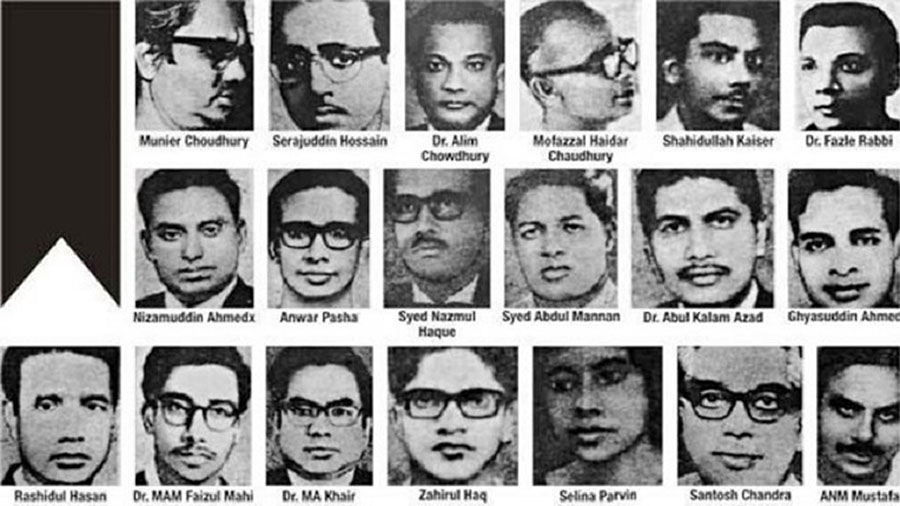
Today is Martyred Intellectuals Day. On this day in 1971, just two days before the final victory of the great Liberation War was certain, the Bengali nation lost its best sons. The Pakistani occupation forces and their local allies, the Razakars, Al-Badr, Al-Shams, brutally killed the nation’s academicians, researchers, doctors, engineers, journalists, poets, writers, and other talented and conscientious people of the nation.
The main purpose of killing intellectuals was to make the nation devoid of talent and cripple it, so that this war-torn country could not stand up. The anti-independence clique definitely understood that their defeat was inevitable. They knew that if these best sons of the nation were alive, they would have no place on this earth and this country would once again flourish, be filled with talent, technology and modernity. That is why the distinguished people were systematically killed in a demonic manner in the dark of night.
The massacre of December 14, 1971, was the most heinous and barbaric incident in the history of the world, which shocked peace-loving people around the world. After the brutal massacre, the killers left their bodies in various killing fields in Dhaka, including Mirpur and Rayerbazar.
Immediately after the victory in the Liberation War, the relatives of the martyred intellectuals and the victorious Bengalis found their mutilated and mutilated bodies in the Mirpur and Rayerbazar massacre sites. The bodies had injury marks, eyes, hands and feet were tied. Many were shot, while many were killed with sharp weapons. Many could not identify the bodies of their loved ones due to the injury marks on the bodies.

Among the prominent personalities who were murdered were Professor Munir Chowdhury (teacher, playwright), Shahidullah Kaiser (novelist, journalist), Anwar Pasha (poet, writer), Dr. Fazle Rabbi and Dr. Alim Chowdhury (doctors), Anudwaipayan Bhattacharya, Dr. Md. Murtaza, Dr. Abul Khair, Professor Rashidul Hasan, Professor Sirajul Haque and Dr. Santosh Bhattacharya (teachers at Dhaka University), journalists Sirajuddin Hossain, Selina Parveen and numerous intellectuals.
According to a nationally published compilation and international media information in 1972, the total number of martyred intellectuals was 1,070.
Identity of the planners and assassins
Among the masterminds of this heinous massacre was Major General Rao Farman Ali of the Pakistan Army, who planned to kill about 20,000 intellectuals, according to the report of the inquiry committee. He acted as the main mastermind of this barbarity.
However, to implement his blueprint, the task of preparing the list and carrying out the killings at the field level was given to the notorious paramilitary force Al-Badr formed by Jamaat-e-Islami. This force was the main task of wiping out the best sons of the Bengali nation. Chowdhury Moinuddin (operation in-charge) and Ashrafuzzaman Khan (chief executioner) were identified as the two main killers of the Al-Badr force.
After the victory on December 16, a personal diary of Ashrafuzzaman Khan was recovered from his house in Nakhalpara. Two pages of it contained the names of about 20 intellectuals along with their quarter numbers in the university, which was clear evidence of this planned murder. Not only that, according to the testimony of Ashrafuzzaman Khan’s car driver Mofizuddin, the decomposed bodies of several intellectuals were recovered from the Beel in Rayerbazar and the Sialbari massacre site in Mirpur, whom he had shot dead with his own hands.

The other main assassin, Chowdhury Moinuddin, was a member of the central committee of Jamaat-e-Islami in 1971. He used to collect the names and addresses of intellectuals from the Observer Building and deliver them to Rao Farman Ali and Brigadier Bashir Ahmed.
Apart from these main killers, many others were involved in this atrocity. Among them were ABM Khaleeq Majumder (the killer of journalist Shahidullah Kaiser and the leader of Jamaat-e-Islami in Dhaka at the time), Maulana Abdul Mannan (the killer of eminent physician Dr. Alim Chowdhury), and Abdul Quader Mollah (the killer of poet Meherunnesa).
Our martyred intellectuals were talented and stalwarts. They were the voice of the nation’s conscience. They wanted a non-communal, discrimination-free, modern and progressive Bangladesh.
Their sacrifices show us the right path in any crisis. On Martyred Intellectuals’ Day, the nation, inspired by the spirit of the Liberation War, pays deep respect to them and takes an oath to build a developed and humane Bangladesh by embracing their ideals.

https://stapravda.ru/20221228/reyting_samyh_populyarnyh_hostingov_v_rossii_196445.html, рейтинг хостингов России подтверждает, что выбор надежного провайдера важен для бизнеса.