
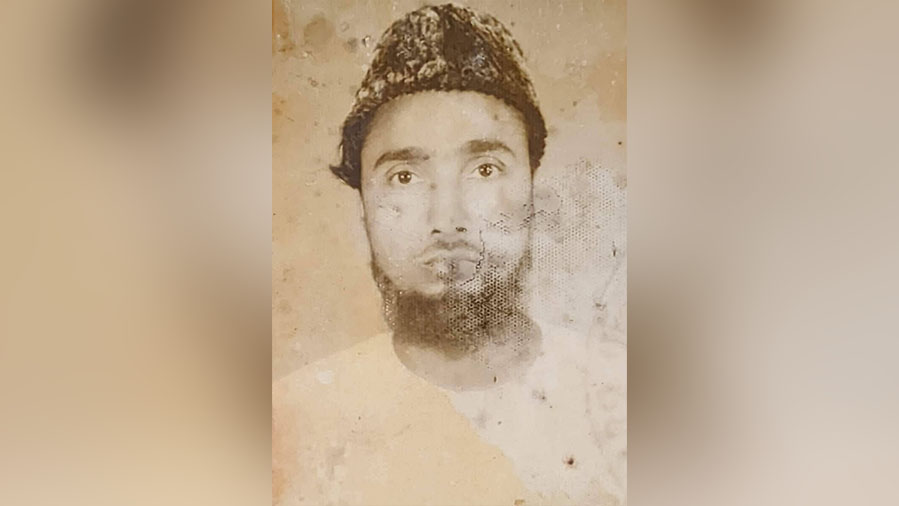
(Daily Azad, 24th February 1972)
Muqtadir Ahmed Mukta
Maulana Aliur Rahman was born on 7th February 1932 in Moyarchar village of Tukerbazar Union in Sylhet Sadar Upazila. The son of Shah Habibur Rahman Khorasani (RA), a descendant of Hazrat Kamal Uddin Shah, an associate of Hazrat Shahjalal (RA), and Ajibunnesa, Maulana Aliur Rahman was the eldest of 13 siblings. He became an Alim in 1949, third in the first division in the Fazil examination in 1951, and third in the first division in the title examination in Dawra-e-Hadith in 1953.
On February 21, 1952, Salam-Barkat were martyred when students protesting for language rights were shot at on the streets of Dhaka. Gobind Charan Park in Sylhet was also abuzz with a protest rally organized by Tamaddun Majlis. Maulana Aliur actively participated in that meeting with his uncle Professor Shafiur Rahman Khorasani. Due to his efforts, a half-day strike was also observed at Sylhet Alia Madrasa.
Maulana Aliur Rahman’s career began in 1953 as the superintendent of Ahmadiya Madrasa in Barisal. In 1954, he returned to Sylhet and began teaching at Sylhet Alia Madrasa, which he continued until 1959.
He left his job and moved to Dhaka in 1960. He worked as an Urdu and Arabic translator and researcher at the Bangla Academy for some time. During that time, he also became widely known throughout the country as a commentator. In 1965, he secured second place in the homeopathic medical certificate examination from Karachi, Pakistan and established a homeopathic medical center called ‘Arogya Kuthir’ in Jinjira, Dhaka.
After settling in Dhaka in 1960, Maulana Oliu began political activities along with writing and tafsir. He first joined the then Jamaat-e-Islami’s affiliate, the Uttehadul Ulama, and served as its provincial vice-president and Dhaka president. However, he resigned after ideological conflicts with the Jamaat-e-Islami arose.
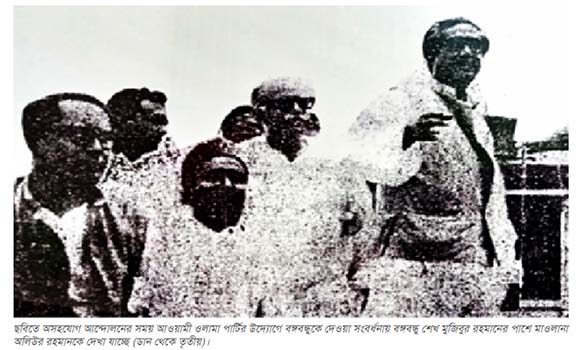
When Bangabandhu Sheikh Mujibur Rahman announced the 6-point demand in 1966, Maulana Aliur Rahman saw in these 6-point demands a document of liberation for the Bengalis. When Jamaat founder Abul Ala Maududi started campaigning against the 6-point demand, he wrote a letter to Maududi urging him to change his attitude towards the Bengalis. He also extended this appeal to the leaders of the then East Pakistan in his letter.
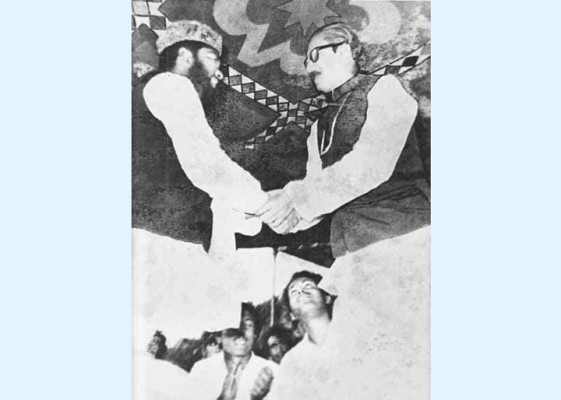
Maulana Aliur Rahman met Bangabandhu during the 6-point movement. On Bangabandhu’s instructions, he formed the ‘Awami Ulama League’. The party began working to build public opinion in favor of the 6-point demands from the very beginning.
The Ulama League was founded with four objectives: to protect the scholarly community from economic hardship and raise awareness of its rights, to establish an independent religious office in Pakistan, to continue the six-point struggle for a fair distribution of wealth between both parts of Pakistan, and to free society from exploitation and corruption.
In December 1971, Maulana Aliur was at Haji Sahabuddin’s house in Lalbagh, Dhaka. On Friday, December 10, when he went to the mosque to offer Friday prayers, a local Jamaat leader recognized him and spoke to him. Even after he returned home after the prayers, he was kept under surveillance.
The next morning, there was a knock on the door. Just as all intellectuals were taken away, the Al-Badr forces took away Maulana Aliur Rahman and Haji Sahabuddin. At night, they buried stones in a pile of bricks on the banks of Rayerbazar Lake and kept them locked in a cell during the day, and the torture continued day and night on the Maulana.
December 14, 1971. Maulana Oliur Rahman was brutally murdered by bayoneting him and gouging out his eyes. When Haji Shahabuddin was released, he returned and told everyone about the atrocity. But Maulana Oliur’s body was never found anywhere.
Maulana’s younger brother, the then instructor (later professor) of the National Institute of Public Administration, Shafiur Rahman Khorasani, searched for his brother’s body. He also published a notice in the newspaper. But his family did not find any further news or body of Maulana.
On February 24, 1972, the Daily Azad published a sub-editorial about Maulana Oliur Rahman under the title ‘They killed a religious person in the name of religion’.
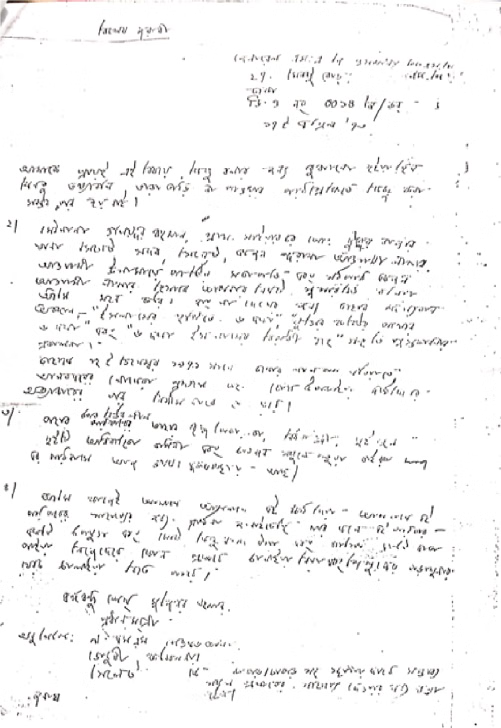
April 17, 1973. Father of the Nation Bangabandhu Sheikh Mujibur Rahman personally wrote a ‘special urgent’ letter to the then Minister General M.A.G. Osmani, a member of parliament elected from a seat in Sylhet.
In the letter he wrote:
“I think Maulana Oliur Rahman is well known to you as an old Awami Leaguer, the President of the Awami Ulama Party and above all an Awami Leaguer. His valuable contribution to Bangladesh is the publication of booklets such as ‘6 points from the perspective of Islam’, ‘6 points, the stone of logic’, and ‘6 points are not against Islam’.”
He also wrote:
“With this letter, I am asking you to help this family so that they can somehow support themselves and cover the education costs of their children by receiving a decent and substantial amount of money and a monthly allowance.”

https://stapravda.ru/20221228/reyting_samyh_populyarnyh_hostingov_v_rossii_196445.html, рейтинг хостингов России подтверждает, что выбор надежного провайдера важен для бизнеса.