

Opinion
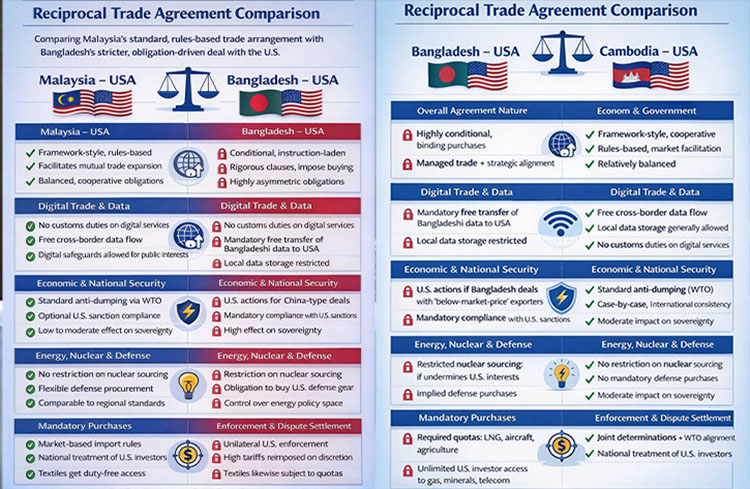
This trade agreement between Bangladesh and the United States has been shrouded in the heat of the election season. The United States recently signed a similar agreement with Malaysia and Cambodia.
But when compared to the relatively flexible and rules-based trade regime of the United States with countries like Malaysia and Cambodia, it becomes even more clear that the proposed framework for Bangladesh is much more restrictive.
According to the USTR agreement, the timeline seems to be as follows:
Agreement signed: 9 February 2026
Implementation start time: Not yet determined. Will begin after internal approvals are completed in both countries and formal exchange of notifications.
The official date the agreement enters into force: 60 days after the exchange of that notification — which could be a few weeks or even months after signing.
The question now is, will the new government approve it? Or will it restart negotiations so that we can get a more balanced agreement like Malaysia and Cambodia?
Below are some of its controversial provisions and their potential impact:
Article 3: Digital Commerce
Main points (paragraphs 3.1–3.3):
No tariffs can be imposed on US digital services.
Article 4: Economic and National Security
This is the most important and controversial part of the agreement, because it raises the question of “sovereignty.”
The gist (Articles 4.1 and 4.2): If Bangladesh does business with companies from countries that sell products “below market value,” the United States can take action. In addition, if the United States imposes sanctions on a country, Bangladesh must comply with them and implement export controls accordingly.
Possible effects:
Bangladesh may face obstacles in purchasing relatively cheap raw materials or products from China or other countries.
Bangladesh’s foreign policy could become closely aligned with US interests, reducing its ability to freely choose trading partners.
Article 4.3: Nuclear Energy and Defense
Bottom line: Bangladesh will not be able to buy nuclear reactors or fuel from any country that undermines US interests.
Possible effects:
Russian support for the Rooppur nuclear power plant or any future project may become impossible. This could pose a risk to Bangladesh’s energy security.
Section 5: Compulsory Purchase
This clause indicates a “hostage-like” obligation, as it specifies what must be purchased.
Sections 5.1 and 5.2:
US investors should be given free access to Bangladesh’s mineral resources, gas and telecommunications sectors.
Article 5.3 (Textile Sector):
Bangladesh will only get duty-free benefits in the garment sector if it imports a certain amount of cotton from the United States. There is some ambiguity here too. Link in the comments.
Article 5.4 and Annex-3 (Procurement): Bangladesh shall endeavour to procure the following goods—
Biman: Biman Bangladesh Airlines will need to purchase 14 Boeing aircraft.
Energy: $15 billion worth of US LNG to be purchased over 15 years.
Agricultural products: 700,000 tons of wheat, $1.25 billion worth of soybeans, and $3.5 billion worth of cotton will have to be imported annually.
Possible effects:
This feels more like an imposed purchasing obligation than free trade. It effectively ensures the profits of US companies, regardless of Bangladesh’s actual needs or capabilities.
Article 6: Implementation
Article 6.4: If the United States believes that Bangladesh is not complying with any of the conditions, it can reimpose the previously high tariffs.
Possible effects:
The ultimate control of the agreement will be entirely in the hands of the United States. They will effectively play both the role of judge and enforcer. The WTO has no role.
Finally, under this agreement, Bangladesh has also agreed to purchase a certain amount of US military equipment. This has the potential to increase Bangladesh’s dependence on US technology.
-Asif Saleh
Former policy specialist at the United Nations Development Programme – UNDP.

https://stapravda.ru/20221228/reyting_samyh_populyarnyh_hostingov_v_rossii_196445.html, рейтинг хостингов России подтверждает, что выбор надежного провайдера важен для бизнеса.