
❐ Special Correspondent
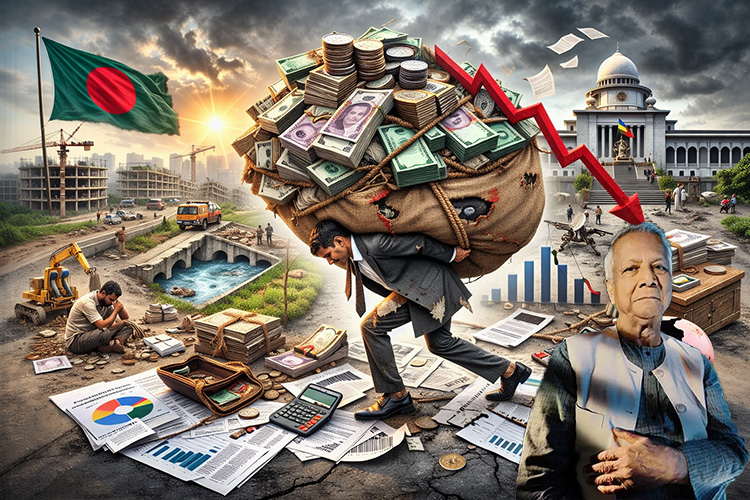
A new reality has emerged in Bangladesh’s public finances in the 2024-25 fiscal year. Despite reducing development spending, the debt pressure has not decreased; rather, the state has had to borrow to meet regular operating expenses. That is, revenue income has not been sufficient to cover salaries, allowances, interest, subsidies, and administrative expenses. In this context, the first budget for the BNP-led government, which has taken charge of a new political chapter, is becoming a tough test of the combination of financial stability and political commitment.
An economy of survival, not development
In the fiscal year 2024-25, the revenue collected was Tk 4.36 trillion, while the operating expenditure stood at Tk 4.59 trillion. This means that even excluding development projects, there has been a deficit to meet daily administrative expenses. Just to cover operating expenses, the government had to borrow Tk 23,742 crore—which economists believe is a rare occurrence in four decades.
Highlighting this picture, in a discussion at the ‘Citizens’ Platform for SDG Implementation, Bangladesh’, Toufiqul Islam Khan, Additional Research Director of the Center for Policy Dialogue, said that the country has now reached a financial stage where the big question is not development but survival. He commented that such a situation has not been seen since the time of Hussain Muhammad Ershad in the 1980s.
Debt inflation: Low development, high liabilities
According to data from the Ministry of Finance, the total government debt, both domestic and foreign, stood at Tk 2,149,444 crore as of September 30, 2025. The debt increased by Tk 2,60,257 crore in the 14 months of the outgoing interim government.
The notable thing is that during this period, development expenditure was the lowest in seven years. ADP implementation was 1 lakh 53 thousand crore taka, which is even less than a few years ago. In other words, even though development has slowed down, debt has not decreased; rather, it has increased. A large part of this has come to pay interest, subsidies and manage previous liabilities.
Foreign debt and currency pressure
In June 2022, external debt was around 495,000 crore taka. By the end of September 2025, it had increased to 951,869 crore taka—almost double. During this period, the government has received 3.44 billion dollars in budget support from development partners, including the International Monetary Fund. Due to the depreciation of the taka, the liability is becoming even larger if external debt is converted into taka, which will put pressure on future repayment capacity.
Bank-based lending and investment contraction
There has also been a major change in domestic debt. In 2022, the government’s debt from the banking sector was Tk 420,000 crore; in September 2025, it increased to Tk 777,000 crore. Borrowing through treasury bonds and bills has increased significantly.
This has had an impact on the private sector. Credit flow has fallen below 6 percent—which is worrisome for investment and employment. According to economists, as the government’s dependence on banks increases, private entrepreneurs are deprived of credit and the pace of growth slows.
Promises vs. reality in the first budget
The new government faces pressure to implement election promises—allocating 5 percent of GDP to health and education, waiving agricultural loans, expanding social security, and a new wage structure—but if revenue growth is limited, additional spending will directly increase reliance on debt.
According to economists, just the partial implementation of the new salary structure may require an additional Tk 30,000 crore. As a result, expenditure expansion without revenue reform will not be sustainable.
There is no way out except for structural reforms.
The current crisis is not temporary—it is the result of long-standing revenue weakness. It is difficult to reduce the revenue deficit without expanding the tax net, digitalizing VAT and income tax administration, rationalizing tax exemptions, and increasing the share of direct taxes.
Expenditure also needs to be re-prioritized and project evaluations need to be made. Failure to prioritize financial stability over political popularity could further exacerbate debt pressures.
The new government’s first budget is therefore not just a statement of income and expenditure; it will be a real test of fiscal discipline and policy capacity.

https://stapravda.ru/20221228/reyting_samyh_populyarnyh_hostingov_v_rossii_196445.html, рейтинг хостингов России подтверждает, что выбор надежного провайдера важен для бизнеса.