
❐ BD Digest Desk
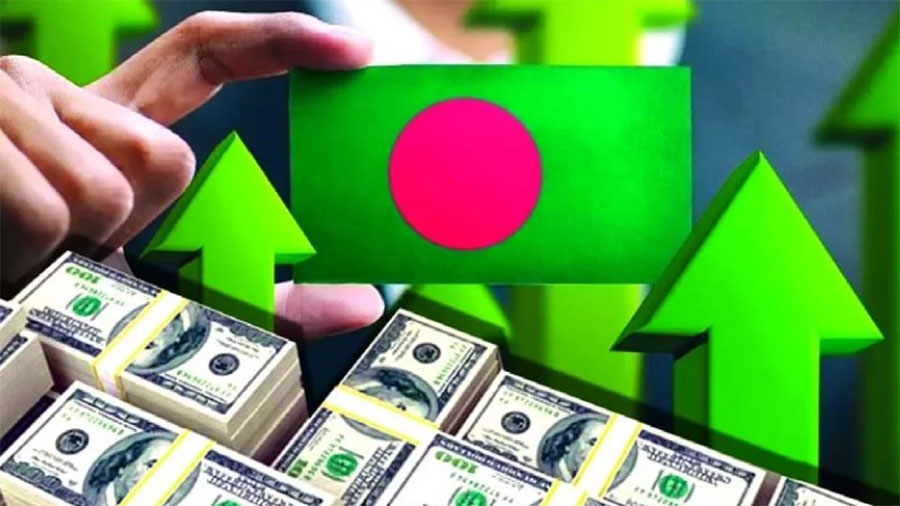
Where there was once optimism about reaching the milestone of a one and a half trillion dollar economy by 2024, the goal has now been set to build a one trillion dollar economy by 2034.
This delay of almost a decade and the simultaneous reduction in the size of the target are raising new questions about the pace, capacity, and reality of the country’s economy.
On March 14, 2023, at an event in the capital, Prime Minister Sheikh Hasina of the Awami League government said, ‘Next year we are going to touch the milestone of a one and a half trillion economy.’ Considering the timing of her speech, there was an indication that such a goal would be achieved by 2024.
However, recent economic realities are painting a different picture.
In response to a written question in the National Parliament on Monday, Finance Minister Amir Khasru Mahmud Chowdhury said that the government has set a goal to develop Bangladesh into a one trillion dollar economy by 2034. At the same time, he said that the current per capita income stands at 2,769 US dollars and emphasis is being placed on increasing investment, employment, productivity and exports to reach this goal.
Analyzing these two statements from two periods, it is clear that Bangladesh has not only fallen behind schedule in its goal of a trillion dollar economy, but has also had to reduce the scope of the target. The expectation of one and a half trillion dollars by 2024 has now settled at one trillion dollars a decade later.
This means that the target has been set at least 10 years behind in time and at least $500 billion less in size.
Economists say that both global and domestic pressures have driven this change.
Prime Minister Sheikh Hasina herself mentioned the ongoing Russia-Ukraine war, economic sanctions, and global supply shortages in her 2023 speech. These have led to an increase in fuel and food prices in the global market, which has impacted import costs, inflation, and foreign exchange reserves.
Stagnation in domestic investment, slowdown in the industrial sector, limitations in export diversification, and challenges in job creation have also become major obstacles to achieving the goal.
According to the Ministry of Finance, maintaining the desired growth requires increased productivity and a significant expansion of private investment, which has not yet reached the expected levels.
The recent stance of policymakers suggests that the government is shifting away from ambitious goals and is now focusing on more realistic plans. Accordingly, a strategy has been adopted to gradually grow the economy through IT, agro-processing, the small and medium enterprise sector, and increasing remittances.
However, the question remains as to how feasible it will be to implement this goal, which has been postponed by a decade, and whether any new adjustments will be necessary in the meantime, because global economic uncertainty, energy market volatility, and geopolitical tensions have not yet fully subsided.
Overall, while the dream of becoming a trillion-dollar economy remains intact, reality suggests that the path to achieving that goal is now longer and relatively slower.

https://stapravda.ru/20221228/reyting_samyh_populyarnyh_hostingov_v_rossii_196445.html, рейтинг хостингов России подтверждает, что выбор надежного провайдера важен для бизнеса.