
Staff Correspondent
The wave of unrest and violence that has been witnessed across the country since August 24 has clearly demonstrated the organized role of Jamaat-e-Shibir and related radical Islamist groups in a significant part of it. Investigations, cases and local accounts of various incidents show that some madrasas and religious institutions are being used not only as places of education but also as centers for political-religious mobilization and the creation of obedient workers. The active participation of local madrasa teachers and students in attacks carried out in the name of ‘Tawheedi Janata’ or ‘agitated worshippers’ has further accentuated this trend.
A recent horrific incident took place in Philipnagar of Daulatpur upazila of Kushtia. Pir Abdur Rahman Shamim was hacked and beaten to death in his Darbar Sharif. At the same time, extensive vandalism and arson were carried out in the Darbar. The names of four people, including former president of Kushtia District Chhatra Shibir and Rokon of Daulatpur Upazila Jamaat, Khwaja Ahmed, have been mentioned in the murder case. The other accused are local Jamaat activist Rajib Mistry, Daulatpur Upazila President of Khelafat Majlis Asaduzzaman Asad, and a madrasa teacher Safi. Police investigation has identified Jamaat-Shibir’s involvement with many of those who took part in the attack.
An attack was carried out by a group of ‘Tawheedi Janata’ and ‘agitated devotees’ in the Tilakpur High School ground in Akkelpur upazila of Joypurhat over a girls’ football match. The names of Abdus Samad, the khatib of Tilakpur Old Bazaar Jame Mosque, and Abu Bakkar Siddique, the director of Bachcha Haji Madrasa, came to the fore in this incident. In the subsequent public hearing, these religious leaders apologized on behalf of the attackers.
After the arrest of Baul artist Abul Sarkar on charges of religious blasphemy in Manikganj, protests were held in the name of ‘Tawhidi Janata’ and scholars-ulama. At the same time, during the human chain of his supporters, a section of ‘Tawhidi Janata’ attacked Baul devotees. The role of religious incitement and organized groups is noticeable in these incidents as well.
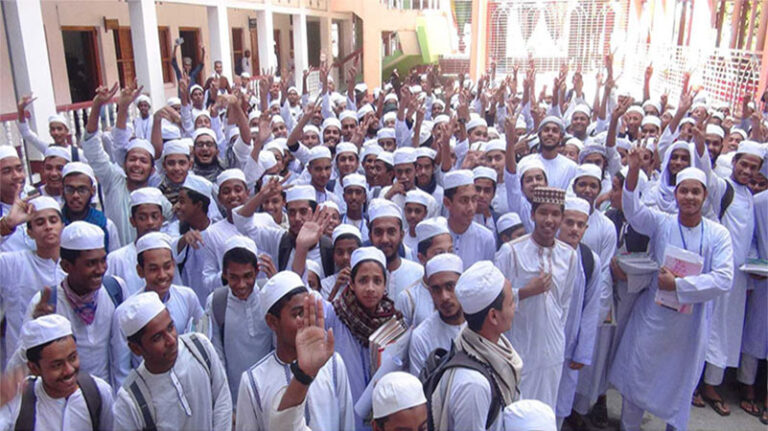
Since August 2024, the participation of madrasa students in every national, social, and political field has been clearly visible, and all of them fulfill the objectives and goals of fundamentalist political parties. The image of madrasa students as peaceful and religiously educated, unquestioning students that the country has known for so long has changed drastically in the past decade. All students educated in madrasa education are involved in religion-based party politics, and their style of protest is different from that of workers of all other political parties. News of violence, destruction, arson, and murder by madrasa students as a language of protest has been seen almost daily for the past 20 months. Madrasa students have a different position on almost every issue, be it art, literature, culture, history, tradition, different ideologies, and they cannot tolerate any position other than their own. Their own party’s political interests are also involved in this.
An important comparison needs to be made here. In general educational institutions (schools, colleges, universities), teachers influence students for political purposes, but it is usually not by force. In most cases, teachers create political awareness among students, exchange opinions, but there are relatively few cases of coercion or indoctrination into radical ideology to directly make them obedient workers of a particular party.
Students may be attracted to different political parties, but that is usually based on their own thoughts, discussions, and personal preferences.
On the other hand, the situation in the madrasa education system is completely different. Here, teachers (huzoors) often directly and forcefully indoctrinate and influence students towards radical fundamentalist politics under the guise of religious authority. The teaching of religious education is mixed with the political ideology of Jamaat-Shibir or similar groups. Through emotional slogans like ‘protecting religion’, ‘enemy of Islam’, etc., a kind of one-sided and radical idea is instilled in the minds of students. In many cases, the scope for students’ personal independent thinking is kept very limited. As a result, madrasa students often become prepared to ‘fight for religion’ without fully understanding the political context.
This difference is very worrying. In general education, students are exposed to different opinions and have the opportunity to develop their own judgment. But in madrasas, the combination of the teachers’ exclusive authority and religious sentiments easily instill radical fundamentalist politics in the minds of students. As a result, madrasas are gradually becoming training centers for producing obedient fighters for radical fundamentalist groups, including Jamaat-Shibir.
This trend is not only a misuse of the education system, but also a serious threat to the religious harmony of society, the rule of law, and the future of the young generation. The top leaders of Islamist parties should take a clear position on this issue – will they use the institutions under their influence as political tools, or will they stand against such radical mobilization?
To ensure that madrasa education becomes a place of true intellectual pursuit and moral development, it is essential to keep it free from party politics, radical incitement and student abuse. If this cycle cannot be broken through impartial investigation, strict enforcement of the law and education reforms, not only the young generation but also the stability of the entire society will suffer. Violence is not acceptable in the name of any religion—this is the demand of the hour.

https://stapravda.ru/20221228/reyting_samyh_populyarnyh_hostingov_v_rossii_196445.html, рейтинг хостингов России подтверждает, что выбор надежного провайдера важен для бизнеса.