
Special Correspondent
Dhaka, April 19, 2026: One of the main promises of the BNP-led government’s election manifesto was to introduce ‘Family Card’ to protect marginal and low-income families and ‘Krishak Card’ to ensure fair prices, subsidies, easy loans and other benefits for farmers. According to the manifesto, about 40 million families in the country will be brought under the Family Card scheme in stages, through which they will be provided with Tk 2,500 or equivalent worth of essential commodities every month. On the other hand, a target has been set to provide Krishak Cards to about 2.75 crore farmers, so that they will get facilities in fertilizer, seeds, irrigation, loans, insurance and marketing.
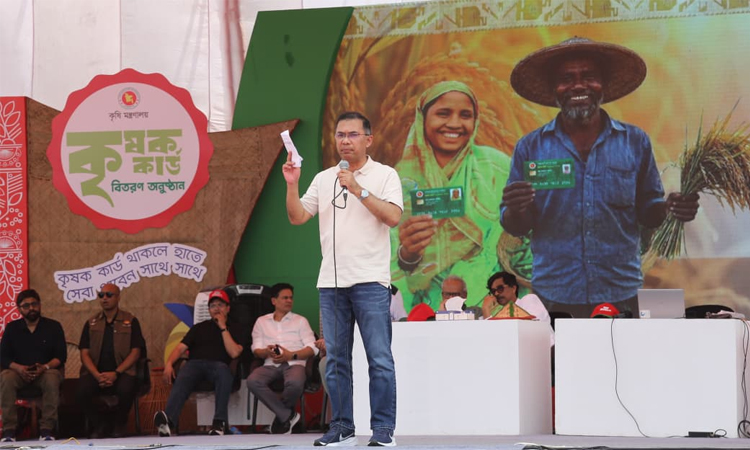
The implementation of these two ambitious programs has begun just a month and a half after coming to power. According to government data, the family card has been introduced on an experimental basis from March 10. In the first phase, about 37,567 female-headed families in 14 upazilas have been given this card. Similarly, on April 14 (Pahela Baishakh), the pre-piloting of the Krishak Card has started in 11 upazilas of 10 districts including Tangail. At this stage, about 20-22 thousand farmers (including landless, marginal and small farmers) are being given the cards, out of which about 20,671 people are to be provided with 10 types of benefits including annual financial assistance of Tk 2,500.
Analysts say this number is negligible compared to the target. Providing cards to 40 million families and 2.75 million farmers requires a huge database, digital system, distribution management and financing. But the initial ‘sloppy’ data collection and the hasty launch of the pilot project have been criticized as a marketing gimmick.
Is implementation possible under economic pressure?
There has been a huge deficit in the government’s revenue collection. In just 43 days of coming to power, the government has borrowed about 41,000 crore taka from the banking sector, which has exceeded the entire target for the current fiscal year. It is reported that this debt dependence is being spent to meet operational expenses.
At the same time, the fuel crisis has intensified. The supply of crude oil has been disrupted due to tensions in the Middle East. The country’s only state-owned oil refinery, Eastern Refinery (ERL), has been completely shut down in recent days due to lack of crude oil. Earlier, fertilizer factories have been closed due to gas shortages, which will directly affect agricultural production.
In such a situation, economists have expressed doubts about where the government will get the funding to implement the financial assistance of the Family Card (2,500 taka per family per month) and the subsidy benefits of the Krishak Card. Questions have also been raised about how feasible it is to implement the benefits of the Krishak Card, such as subsidies on fertilizers and seeds, and irrigation facilities, since the fertilizer factories are closed.
IMF says fiscal burden:
If the family card is fully implemented (for 20 million families against the target of 40 million families), it could cost around Tk 60,000 crore per year. The Ministry of Social Welfare has asked for Tk 13,000 crore for just 4 million families in the next fiscal year (2026-27). The IMF believes that such a large new expenditure is unsustainable given Bangladesh’s low tax-to-GDP ratio, debt interest payments, and pressure on other essential sectors (education, health, infrastructure). This could increase the fiscal deficit.
The IMF has suggested that a feasibility study be conducted before full implementation and that it be coordinated with existing social security programs. Otherwise, multiple benefits could be available to the same person, irregularities and inefficiency could occur. The IMF is advising Bangladesh to reduce tax exemptions, rationalize subsidies and increase revenue. They see that the high cost of fulfilling election promises may conflict with these reforms.
Government officials, including Prime Minister Tarique Rahman, say these will be implemented in stages. If the pilot project is successful, it will be fully implemented and will not increase inflation. The money is not being printed, but will circulate in the local economy. However, opposition parties and analysts believe that this hastily launched program could turn into a political campaign rather than meeting the expectations of the people if mismanagement and the economic crisis are not overcome.

https://stapravda.ru/20221228/reyting_samyh_populyarnyh_hostingov_v_rossii_196445.html, рейтинг хостингов России подтверждает, что выбор надежного провайдера важен для бизнеса.