
International Court of Justice ruling may also impact Gaza genocide trial | Gambia demands compensation from Myanmar and safe repatriation of Rohingya

Special Correspondent. Dhaka, November 17, 2026.
The International Court of Justice (ICJ), the UN’s highest court, is set to deliver a historic ruling on Thursday (November 19) on whether Myanmar’s military campaign against the Rohingya Muslim population constituted genocide. The ruling could have a significant impact not only on Myanmar’s international responsibility but also on the future, safe repatriation and resolution of the long-running Rohingya crisis for more than 1.2 million Rohingya refugees in Bangladesh.
The ICJ ruling could be a landmark example of how international law establishes state responsibility for genocide, and could also have implications for a South African case against Israel over the Gaza massacre, Reuters reported on Tuesday.
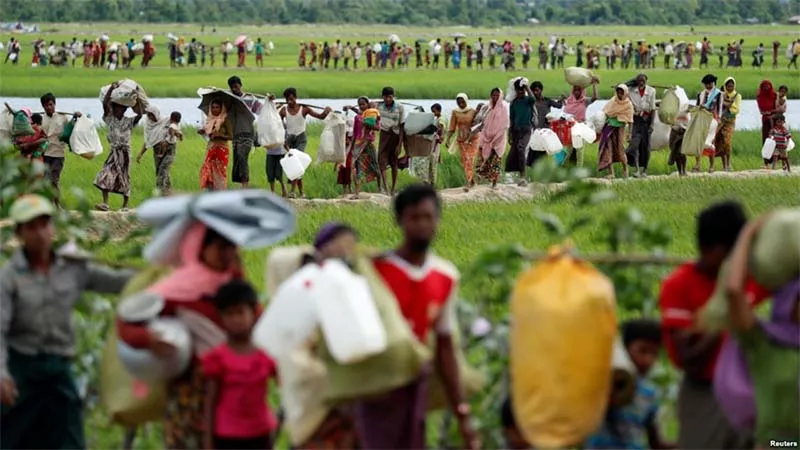
In 2019, the West African country of Gambia filed a case against Myanmar at the ICJ. The complaint states that the Myanmar military’s campaign in Rakhine State in 2017 was a genocidal campaign aimed at destroying the Rohingya population. During that campaign, at least 730,000 Rohingya were forced to flee to Bangladesh to save their lives.
The campaign has been accused of killings, gang rapes, sexual violence, burning of villages and widespread torture against Rohingya. A UN fact-finding mission has also found evidence of genocidal acts. Myanmar has consistently denied the allegations of genocide, saying the campaign was a legitimate military operation against armed insurgents.
What will the court look for to prove responsibility for genocide?
The most important factor in international law when proving genocide is establishing the specific intent to destroy, in whole or in part, a population, in addition to the commission of the crime.
According to the 1948 Convention on the Prevention and Punishment of Genocide, acts committed with intent to destroy, in whole or in part, a national, ethnical, racial or religious group, such as killing, causing serious bodily or mental harm, inflicting life-threatening conditions, imposing forced birth control, or transferring children to another group may constitute genocide.
According to the Reuters report, the court’s judges will specifically consider how the UN investigation report, the continuity of military actions, crimes against women and children, and mass killings are assessed to prove the intent of the genocide.
According to Melanie O’Brien, a professor of international law at the University of Western Australia, there are several legal similarities between the Myanmar case and the ongoing case against Israel in Gaza. In particular, the denial of genocide charges by presenting the military operation as a security or counter-terrorism operation is significant in both cases.
Priya Pillai, an international lawyer and head of the Asia Justice Coalition, said the verdict in this case will have implications for other genocide cases.

Myanmar’s Union Minister for the President’s Office, Ko Ko Hlaing, sits in a courtroom during the hearing of an important case filed by Gambia.
How will the future of 1.2 million Rohingya in Bangladesh be affected?
The case against Myanmar may have the most direct impact on Rohingya refugees seeking refuge in Bangladesh.
At least 730,000 Rohingya who took refuge in Bangladesh after the 2017 military campaign, along with new arrivals, currently number about 1.2 million Rohingya living in Cox’s Bazar and surrounding areas. They have long been living in inhumane conditions in one of the world’s largest refugee camps.
The Reuters report highlights the experience of Hasina Khatun, a 34-year-old Rohingya woman living in Cox’s Bazar. She lost her husband and brother in the 2017 In-Din massacre. She was pregnant at the time of her husband’s death. She now lives with her three children in a 9-by-12-foot shelter made of bamboo and plastic.
He told Reuters they had been waiting for this ruling for a long time. They hoped the court’s ruling would pave the way for justice and allow them to return to Myanmar with dignity, security, citizenship and full rights.
This ruling could potentially lead to some important changes in the Rohingya crisis in Bangladesh.
1. International pressure on Myanmar will increase
If the court upholds the genocide charges against Myanmar, international pressure on the country’s military and state authorities could increase manifold. Establishing state responsibility under the Genocide Convention will further strengthen the question of ensuring the safety, rights and protection of the Rohingya.
2. The legal basis for the demand for safe repatriation will be strengthened
Gambia has not only asked the court to determine responsibility for genocide; it has also demanded that the Rohingya return safely and with dignity. The case also demands the return of their lost property, family reunion, medical and psychological rehabilitation, and the right to live and earn a living freely in Myanmar.
The court’s decision on such claims could create important diplomatic and legal groundwork for Bangladesh.
3. A path to compensation may be created
Gambia has also filed a claim for compensation from Myanmar. If the court determines liability for compensation, it will strengthen the international recognition of the individual and collective losses suffered by the Rohingya and their demand for economic compensation for rehabilitation.
Bangladesh has long borne the costs of shelter, food, medical care, security and humanitarian assistance for the Rohingya. As a result, Bangladesh also has a vital interest in the issue of compensation and rehabilitation.
4. Bangladesh’s diplomatic position on Rohingya repatriation may be strengthened
The Rohingya crisis is not just a humanitarian problem for Bangladesh; it is also a major challenge in terms of national security, economy, border management, and regional stability.
If the international court establishes genocide liability, Bangladesh will be able to more strongly highlight this position at the international level, stating that repatriation cannot be implemented without ensuring the citizenship, security, and fundamental rights of the Rohingya.
However, repatriation will not automatically begin with the court ruling. The political situation in Myanmar, control of the military, security in Rakhine State, and ensuring citizenship and rights for the Rohingya will still remain major obstacles.
It could also be an important precedent in the Gaza genocide case.
Another important aspect of this case against Myanmar is that its legal implications could also have implications for the genocide case filed by South Africa against Israel in Gaza.
In 2023, South Africa filed a case against Israel at the ICJ alleging violations of the Genocide Convention. Israel has denied the allegations.
The types of evidence the court considers in determining the intent of genocide in the Myanmar case, how it assesses the continuity of military operations, and how it considers crimes committed against women and children—these issues may also be important in the judicial analysis of the Gaza case.
The verdict is final, but implementation is the big challenge
The International Court of Justice is the principal judicial organ of the United Nations. It tries states for violating international treaties. The International Criminal Court (ICC) tries individuals for crimes. As a result, although the ICJ case found the Myanmar state responsible, it does not have the jurisdiction to impose criminal penalties on individual military officials.
The ICJ’s ruling is final and cannot be appealed. However, implementing the ruling and ensuring things like compensation or repatriation are a major challenge.
For Bangladesh, the November 19 verdict is not just an international judicial decision; it is a crucial moment in determining the future of the Rohingya crisis that has been going on for eight to nine years.
The ruling could open a new door to international recognition and justice for the millions of people fleeing Rakhine, Myanmar, for their lives. And for Bangladesh, it could be an opportunity to engage the international community more effectively in resolving one of the world’s long-running refugee crises.
Original source: Reuters — Top UN court ruling on Myanmar genocide to be watched for clues on Gaza, 17 November 2026. Additional legal context: Human Rights Watch — International Court of Justice Judgment in Myanmar Genocide Case .

https://stapravda.ru/20221228/reyting_samyh_populyarnyh_hostingov_v_rossii_196445.html, рейтинг хостингов России подтверждает, что выбор надежного провайдера важен для бизнеса.