
❐ BD Digest Desk
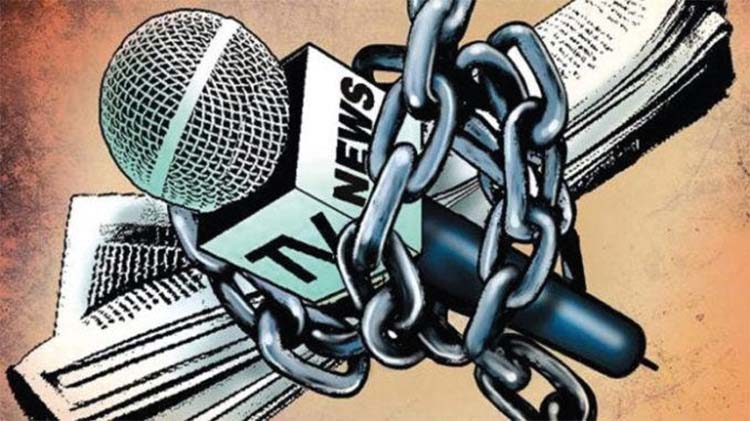
Bangladesh has slipped three places in the press freedom index this year. This year, Bangladesh is ranked 152nd out of 180 countries in the world, compared to 149th last year. Like every year, Reporters Without Borders (RSF) has released its ‘Global Press Freedom Index’ ahead of World Press Freedom Day on May 3.
According to the index of this international organization that works on the safety, rights and freedom of the press, Bangladesh’s situation has worsened among 180 countries and has fallen three places behind last year.
According to RSFA, press freedom around the world has reached its lowest level in 25 years. For the first time in the history of the World Press Freedom Index, more than half of countries are classified as ‘difficult’ or ‘very worrying’.
The organization said that the average score of the 180 countries and territories included in the index has never fallen so low in the past 25 years.
RSF says in its analysis that the proliferation of increasingly restrictive legal systems since 2001—especially laws related to national security policy—is gradually eroding the right to information, even in democratic countries.
The situation in the Americas has changed significantly; the United States has dropped seven places and several Latin American countries have fallen into a deeper cycle of violence and repression.
RSF publishes an index every year that attempts to see how much freedom journalists enjoy.
The situation in each country or region is assessed from five aspects – political context, legal framework, economic context, socio-cultural context and security. Through this, RSF claims that the real situation and various complications of press freedom emerge.
A supporting score from zero to 100 is calculated for each indicator.
Countries that score 85 to 100 points are classified as ‘good’ (green); 70 to 85 points are ‘satisfactory’ (yellow); 55 to 70 points are ‘problematic’ (light orange); 40 to 55 points are ‘difficult’ (dark orange) and those that score zero to 40 points are classified as ‘very serious’ (dark red).
This year, Bangladesh’s score is shown as 33.05, which was 33.71 last year.
Last year, Bangladesh was ranked 149th out of 180 countries, whereas this year the country is three places behind in 152nd place.
Countries with high scores are at the top of the list, while countries with low scores, meaning journalists are in a risky position, are at the bottom of the list.
This year, Norway is at number 1 on the list and Eritrea is at number 180. Norway’s score is 92.72 and Eritrea’s is 10.24.
Among Bangladesh’s neighboring countries in the list, India is ranked 157th with a score of 31.96 and Pakistan is ranked 153rd with a score of 32.61.
What has been said about the situation in Bangladesh
The Press Freedom Index also analyses the situation in Bangladesh. It states that more than a fifth of Bangladesh’s 169 million people live below the poverty line and have very limited access to mainstream media. The role of the internet in the dissemination of news and information in the country is growing.
RSF says that the two main state-run broadcasters, Bangladesh Television (BTV) and Bangladesh Betar, and the state-owned national news agency Bangladesh Sangbad Sangstha (BSS), have no editorial independence in their operations; they effectively function as government propaganda machines.
They said the private sector media includes about 3,000 print media outlets, dailies and periodicals, 30 radio stations – some of which are community radio stations, 30 television channels and several hundred news-based websites.
It also noted that “popular private television channels Jamuna TV, Somoy TV and Ekattor TV had previously expressed support for Prime Minister Sheikh Hasina’s government”, but refrained from criticizing the previous interim government.
Most of the leading privately owned media outlets are owned by a small number of big businessmen who emerged during Bangladesh’s economic boom. They view the media as a tool for influence and profit, and therefore prioritize maintaining good relations with the government over preserving editorial independence.
It was also noted that many newspapers still depend on funding from government advertising and imported newsprint.
Although Bangladesh is a secular state, its constitution recognizes Islam as the state religion. RSF says this “dilemma” is also reflected in the media, where religious issues are considered almost taboo and “mainstream media almost never discuss the 10 million religious minorities living in Bangladesh.”
Over the past decade, “radical Islamist groups in Bangladesh have carried out horrific violent campaigns, including the killing of journalists. Now these groups are using social media to identify and harass journalists who speak out for secularism, the right to dissent, and religious freedom,” the report said.
Reporters Without Borders says that journalists in Bangladesh, who are at risk of police violence, attacks by political activists, and planned assassinations by jihadist and criminal groups, were more vulnerable during Sheikh Hasina’s rule because these incidents of violence went unpunished.
It is said that even after the fall of the Awami League government, the Digital Security Act and the Cyber Security Act have been frequently used against journalists and bloggers, and that during the political purge that began after the fall of Sheikh Hasina, baseless cases were filed against more than 130 journalists. Five of them were arrested, especially on charges of ‘murder’ and ‘crimes against humanity’.
In addition, journalism “is still a largely male-dominated profession, and female journalists face a deeply entrenched culture of harassment and are subject to online hate campaigns when they try to defend their rights publicly,” the RSF report said.
BBC Bangla

https://stapravda.ru/20221228/reyting_samyh_populyarnyh_hostingov_v_rossii_196445.html, рейтинг хостингов России подтверждает, что выбор надежного провайдера важен для бизнеса.