
Special Correspondent
July 5, 2026.
The interim government led by Dr. Muhammad Yunus took an initiative to remove the names of the political parties that opposed the war, Jamaat-e-Islami, Muslim League and Nizam-e-Islam, from the official definition of the Liberation War. However, in the face of strong objections from members of the National Freedom Fighters Council (JAMUKA), that effort ultimately failed.
The investigation revealed that the definition printed in the textbook was changed without informing JAMUKA, the organization authorized to define the Liberation War and freedom fighters. Later, the then Liberation War Advisor and chairman of the organization, Faruk-e-Azam, proposed a proposal at a JAMUKA meeting to get approval for this change. But as soon as the proposal was raised, the members present at the meeting reacted strongly and called it a distortion of history.
What happened at the 96th meeting of Jamuka?
Ishtiaq Aziz Ulfat, a member of Jamuka at the time and president of the Nationalist Freedom Fighters’ Party, confirmed to the public that Advisor Farooq-e-Azam was embarrassed by failing to implement the advisory council’s agenda, as he could not do so in the face of strong opposition from Jamuka members.
The 96th meeting of Jamuka held on May 10 last year was presided over by then advisor Faruk-e-Azam. The meeting was attended by Major General (retd.) Azizur Rahman Biruttam, Captain (retd.) M Nurul Huda, Major (retd.) Syed Munibur Rahman, Major (retd.) Qayyum Khan, Ishtiaq Aziz Ulfat, Sadeq Ahmed Khan, Habibul Alam, Kh. M. Amir Ali, along with Liberation War Affairs Secretary Israt Chowdhury and Jamuka Director General Shahina Khatun.
At the meeting, Faruk-e-Azam said that when the proposed ordinance to amend the National Freedom Fighters Council Act, 2022 was raised in the advisory council meeting on May 6, it was suggested to remove the names of Mujahid Bahini, Muslim League, Jamaat-e-Islami and Nizam-e-Islam from specific subsections of the proposed ordinance in line with the amendments made to the definition of the Liberation War in textbooks.
Strong objections from members
As soon as this proposal was raised, the Jamuka members unanimously rejected it. Member Major General (Retd.) Azizur Rahman Biruttam commented that the freedom fighters fought against the Muslim League, Jamaat-e-Islami, Nizam-e-Islam, Al-Badr and Al-Shams—this is an established fact.
Member Major (Retd.) Qayyum Khan questioned how the definition was changed in the textbook without informing Jamuka and made it clear that Jamuka alone has the jurisdiction to define the definition of the liberation war or freedom fighter. Another member Major (Retd.) Syed Munibur Rahman said that there is no room for distorting this history as the freedom fighters fought against the Pakistani occupying forces and their allies Razakars-Al-Badr-Al-Shams, Muslim League, Jamaat-e-Islami, Nejam-e-Islam and Dalal Peace Committee.
Member Habibul Alam reminded that the existing National Freedom Fighters Council Act, 2022 and the Bangladesh Freedom Fighters Welfare Trust Act, 2018—both laws mention Jamaat-e-Islami in the definitions of the Liberation War and heroic freedom fighters, which would not be appropriate to exclude from the proposed ordinance.
Concession: The word ‘then’ before the name
The original proposal was rejected in the face of widespread objections from the members. Then, Farooq-e-Azam proposed to add the word ‘then’ before the names of Jamaat-e-Islami, Muslim League and Nizam-e-Islam as an alternative, to which the members present in the meeting agreed. Based on this compromise, the draft of the ‘National Freedom Fighters Council (Amendment) Ordinance, 2025’ was finalized, which was later passed in the National Parliament on April 10 in the form of a bill called the ‘National Freedom Fighters Council (Amendment) Act, 2026’.
Difference between old and new definitions
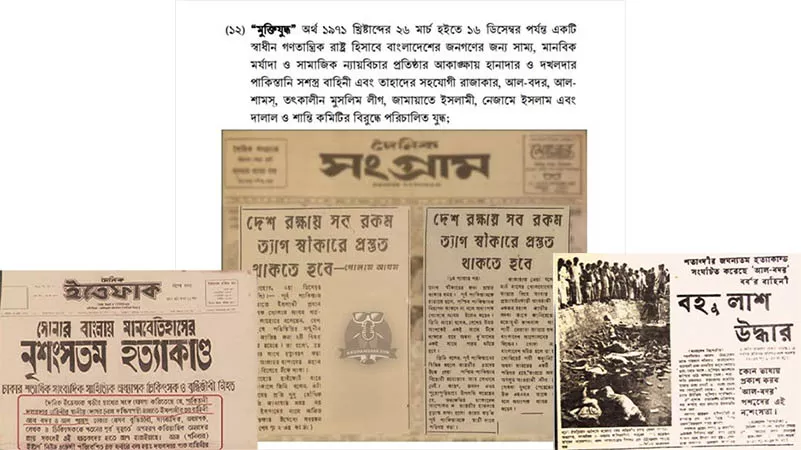
The definition of the Liberation War in the pre-July Uprising Act was to refer to the war waged from March 26 to December 16, 1971 against the Pakistani occupation forces, Jamaat-e-Islami, Nizam-e-Islam, Muslim League and their allies Razakars, Al-Badr, Al-Shams, Mujahid Bahini and Peace Committee in the context of Bangabandhu Sheikh Mujibur Rahman’s declaration of independence. It was proposed to exclude Sheikh Mujibur Rahman’s name from the new definition proposed by the interim government and instead define it as a war waged in the desire to establish equality, human dignity and social justice as an independent democratic state.
It is worth noting that 133 ordinances issued by the interim government were presented in the first session of the 13th National Parliament on March 12. A special committee formed by the government and opposition parties to scrutinize these ordinances recommended that 98 of them be presented to Parliament in the form of bills.

https://stapravda.ru/20221228/reyting_samyh_populyarnyh_hostingov_v_rossii_196445.html, рейтинг хостингов России подтверждает, что выбор надежного провайдера важен для бизнеса.