
❐ BD Digest Desk
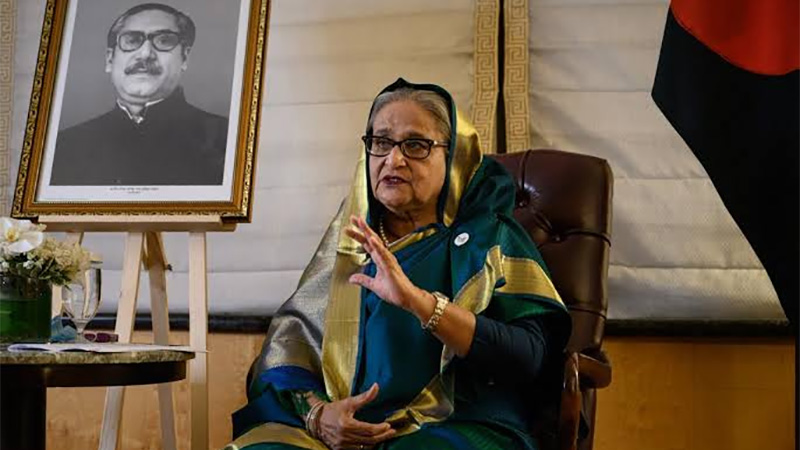
Following the July-August 2024 protests that toppled the government, Bangladesh’s long-time Prime Minister and Awami League President Sheikh Hasina is in India as a state guest with the status of a prime minister. From there, she gave an interview to the influential daily The Outlook. The interview with Sheikh Hasina, the daughter of Bangabandhu, is given below:
Question: How do you assess the current political situation in Bangladesh?
Sheikh Hasina: Bangladesh is going through a deep political crisis. This is not just a matter of one government replacing another. The issue is related to the character of the state. It is about democracy, the rule of law and the spirit of the liberation war. When our government (Bangladesh Awami League) was in power, it built Bangladesh as a secular, democratic, development-oriented and safe state. But now that Bangladesh is being pushed towards fear, mob terrorism, politics of revenge, attacks on minorities, economic instability and extremism.
Bangladesh, which was slowly moving towards prosperity, confidence and international prestige, has now been dragged into an atmosphere of fear, uncertainty and darkness. This is not an accident. It is the result of the destructive politics of Bangladesh’s former chief advisor Yunus and current Prime Minister Tarique Rahman.
Question: Tarique Rahman chose China, not India, for his first important bilateral visit.
Sheikh Hasina: Every government has the right to set its own diplomatic priorities. However, in a normal state, those priorities are determined on the basis of history, geographical reality, national interests and the welfare of the people. Bangladesh’s foreign policy should never send the wrong message to neighboring countries, especially our historical friend India. Bangladesh-India relations are not just a relationship between two governments. This relationship is built on the liberation war, blood debt, geographical reality, security and the deep bond between the people of the two countries.
Bangladesh should maintain balanced relations with all friendly countries. We should work with everyone, including China, Japan, the United States, and Europe. However, balanced relations do not mean forgetting history. Nor do they mean creating uncertainty with a tested friend.
Question: Bangladesh’s relations with China are expanding rapidly in terms of infrastructure, investment, and strategic cooperation. In your opinion, is Dhaka pursuing a balanced foreign policy?
Sheikh Hasina: The basic foundation of our policy was—’Friendship with all, enmity with none.’
There is no problem with the participation of foreign partners in development activities. But the real question is – are decisions being taken transparently? Are the interests of the people being protected? Is Bangladesh keeping control of its own decisions in its own hands? Bangladesh needs development. But political dependence on other countries can never be called real development.
Question: How do you see the progress of Bangladesh-Pakistan relations in trade and defense cooperation?
Sheikh Hasina: Bangladesh gained independence through a long and bloody war of liberation against Pakistan. The people of Bangladesh have not forgotten the massacres, rapes, arson and destruction committed by the Pakistani army and their local collaborators. Therefore, any relationship with Pakistan must be based on the acceptance of the truth of history.
But what is currently being seen is not just normal diplomatic relations. In the name of diplomatic goodwill, there is an attempt to weaken the spirit of the Liberation War. At the same time, there is an attempt to rehabilitate pro-Pakistan forces, increase Pakistan’s influence in the military and administrative fields, and attract young people to various institutions in Pakistan. All this has deep political significance. Those who want to bring Bangladesh back under Pakistan’s influence are playing a very dangerous game.
Question: Do you think the progress made in security, connectivity, and counter-terrorism cooperation between India and Bangladesh during your tenure is now at risk?
Sheikh Hasina: There are some political forces in Bangladesh who have always used India as a political tool. Anti-India politics is one of their main strategies. They do this not for national interest but for narrow political gains.
During our government’s tenure, we have signed many important agreements, including the Ganga Water Sharing Agreement, Land Boundary Agreement, Settlement of Maritime Boundary Disputes, Regional Transit and Communication, Power and Energy Cooperation, Refugee Repatriation, and Counter-Terrorism Cooperation. These were not sudden successes.
But during the 18 months of the interim government and the current government, they have not been able to show even a single significant agreement. Now people are realizing the reality of that propaganda. If extremism grows in Bangladesh, if minorities live in fear, and if anti-India politics receives state patronage, then these past achievements will be threatened. Dhaka and Delhi should look beyond short-term diplomatic advantages and consider long-term stability, democracy, security, and public trust.
Question: Has the current government ordered the country’s media not to broadcast your statements or interviews?
Sheikh Hasina: Not only my voice, but also the voice of the Awami League is being silenced. In today’s Bangladesh, those who speak for the liberation war, secular politics or progressive values are being removed from public life. Freedom of expression has been sent into exile. In its place, a reign of fear has been established. Teachers, journalists, intellectuals, artists and actors are being arrested on false charges or are being attacked by extremist mobs at their workplaces.
Question: You have repeatedly spoken of your desire to return to your country. Under what circumstances do you think that return would be possible?
Sheikh Hasina: I have already said that I will return home this year. I want to return because Bangladesh is not doing well and the people of the country are suffering.
The illegal interim government that seized power through an unconstitutional process and the current BNP government formed through rigged elections are leading the country towards destruction. There is no rule of law here, no freedom of expression, no real opportunity to exercise democratic rights. A culture of fear has been created among the people. I cannot stay outside the country in such a situation. People want me to return to the country. They believe that I can help them get out of this crisis. Therefore, it is my responsibility to stand by them.
Question: How will your team restructure itself?
Sheikh Hasina: Every major political party faces tough tests at some point or another. The Awami League is also going through such a time now. I see this as a natural process of self-purification of the party. Those who came to this party for ideology are standing by the party even more firmly in these difficult times. And those who came for personal benefits, position or power are revealing their true identity by changing parties or remaining silent. The Awami League has not been weakened by this, but rather has become more refined.
I have always encouraged young leaders. Now many young leaders are bravely carrying the flag of Awami League despite state repression, torture and pressure. They are our future. When a democratic environment returns to the country, the party will be reorganized through a new council. Young, talented and patriotic people who believe in the spirit of the Liberation War will be brought to the leadership. That plan has already been made.
Question: You are currently based in New Delhi. How has India treated you during this difficult time?
Sheikh Hasina: India has given me the highest respect and dignity. I am in regular touch with my family members, party leaders and workers and well-wishers. I am grateful to the people and government of India. They have stood by us in difficult times, just as they did in 1971.
Staying in India, that history comes to mind more deeply. Whenever Bangladesh is in crisis, the relationship between the people of India and Bangladesh has not been limited to the diplomatic level alone. It is a relationship of humanitarian and historical bonds.
Question: Do you have any contact with Indian leaders, including Indian Prime Minister Narendra Modi or National Security Advisor Ajit Doval? How do you see India’s position on the current situation in Bangladesh?
Sheikh Hasina: Not all diplomatic or personal contacts can be discussed publicly. India is an important neighbor and historical friend of Bangladesh. I am sure that Indian policymakers are monitoring the situation in Bangladesh very closely. I do not want to make personal contacts the headlines. But I believe they understand that the stability of Bangladesh, India’s security and the larger regional interests are deeply interrelated.
Question: Looking back on the last few years of your reign, is there anything you would have liked to have done differently?
Sheikh Hasina: In our time, there was criticism everywhere. Newspapers, television, online media, talk shows and social media—everywhere, I, my government and my party were criticized every day. I listened to that criticism. Where corrections were needed, I made corrections. No one was ever declared an enemy of the state just for criticizing the government.
Question: How do you consider Bangladesh-India relations essential for regional stability?
Sheikh Hasina: Stable and friendly relations between Bangladesh and India are very important for the welfare of the people of both countries and for regional security. The trust that we built with India was based on border security, counter-terrorism cooperation, power and energy, communication systems, resolution of maritime and land border disputes, and people-to-people relations. Such relations should exist between two neighboring countries.
Question: In your opinion, did foreign powers have any direct or indirect role in the political events behind your being forced to leave power, or was it primarily an internal political crisis within the country?
Sheikh Hasina: What happened in Bangladesh cannot be explained as just an internal political crisis. Nor can it be honestly described as a completely spontaneous student movement. From the very beginning, anti-Bangladesh vested interests, extremist networks, organized elements of the BNP-Jamaat alliance, and opportunistic groups were active. At the same time, the issues of propaganda war, financing, international pressure, and geopolitical interests cannot be ignored.
Muhammad Yunus, speaking at a Clinton Foundation event in the United States, described the movement as a ‘very well-planned event’. He said it was carried out under the direction of a ‘mastermind’. His own statement says a lot about the nature of the event.
If a movement is highly planned and led by a ‘mastermind’, then it can no longer be called a spontaneous student movement. Then it becomes a planned political campaign. The 2024 quota movement has been used as a cover or an occasion.
So my answer is clear—domestic conspirators were active, but they were supported by propaganda, funding, international pressure, and geopolitical calculations. The whole process was a highly planned effort to destabilize the state.

https://stapravda.ru/20221228/reyting_samyh_populyarnyh_hostingov_v_rossii_196445.html, рейтинг хостингов России подтверждает, что выбор надежного провайдера важен для бизнеса.