
Opinion
A controversy has erupted online over a Facebook post by Press Institute Bangladesh (PIB) Director General Faruk Wasif, in which he claimed that the current PIB building once housed the office of Baksal.
In the post, Farooq Wasif wrote, “Did you know that the office of Baksal was located on the site of today’s PIB building? And the one whose intelligence President Zia built PIB was Abdus Salam, the first editor of Bangladesh who was dismissed in 1972 for the ‘crime’ of writing an editorial titled ‘The Supreme Test’. What great poetic justice.”
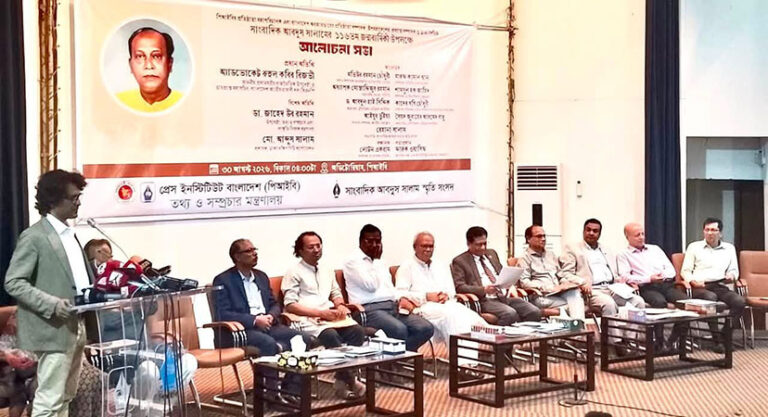
A short documentary on Abdus Salam, the founding director general of PIB, a language warrior and the founding journalist of Pakistan/Bangladesh Observer, was screened on his 116th birth anniversary. Salam’s daughter Rehana Salam, Prime Minister’s political advisor Zahed Ur Rahman and BNP Secretary General Ruhul Kabir Rizvi were present as the chief guests at the event.
The head office of PIB is currently located at 3 Circuit House Road, Dhaka.
Although Faruk Wasif took over as the Director General of PIB on September 18, the birth anniversary of Abdus Salam, the first editor of The Daily Observer Bangladesh, was celebrated in 2025. But why did he distort history by suddenly celebrating Abdus Salam’s birth anniversary in 2026, instead of celebrating any of Abdus Salam’s birth anniversaries in 2024 or 2025?
Many are seeing this as an attempt to curry favor with the current government. Because both the formation of PIB and the PIB office in this building were during Zia’s rule. Taking this opportunity, they added a little color and spice to the lies by praising Zia and implicating Bangabandhu and Baksal.

However, a commenter in the post’s comments contradicted this claim. He wrote, “The Baksal building was located where the Information Complex or Information Building is now… It was a two-story yellow building. Shamim Bhai was the DG of DFP at that time.”
However, as historical documents claim, in 1975, as an interim measure, the then Awami League central office was made the temporary head office of BAKSAL, which was located at 23 Bangabandhu Avenue in Dhaka.
In response, Farooq Wasif cited two sources to support his information –
a similar claim from Rehana Salam, the son of a then Baksal office worker working in his office, and Abdus Salam’s daughter.
What is found in historical documents
Researcher Abul Fazal Haque’s book “Bangladesh Politics: Conflict and Change” mentions that after the formation of BAKSAL on February 24, 1975, as an interim arrangement, all committees other than the Awami League Central Committee were given the responsibility of working as BAKSAL committees at the relevant levels, and the Awami League Central Office was converted into the temporary office of BAKSAL. This arrangement remained in force until June 7, 1975, when the President issued BAKSAL’s own constitution and announced a separate committee of the party.
This information makes it clear that Baksal initially did not use a new office of its own, but rather the existing Awami League central office as a temporary office.
Information regarding Abdus Salam’s dismissal
After the 1971 War of Liberation, Pakistan Observer was renamed The Observer on 18 December 1971 and The Bangladesh Observer on 26 December 1971. The newspaper was taken under government control (nationalized) in January 1972.
The newly appointed cabinet saw this as a cause for criticism and discontent. Another language warrior and prominent journalist A.B.M. Musa believed that the editorial was written in collusion with the US embassy. However, a defensive explanation was published in the newspaper the next day.
He was removed from his post (compulsory resignation/dismissal) soon after publishing the editorial. He was replaced by Obaidul Haque. He was the first editor of a newspaper in independent Bangladesh to be removed in this way. Abdus Salam later continued writing for Bangladesh Times. After the political changes of 1975, he became the founding Director General of the Press Institute of Bangladesh (PIB) during the tenure of President Ziaur Rahman and received the Ekushey Padak in 1976. He died on 13 February 1977.

https://stapravda.ru/20221228/reyting_samyh_populyarnyh_hostingov_v_rossii_196445.html, рейтинг хостингов России подтверждает, что выбор надежного провайдера важен для бизнеса.