
Special Correspondent
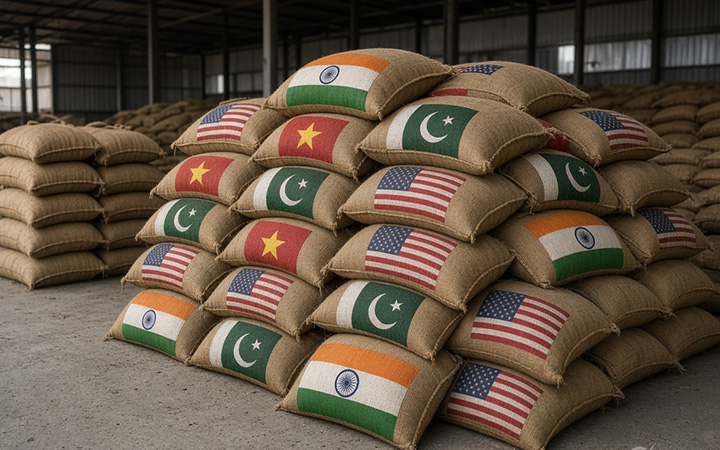
Bangladesh, once self-sufficient in rice and even exporting, has now become a regular rice importer. Large quantities of rice are coming from India and Vietnam, and Bangladesh has also ranked among the top ten rice importers from the United States. The question has arisen – is this agriculturally-dominated country no longer as self-sufficient as it once was?
Rice import dependency
According to recent data, Bangladesh is still the world’s third largest rice producer. Rice production in the country reached about 37.4 to 37.7 million tons in the fiscal year 2025-26. Still, imports are increasing. According to USDA and local sources, rice imports are forecast at about 1.4 million tons in 2025-26 and 1.5 million tons in 2026-27. In 2024, rice worth about $84.6 million was imported from India alone, which is the bulk of the total imports. Rice is also coming from Vietnam and Myanmar.
India is the main source of Bangladesh’s rice imports due to its geographical proximity and low prices. However, in 2025, the cost of Bangladesh’s rice imports from the United States increased by about 1,365 times compared to the previous year. As a result, Bangladesh has made it to the list of top 10 buyers of US rice.
According to the USDA, Bangladesh imported 47,550 tons of rice from the United States in 2025. Its monetary value was $35.74 million. At 122 taka per dollar, this amounts to about 4.36 billion taka in Bangladeshi currency.
Why are imports increasing?
The main reasons include population growth and pressure on per capita consumption, expansion of government food distribution programs, disruption of production due to natural disasters including floods and droughts, and imports by the government and private sectors to stabilize the market. Although domestic production has increased, demand is growing faster. As a result, the self-sufficiency rate has decreased and dependence on imports to meet the deficit is increasing.
Impact of fertilizer and seed shortages
Farmers are facing huge losses and frustration due to the lack of proper management of fertilizers and seeds in agricultural production, which is making the country’s food production dependent on imports. Recent data shows that although the demand for fertilizers in the 2026-27 fiscal year is about 6.77 million tons, the stock is only around 1.6 million tons, which is much lower than the safe level. Domestic factories are able to produce only one-sixth of the demand (about 1.1 million tons), the rest is dependent on imports.
At the field level, farmers are being forced to buy fertilizer at prices up to double the government-set price (20-27 taka per kg of urea); in some places, there have been incidents of warehouses being broken open and fertilizer being taken away. Similarly, due to low-quality and adulterated seeds, the yield in many areas during the Aman season has been less than half—farmers say that production costs have increased by 30-35 percent compared to the previous year, but the yield has decreased. As a result of this crisis, production costs are increasing, farmers are losing money instead of profit, and are losing interest in rice cultivation. As a result, the import of agricultural products, including rice, is increasing, failing to meet domestic production demand, which is putting food security and the agriculture-dependent economy at risk in the long run.
What is the effect?
Increasing rice imports are increasing foreign exchange pressure. Farmers are getting frustrated by not getting fair prices, which could affect production in the long run. On the other hand, while imports are helpful in controlling inflation, the image of the country’s agriculture-based economy is being tarnished. Experts say that Bangladesh may become more import-dependent if improved seeds, irrigation systems, storage facilities and incentives for farmers are not increased.
Bangladesh, once known as a rice exporter, is now a regular importer. This transformation in an agriculturally-dominated country poses significant challenges to food security and economic stability.

https://stapravda.ru/20221228/reyting_samyh_populyarnyh_hostingov_v_rossii_196445.html, рейтинг хостингов России подтверждает, что выбор надежного провайдера важен для бизнеса.