

Special Correspondent
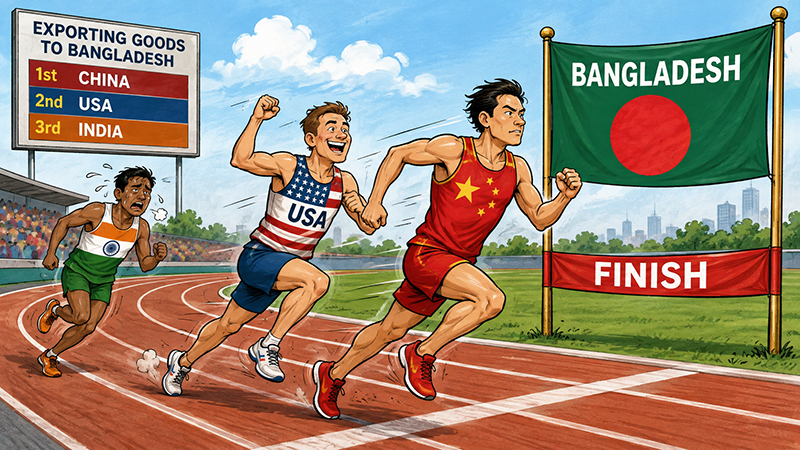
The United States has overtaken India to become Bangladesh’s second largest trading partner. This is a result of a decline in Bangladesh’s bilateral trade with India and an increase in imports from the United States. China is still Bangladesh’s largest trading partner.
According to the National Board of Revenue (NBR), Bangladesh’s bilateral trade with the United States was $12.67 billion in the fiscal year 2025-26, while its trade with India was $10.72 billion. As a result, the United States is about $1.95 billion ahead of India. Imports from the United States increased by 43 percent in one year, from $2.49 billion to $3.56 billion, while imports from India decreased by about 7.5 percent and exports to India decreased by about 3 percent.
Questions about increasing imports before signing the agreement
But an important aspect of these statistics is the timeline. Bangladesh’s trade agreement with the United States was signed on February 9 of this year—that is, at the very end of the 2025-26 fiscal year. This means that for the first eight months of that fiscal year, the interim government spontaneously increased imports of American goods at high prices, without any contractual obligations. This trend of 43 percent increase in imports from the United States in a single fiscal year, despite the terms of any formal agreement, is seen by observers as a sign of Bangladesh’s increasing policy-making position toward the United States.
Economists fear that if imports had increased so much before the agreement was signed, how much could imports from the United States actually increase in the current 2026-27 fiscal year, when the contractual obligations come into effect. Under the agreement signed in February, there is a plan to buy about $3.5 billion in US agricultural products and about $15 billion in energy products over the next 15 years, which they fear will further strengthen this import trend in the coming years.
The initial signs of that trend are already clear. The nearly $8 billion Boeing aircraft purchase deal and the government’s decision to purchase LNG at high prices—both examples indicate that the influence of high-priced US goods in the domestic market will continue to grow, regardless of the actual purchasing power of ordinary people in Bangladesh.
The real picture of exports and trade balance
According to NBR data, Bangladesh’s exports to the United States in the 2025-26 fiscal year were about $9.11 billion. As exports were much higher than imports ($3.56 billion), Bangladesh has a trade surplus of about $5.55 billion with the United States. However, according to analysts, while this surplus indicates the strength of export earnings, the promise of increasingly high-value agricultural products, energy and machinery imports could quickly narrow this balance in the future.
The picture is completely different in the case of China and India. According to the information presented by Commerce Minister Khandaker Abdul Muktadir in the National Parliament recently, Bangladesh has a trade deficit with 58 countries of the world in the outgoing fiscal year 2025-26, of which the largest deficit is with China—about 17.87 billion dollars. In that fiscal year, Bangladesh’s exports to China were only 694.49 million dollars, while imports were about 18.56 billion dollars. The second highest deficit is with India, about 7.86 billion dollars—as a result of total trade, which is the result of imports of about 9.29 billion dollars and exports of only 1.43 billion dollars.
In other words, while Bangladesh’s huge trade deficit with China and India continues, many see the trade surplus with the United States as a sign of relief. However, economists remain concerned about the trend of spontaneous increases in imports of US goods at high prices in the pre-agreement period and the possibility of contractually mandated imports in the coming years.

https://stapravda.ru/20221228/reyting_samyh_populyarnyh_hostingov_v_rossii_196445.html, рейтинг хостингов России подтверждает, что выбор надежного провайдера важен для бизнеса.