
Opinion
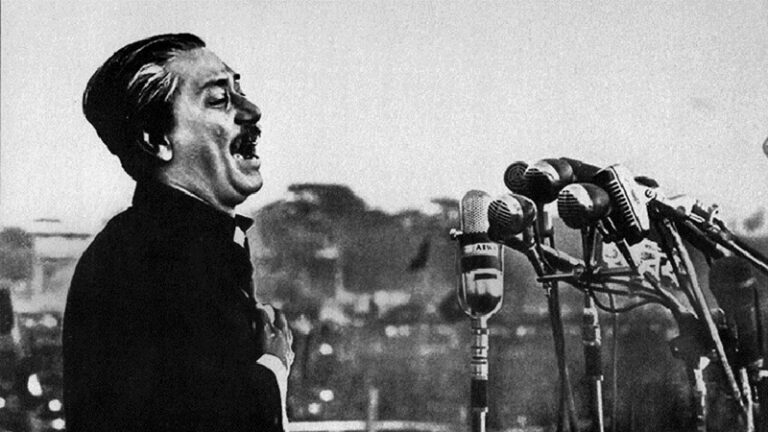
Sheikh Mujibur Rahman did not hide on the night of the March 25 massacre—he voluntarily, consciously, accepted captivity. This one decision still questions the statehood of Bangladesh. To some, it was a stubborn surrender, to others, a profound strategy. But if it was simply a matter of personal security or immediate politics, why did this captivity ultimately make the birth of a state inevitable? We are perhaps standing before the most misunderstood decision in history—where captivity became the most powerful language of freedom.
Bangabandhu’s voluntary imprisonment was not just the arrest of a leader; it created a shock on both the battlefield and the public mind. This imprisonment not only stirred the masses, it also angered them – it gave rise to a kind of moral anger, where it became impossible to remain neutral. That anger acted as a tonic to jump into the mortal fight, fear was replaced by the determination to resist. The mass uprising created a mass explosion that determined the direction of the war. It was through this psychological transformation that the war for the birth of Bangladesh gained momentum towards inevitable victory.
Many call it surrender. But first, it is important to redefine the political meaning of the word ‘surrender’. In political theory, surrender means giving up the claim to power. But in March 1971, Bangabandhu did not give up the claim to power; rather, he made the source of power—the mandate and moral legitimacy of the people—visible through his captivity. His decision was full of political wisdom and ingenuity, which turned into a people’s war.
The global context is also crucial here. The world was then locked in the harsh realities of the Cold War. The US and China were Pakistan’s strategic allies, the UN was reluctant to go beyond state-based legitimacy, and India was also seeking moral and diplomatic grounds before direct military intervention. In such a situation, a leader in hiding would easily be labeled as an ‘internal rebel’ by the international media and would be considered a fugitive if he sought safe haven in India. But the arrest of a prisoner, a representative of the elected and majority population – this is the strongest moral document of the state’s claim.
Here Bangabandhu’s decision took the form of a fundamental state theory that was the masterstroke of the freedom struggle. He did not choose the path of leadership as an individual; he made himself the symbol of the state. His imprisonment was not personal—it became the imprisonment of the state. His trial meant a trial of the political rights of a nation. And his possible hanging was not just the death of a leader, but the announcement of the murder of a state. There was no safe path open to Pakistan—on every path, moral and political defeat became inevitable.
There are many similar examples of this state thinking principle globally. Nelson Mandela of South Africa did not give up his political demands even during his long imprisonment, but rather created a new moral and political platform. Mahatma Gandhi strengthened his movement despite repeated arrests and strengthened the moral power of the state. Even after the arrest of Lech Walesa of Poland, the democratic movement strengthened internationally. Bangabandhu’s imprisonment is also evidence of a similar state thinking – where even if the individual moves away, the moral power of the state remains strong and the process of independence becomes mandatory.
This decision was not without risk. There was a possibility of execution, the threat of a leadership split was strong. But state thinking does not always choose the path of least risk; it chooses the steps without which the birth of the state would have been impossible. Bangabandhu’s decision was one of extreme risk, but of high certainty. It may have been a weak position in military terms, but it was irresistible in political and moral terms.
Today, it is clear that this captivity internationalized the liberation war, exposed the genocide to the global conscience, and transformed Bangladesh’s independence from a ‘possibility’ to an ‘inevitability’. Bangabandhu’s capture was not a stubborn surrender; it was a declaration of deep state thinking – where the individual recedes and the state comes to the fore, and captivity becomes the most powerful language of freedom. This decision is an important pillar of the moral foundation on which Bangladesh stands as a state. History reminds us – some wars can be won with weapons, but a state can be won with a decision that closes all avenues of retreat for the ruler. That historic decision of Bangabandhu transformed the battlefield of independence into the great sacrifice of state-building.
Through his strong leadership and indomitable courage, the dream of a new state was born from the battlefield –
the emergence of independent, sovereign Bangladesh.
– Kanon Khan
politician and social activist

https://stapravda.ru/20221228/reyting_samyh_populyarnyh_hostingov_v_rossii_196445.html, рейтинг хостингов России подтверждает, что выбор надежного провайдера важен для бизнеса.