
Staff Correspondent
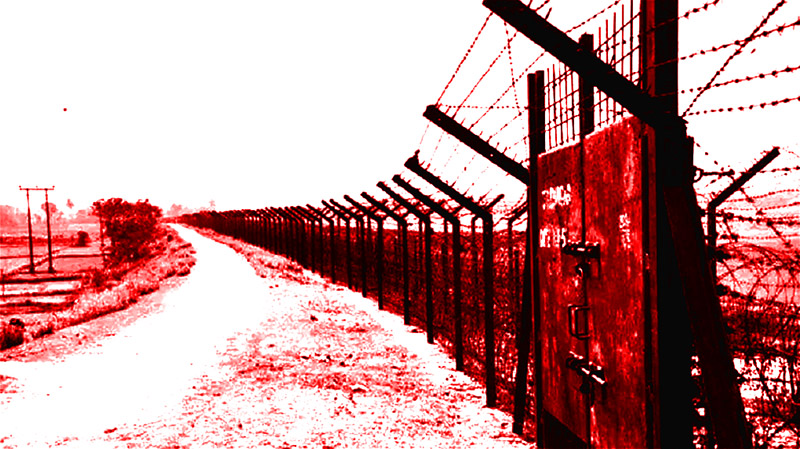
Human rights activists and security analysts have alleged that the interim Yunus government has failed to reduce the number of deaths on the Bangladesh-India border despite promising to restructure relations with India and manage the border humanely. This is reflected in the statistics for 2025, where the highest number of Bangladeshi citizens were killed on the border in the last five years.
According to human rights organizations, 34 Bangladeshis were killed at the border in 2025, the highest number between 2021 and 2025. The situation comes against the backdrop of the 15th anniversary of the 2011 killing of teenager Felani Khatun—an incident that became a symbol of border killings in the international arena.
On January 7, 2011, Felani was shot dead by the Indian Border Security Force (BSF) at the Anantapur border in Kurigram. She had been living illegally in India with her father for a long time. As the marriage was arranged, she and her father secretly crossed the barbed wire and entered the country. When Felani’s shirt got caught in the barbed wire, she screamed. Thinking she was a smuggler, the BSF opened fire. Felani’s father managed to cross the border safely, but Felani was shot dead. When the picture of Felani’s body hanging from the barbed wire went viral internationally, there was a storm of condemnation.
On the 15th anniversary of the Felani killing, the question is once again being raised – how effective have the two countries’ commitments to stop border killings been?
Human rights organizations have claimed that Yunus’ government has failed to take these steps, even though strong diplomatic initiatives, joint monitoring, and adherence to international human rights standards are urgently needed to stop the loss of lives at the border.
According to data compiled by various media outlets, including the human rights organization Ain O Salish Kendra, the number of Bangladeshi deaths at the border in the last 5 years was 18 in 2021, 23 in 2022, 31 in 2023, 30 in 2024, and 34 in 2025.
According to this calculation, the highest number of Bangladeshi citizens lost their lives at the border in the last 5 years in 2025. Most of the victims died in BSF firing. In some cases, there are also allegations of torture, chasing, or beating after being detained as suspects.
Earlier, the number of deaths at the border was even higher in 2020. That year, 48 Bangladeshi citizens were killed. However, after 2021, the number decreased slightly in comparison to the previous few years, but since 2023, there has been an upward trend.
According to human rights organizations, these killings are taking place during cattle smuggling, illegal border crossings, agricultural work, or while traveling in border areas. In many cases, the victims were allegedly unarmed.
Although the border killings have been discussed several times at the diplomatic level, those concerned believe that the reality has not changed. Although there has been talk of using ‘non-lethal’ methods to stop border killings, it has not been effectively implemented at the field level.
Security and international relations analyst Aminul Haque said, “Although the Yunus government verbally opposed India, it could not take any effective steps to stop border killings. As a result, the number of border killings suddenly increased in 2025.”
He said, “The problem needs to be resolved through issue-based diplomatic discussions rather than face-to-face confrontation with India. Bilateral problems cannot be resolved through hate speech or rhetoric. To stop border killings, practical initiatives must be taken on security, human rights, and border management.”
According to human rights activists, most of those killed on the border are poor people. Their families are being deprived of justice and compensation. In many cases, despite investigations, there is no visible punishment against the perpetrators.

https://stapravda.ru/20221228/reyting_samyh_populyarnyh_hostingov_v_rossii_196445.html, рейтинг хостингов России подтверждает, что выбор надежного провайдера важен для бизнеса.