
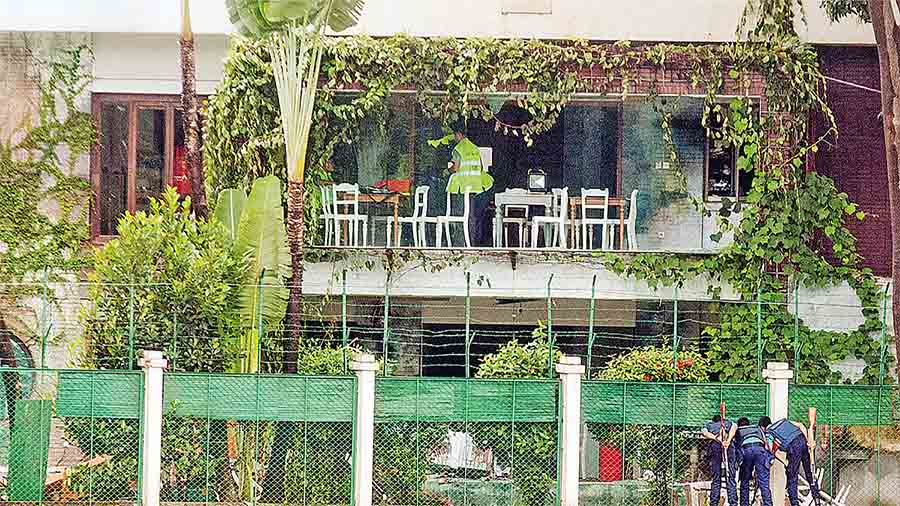
❐ Special Correspondent
A decade ago, on July 1, 2016, militants carried out a horrific attack and brutal murder at the Holey Artisan Bakery in the capital’s Gulshan. Five and a half years ago, the Dhaka Special Anti-Terrorism Tribunal sentenced seven defendants to death for their involvement in the attack and murder.
Although the case is currently pending in the Supreme Court, there has been no progress in the final settlement of the case. However, the state has said that it will take steps to resolve the case quickly.
The High Court ruled in 2023, rejecting the death references (applications for approval of the death penalty) of the defendants sentenced to death by the trial court. The high court sentenced the defendants to life imprisonment instead of the death penalty.
But there has been no further progress in the trial of the case in terms of final settlement. The defendants’ leave to appeal (application for permission to appeal) against the High Court verdict is now pending in the Appellate Division.
Among them, in August 2024, an inmate was shot dead by prison guards while escaping from Kashimpur High Security Prison in Gazipur.
The state’s Chief Legal Officer Md. Ruhul Quddus Kajal said that although there is no lack of sincerity in hearing and resolving any case quickly, it is not possible due to various realities, including the shortage of judges.
However, although he said the state would take initiatives to hear and resolve the case quickly, he did not mention any timeframe.

The militants who attacked the Holy Artisan
Background of the incident
The terrorist attack on the Holy Artisan Bakery took place on July 1, 2016. Five young militants, Nibras Islam, Shafiqul Islam alias Ujjwal, Mir Sameh Mobasher, Rohan Ibne Imtiaz, and Khairul Islam alias Payel, entered the Holy Artisan restaurant armed with pistols, sub-machine guns, and sharp weapons a week before the Eid al-Fitr.
They killed 20 people, including 17 foreign nationals. Two police officers lost their lives trying to stop the attack. Several others were injured. The militants were later eliminated in an army commando operation (Operation Thunderbolt).
The Middle East-based international terrorist organization Islamic State (IS) issued a statement that night, claiming responsibility for the attack. The then government rejected the IS claim, saying that the domestic terrorist organization Neo-JMB was responsible for the attack.
The verdict in the case filed under the Anti-Terrorism Act in connection with the attack was delivered on November 27, 2019. Judge Mujibur Rahman of the Dhaka Special Anti-Terrorism Tribunal sentenced the seven members of the neo-JMB to death, the maximum sentence. They were also fined Tk 50,000.
In addition, some of them were given varying terms of imprisonment under two other sections of the Anti-Terrorism Act.
The statements of those involved in planning the attack revealed that they were inspired by Islamic preacher Zakir Naik’s speeches and carried out the terrorist attack. In the wake of this, the extremist preacher Zakir Naik was later forced to flee India.
Later, if the trial court sentences the accused to death, the High Court’s approval is required for its implementation. For this, according to Section 374 of the Code of Criminal Procedure, after the trial court’s verdict, all the documents of the case have to be sent to the High Court, which is known as the death reference.
The case file was filed in the High Court on August 18, 2019. Later, the convicts also filed an appeal and jail appeal against the trial court’s verdict, seeking acquittal. Hearings on the death reference and appeal-jail appeal began in early 2023 and ended on October 11.
Later, on October 30th of that year, the High Court announced its verdict. In the verdict, instead of the death penalty, it sentenced seven accused to life imprisonment. The full 229-page verdict was published on June 17th last year.
The defendants, who were sentenced to life imprisonment, filed separate leave to appeal against the High Court verdict in June last year at the relevant branch of the Appellate Division, said defense lawyer Md. Ariful Islam.
He said that he is currently not involved in the case and said, “After the High Court verdict, no one from the defendants has contacted me. However, I have heard that leave to appeal has been filed on behalf of six defendants.”
The accused sentenced to life imprisonment are Rakibul Hasan alias Regan, Md. Jahangir Hossain alias Rajib Gandhi, Aslam Hossain, Hadisur Rahman, Abdus Sabur Khan alias Sohel Mahfuz, Mamunur Rashid alias Ripon and Shariful Islam Khaled.
On August 6, the day after the fall of the Sheikh Hasina government on August 5, 2024, 209 prisoners escaped from Kashimpur High Security Prison in Gazipur by taking the guards hostage. A total of 6 people were killed in the shooting by the guards.
Among the six people killed was Aslam Hossain, the accused sentenced to life imprisonment in the Holey Artisan case.
The argument that reduced the sentence to life imprisonment
The full 229-page verdict explains why the High Court commuted the death sentences of seven convicts to life imprisonment.
The High Court said in its verdict that it has been proven beyond doubt that the seven appellants, even though they were not present at the scene, conspired and aided the incident. Due to this conspiracy and aid, the court stated that they were guilty of the offence mentioned in clause (a)(ii) of sub-section (1) of section 6 of the Anti-Terrorism Act, 2009. However, the High Court observed that the Anti-Terrorism Special Tribunal had not properly understood the relevant sections and sub-sections and had awarded the maximum sentence of death to the appellants, which was not correct and acceptable, and the court said that for this reason the verdict has been considered to be intervenable.
311 terrorists still at large, country in security fear
At least 311 members of several militant organizations arrested for their involvement in militancy are still at large. They are accused in various cases related to extremist activities.
On August 5, 2024, 9 prisoners convicted in cases related to extremist activities escaped from the high-security central prison in Kashimpur, Gazipur. There is concern in security-related circles about the location and activities of these fugitive militants.
Detailed information on the fugitive militants has been obtained from information updated as of last April by the police’s specialized unit, the Anti-Terrorism Unit (ATU).
Among them, 185 are from Jamaatul Mujahideen Bangladesh (JMB), 83 from Ansar Al Islam, 16 from Harkatul Jihad Bangladesh (HuJ-B), 16 from Neo-JMB, 9 from Allah Dal, 1 from Jamaatul Ansar Fil Hindal Sharqia and 1 from Imam Mahmud’s caravan. Apart from this, 59 members of another banned organization, Hizb ut Tahrir, are absconding in various cases, according to the ATU.
Security analysts believe that violent militants who are on the run from prison, are in hiding after being released on bail, and are absconding as defendants in cases can pose a major security risk.
In July-August 2024, anti-government protesters looted thousands of firearms and a large amount of ammunition, as well as security equipment, from nearly 500 police stations and outposts across the country, as well as various police installations and prisons. Most of the looted weapons have not yet been recovered.
In this reality, analysts believe that monitoring fugitive militants is essential, because they may try to regroup if given the opportunity.
When asked on April 4 whether there was any threat from fugitive militants, ATU Chief and Additional Inspector General Md. Rezaul Karim did not comment directly.
However, he said, “There is no place for extremism in Bangladesh. The peace-loving people of the country do not like extremism.”
On the evening of August 5, 2024, the high-security central jail in Kashimpur was attacked by hardened criminals. They broke into the main gate of the jail and set fire to the warehouse on the third floor. At that time, the notorious criminals were brought out. A total of 202 prisoners, including 9 dangerous militants imprisoned in cases related to militancy, escaped.
According to ATU sources, 2,143 members of banned militant organizations were arrested in various cases across the country from 2021 to 2024. Of these, 1,611 were released on bail from prison in the five years from 2021 to December 2025. Of them, 380 were released on bail after August 5, 2024. 162 are currently in prison.
According to the ATU, 59 death row inmates, 46 life sentence inmates, and 25 serving sentences of varying terms are incarcerated in 16 prisons across the country. In addition, trials of cases against 32 other inmates are ongoing.
Police sources say that some of the people who were released on bail after the fall of the government in 2024 include some prominent militant leaders. Jasim Uddin Rahmani, the founder of the dreaded militant organization Ansarullah Bangla Team, who was directly involved in several militant attacks, including the murder of bloggers, was released on bail on October 20 last year.
Court sources say that two more cases are pending against him. One is being tried at the Anti-Terrorism Tribunal in Dhaka, the other at the Cyber Tribunal. He is alleged to have continued to promote extremism in various speeches after his release.
Maulana Saidur Rahman, the head of the banned organization JMB, was released on bail from Kashimpur-2 Central Jail on March 21.
In addition, Sheikh Al Amin, whom the police believe to be the main person behind the explosion at a women’s madrasa in Keraniganj, Dhaka last December, and several of his associates were released on bail after August 5, 2024. However, they were arrested again after the Keraniganj incident.
Law enforcement officials say there was serious concern about extremist activity in the country from 2013 to 2016. During that time, there were killings of bloggers, writers, publishers, teachers, and foreign nationals, which were orchestrated by Jasim Uddin Rahmani and his Ansarullah Bangla Team.
In 2016, a horrific attack was carried out at the Holey Artisan Bakery in Gulshan, the capital. Earlier, in 2005, the militant organization JMB, supported by the BNP-Jamaat government, exploded 500 bombs simultaneously in 63 districts.
Officials concerned say that considering past experience, there is no scope for relaxing surveillance on fugitives and militants on bail. They believe that identifying the location of those who escape from prison, go into hiding on bail, and are absconding as accused in cases is of utmost importance for security.

https://stapravda.ru/20221228/reyting_samyh_populyarnyh_hostingov_v_rossii_196445.html, рейтинг хостингов России подтверждает, что выбор надежного провайдера важен для бизнеса.