
Opinion
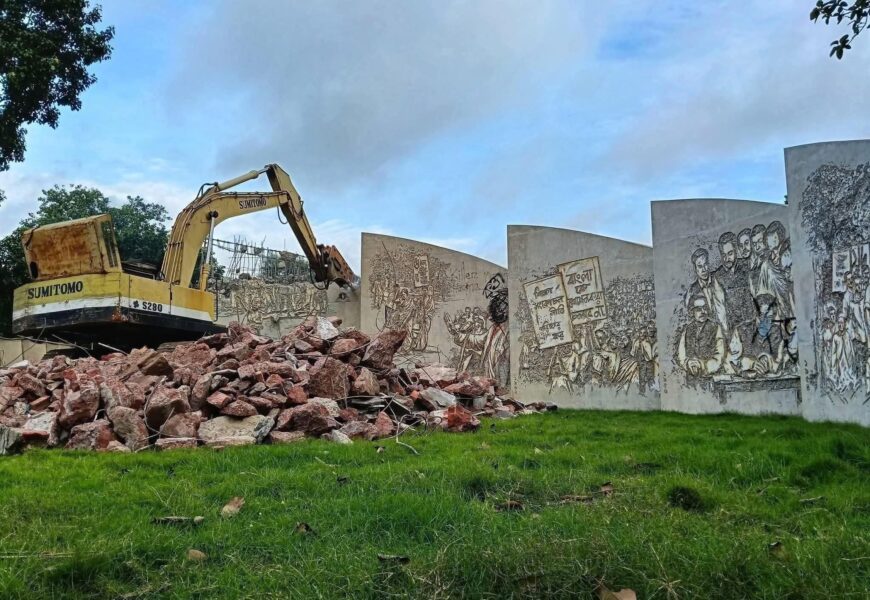
Dhaka’s Bijoy Sarani—a name, a road, a history. Where Bangabandhu’s footsteps once echoed, where every wall, every engraving bore witness to a nation’s birth. There stood a sculpture—the portrait of Bangabandhu Sheikh Mujibur Rahman, surrounded by silent testimonies of our struggle, our bloodstained victory.
Today, broken bricks, twisted iron rods, and dust-covered memories lie scattered before that wall—memories no one wants to touch anymore. A giant yellow excavator stands with its head bowed, as if ashamed of its own actions. But does a machine have conscience?
The wall that once depicted students carrying the bodies of language martyrs—now sits the mechanical beast upon it. The wall where Bangabandhu held a microphone and declared, “This time, the struggle is for our freedom”—now crushes the echoes of his voice beneath its weight.
There was a time when a father would stand by this place and tell his child,
“Look, my son, these walls tell your grandfather’s story. He was a freedom fighter.”
Today, that father weeps—silently, unseen. Because he knows that wall no longer exists.
An elderly woman—her body bent with age—stands beside the shattered sculpture. Her eyes hold no tears, only emptiness. Somewhere on that wall was the face of her martyred son. Now, that face rolls in the dust. She no longer cries, for her tears dried up long ago.
She only whispers, “Was my son wrong, then?”
A schoolboy stands in the distance, his backpack slung over his shoulder. He stares for a long time before picking up a paint-chipped brick from the ground. He presses it to his chest, not knowing why his heart feels so heavy.
This scene is not just the destruction of a sculpture.
It is as if the souls of every martyr are slipping into coffins one by one, their names and faces buried beneath the dust before our very eyes.
Some will say, “The sculpture was removed for development.”
But if development comes at the cost of erasing history, then it is not development—it is self-destruction.
When a nation tears down its own history with its own hands, nothing remains unbroken.
This image, this moment, this destruction—it grips our throats and asks,
“Were you truly liberated, or were you only given the freedom to forget?”
A nation’s most tragic fate is when it forgets itself.
This broken wall marks the beginning of that oblivion.
And the unshed tears in our eyes—perhaps the last act of resistance.
In the evening light, as the sun slowly sets, an elderly freedom fighter stands by the shattered wall. With trembling hands, he picks up a brick. Perhaps this very brick was once soaked in his comrade’s blood. Perhaps his own history was painted on this wall, now merging with the earth.
Can we preserve even those tears? The reflection in this image is not just a fragment of a broken wall—it is the wail of a nation’s soul.
Because history does not break—we break ourselves.
And once broken—no victory, no Bijoy Sarani, ever returns.
– Charu Pintu

https://stapravda.ru/20221228/reyting_samyh_populyarnyh_hostingov_v_rossii_196445.html, рейтинг хостингов России подтверждает, что выбор надежного провайдера важен для бизнеса.