
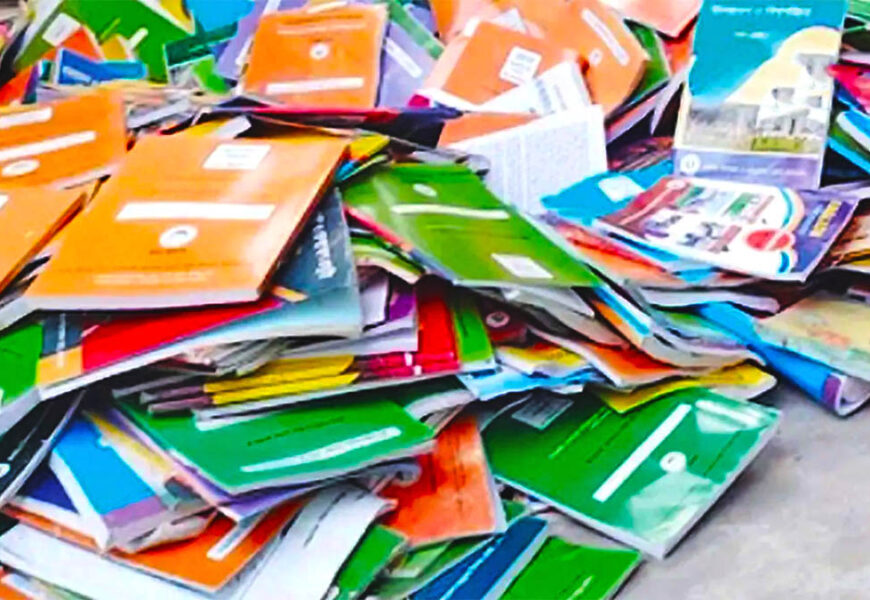
After the Yunus government’s corruption, irregularities and poor quality publications in free textbook printing, foreign companies will now get work, and the domestic industry is on the verge of collapse.
❐ Special Correspondent
After a long-running debate over free textbook printing, the interim government has now gone for an international tender. While this has taken steps to break up the long-standing influential ‘syndicate’ of domestic press owners, it has raised concerns that an established industry could face collapse.
As per the recent decision of the Yunus government, the previous tender for printing secondary level textbooks will be cancelled and a fresh international tender will be invited. To implement this decision, the Cabinet Division’s Procurement Advisory Committee has amended Section 83(1)(a) of the Public Procurement Rules (PPR) 2008. As a result of the amendment, the deadline for submission of tenders has been reduced from 42 days to 15 days.
Several NCTB officials said that tenders for 190 lots for primary level books have already been approved. However, the proposal for 21 crore books for secondary level was returned by the procurement committee on August 19. After that decision, the initiative for international tenders was taken.
It is worth noting that due to irregularities, corruption and poor quality of publications by domestic institutions, Indian institutions were given the responsibility of publishing free textbooks for children for several years during the Awami League government. Several Indian institutions won the work with the lowest price and quality-verified work in international tenders, and gained a reputation for being able to supply books on time and as per the demand.
But the Yunus government expressed its reluctance to give work to Indian institutions and gave the responsibility of publishing to a domestic institution. This increased the cost by about 1,000 crore taka more than before. However, various corruptions including delay in receiving books on time, low-quality paper and ink in printing, negligence in supervision, printing guide books in the relevant press before printing books, giving free books to bookstores in the market, and irregularities worth hundreds of crores of taka by those responsible for publishing came to light.
Even officials of the internationally renowned French organization Bureau Veritas, which is responsible for verifying the quality of books, were exposed to financial irregularities and corruption.
Mohammad Ashrafuzzaman Bhuiyan, Deputy Secretary of the Cabinet Division’s Procurement and Economic Branch, said that book printing is an urgent task. Therefore, the deadline has been reduced. Regarding the international tender, he said that the tender will be invited as per the rules.
Fears of domestic industry
Meanwhile, press owners say that if the interim government’s decision is implemented, the domestic industry will collapse. Currently, 1 million to 1.2 million people are directly and indirectly associated with this sector. Several lakhs of people are employed in every step, including paper, ink, machinery, binding, packaging and transportation.
Mustafizur Rahman, chairman of the Export and Market Development Committee of the Bangladesh Paper Mills Association, said, “It would be a suicidal decision for the government to hand over a task like textbook printing to foreigners. The investment of paper mill owners in this industry is about 70,000 crore taka. The investment of press owners is another 20,000 crore taka. If there is an international tender, millions of people will become unemployed.”
Local press owners say their biggest problem is the price of raw materials. They have to buy a ton of paper locally for about 125,000 taka, while the price of the same quality paper in China is 77,000 to 80,000 taka. With subsidies added to this, foreign companies will be able to easily offer to print books at a lower price. While local presses charge 3 taka 15 paisa per form, China can offer it for only 2 taka 20 paisa. As a result, it is almost impossible to survive in the competition.
Controversy and allegations
According to NCTB officials, domestic press owners have repeatedly created ‘syndicates’ in tenders, causing losses of crores of taka to the state. This year alone, the state has incurred an additional expenditure of 323 crore taka due to their collusion. At the same time, there have been repeated incidents of poor quality books being supplied. Even internationally renowned foreign inspection agents have been accused of approving poor quality books as ‘good’ in exchange for financial benefits.
Incidentally, this year too, allegations were made in the procurement committee that several press owners had obtained huge lots of books through political influence. In the meantime, the decision was made to cancel the new tender and hold an international tender.
The press owners claim that printing and publishing work is on the list of protected local industries. According to PPR 2006 and 2008, national security, question papers, government publications or security papers cannot be given to foreigners. Therefore, inviting international tenders is a violation of the law.
The future is uncertain.
NCTB officials believe that if a new tender is called now, it will be a big challenge to deliver the books by January. Even if the government reduces the deadline, it will be difficult to deliver the books to students on time if the evaluation, approval and printing steps are not completed quickly.
Professor Riyad Chowdhury, NCTB member (textbooks), said, “Our main priority is to deliver the books to the students on January 1. We will try to complete the work quickly, depending on the decision taken by the interim government.”
Although the Yunus government’s decision to award international tenders has the potential to ensure the quality of books for the time being, there are clear fears that this could lead to a collapse in the domestic printing industry. On the one hand, the employment of millions of people is at risk, and on the other hand, legal and policy debates are also coming to the fore. As a result, the issue of textbook printing is not only a technical issue, but is now also becoming a question of national economy and policy.

https://stapravda.ru/20221228/reyting_samyh_populyarnyh_hostingov_v_rossii_196445.html, рейтинг хостингов России подтверждает, что выбор надежного провайдера важен для бизнеса.