

❐ Staff Reporter
Everything from daily necessities like rice, fuel oil, onions and chillies to raw materials for the industrial sector is coming from India. In this continuity, now Hilsa fish has also arrived!
The fish that Bangladesh used to be so brave about, is now not available to the common man. The anti-government protesters of July-August 2024 said that Sheikh Hasina’s government sent all the hilsa to India, so Bangladeshis cannot eat hilsa, and the price does not decrease. The Bangladesh market has become unstable due to India’s aggression… etc. However, after August 5, the situation has been reversed! Dependence on India has increased manifold. Imports of daily necessities have increased more than in the past. The trade deficit has also increased.
After August 5, Bangladesh had shown the ‘muscle power’ of Hilsa politics many times. Government officials had shouted, ‘First Bangladeshis will eat Hilsa, then it will be exported to India.’ But the real picture is different – the price of Hilsa in the country has increased several times. Hilsa has gone beyond the reach of the common man. In this situation, on the contrary, Hilsa import from India has started.
A huge amount of hilsa fish has entered the country through the Benapole land port in Jessore in the last two months. A total of 3,52,786 kg of hilsa was imported through this port in July and August of the current 2026-27 fiscal year. Benapole Fisheries Quarantine Officer Sajeeb Saha confirmed the matter.
According to the Fisheries Quarantine Office, a total of 22 importing companies imported hilsa through Benapole in July and August. The companies include Messrs. Satta Fish, Messrs. Rabbi Enterprise, Messrs. Satta Fish Feed, Messrs. Famous Traders and Messrs. Ryans Hub of Benapole; Messrs. HMR International, Messrs. N. K International, Messrs. Suraiya Trade International and Messrs. Arkin International of Jessore; Messrs. Janata Fish of Bagh Anchra; Messrs. Swarnali Enterprise, Messrs. Sharif Trade International, Messrs. Rupa Enterprise, Messrs. Mariam Enterprise and Messrs. Sajjad Enterprise of Dhaka; a company in Jatrabari; Messrs. Biswas International of Khulna; A total of 22 companies, including Messrs. Jannat Enterprise and Messrs. Ashiq Enterprise of Satkhira and Messrs. Noman Enterprise of Pabna.
Benapole Land Port Fisheries Quarantine Office Inspector Ashwadul Alam said that 3,52,786 kg of hilsa was imported through Benapole Port in the first two months of the 2026-27 fiscal year. In July, 29,440 kg of hilsa entered the country through three importing companies. In the following month, August, another 3,23,346 kg was imported through 19 companies.
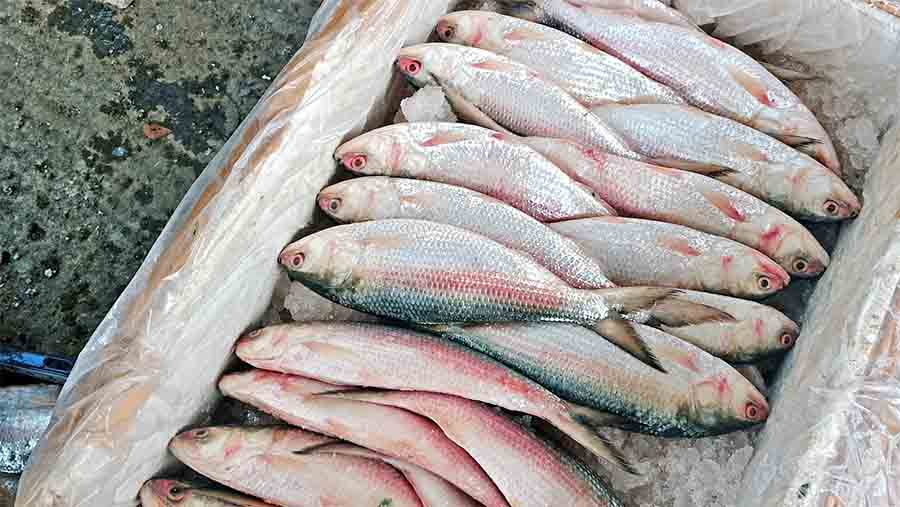
The declared value of imported hilsa in the two months is 6 crore 92 lakh 94 thousand 510 taka. Of this, the value of hilsa in July is 35 lakh 48 thousand 796 taka and the value of hilsa imported in August is 6 crore 57 lakh 45 thousand 714 taka.
It has been found that the supply of hilsa has increased in various fish markets in the district, including Benapole, Sharsha, Bagachra, Navaran, Jessore Bara Bazar, as a large amount of hilsa enters the country through Benapole.
These fish are known as ‘Myanmar Hilsa’ among traders. However, buyers complain that they are often deceived into buying these fish, thinking they are domestic Hilsa.
They claim that although these fish have significant differences in taste and smell from local Hilsa, in many cases buyers are not informed about this.
Some traders in Jessore claim that these hilsa from Myanmar are entering Bangladesh through Benapole land port via India. However, according to information provided by officials of the Benapole Land Port Fisheries Quarantine Office, the hilsa imported through Benapole is Indian.
They said that hilsa from Myanmar enters the country through Chittagong port. They also confirmed that hilsa from Myanmar is being sold in the market.
Meanwhile, a source has claimed that some hilsa has also entered the country illegally through Benapole. On July 22, Benapole Customs authorities seized 12 cartons of Indian hilsa imported through Benapole land port under the declaration of white fish. The quantity of these fish was about 360 kg.
Iqbal Karim, a resident of Loan Office Para, who came to buy hilsa at the Jessore big market, said that he bought a fish thinking it was domestic hilsa. But after cooking and eating it, he felt that the taste and smell of the fish were not like domestic hilsa. According to him, it is quite difficult for ordinary buyers to distinguish domestic and foreign hilsa as they look almost the same.
According to market traders, currently, 1 kg of 200 to 300 grams of domestic hilsa is being sold at a price of 3,300 to 3,400 taka per kg. On the other hand, the price of 1 kg of 300 to 400 grams of Myanmar hilsa is about 1,400 taka per kg. That is, although it is relatively large in weight, the price of foreign hilsa is much lower than that of domestic hilsa. Due to this large price difference, buyers are increasingly interested in low-priced fish in the Jessore market.
A visit to the Jessore Big Bazaar showed that these hilsa are being harvested for sale at several shops, including Padma Fish, Gaurab Fish, Messrs. Titas Fish and Messrs. Zaman Fish.
Meanwhile, an analysis of the import data of Benapole land port shows that the amount of hilsa imports in August increased by almost 11 times compared to July. While 29,440 kg of hilsa were imported in July, the amount increased to 323,346 kg in August. Traders said that a large part of this hilsa is coming to the Jessore market, which has also affected the domestic hilsa market.
Mohammad Piaru, a fish trader in Boro Bazar and owner of M/s Sheikh Piaru Fish, said that according to his knowledge, these hilsa are coming to Bangladesh from Burma or Myanmar via India.
Local Hilsa traders Satyapada, Ershad and Md. Alamgir, along with a few other traders, said that the sale of local Hilsa has decreased due to the entry of relatively large foreign Hilsa at low prices into the market. Due to the low price, a large portion of buyers are turning to foreign fish. Due to this, local Hilsa traders are facing financial losses.
Traders complain that marketing foreign hilsa as domestic fish is causing two types of harm at once. On the one hand, buyers are being cheated due to incorrect information, and on the other hand, domestic hilsa traders are losing market share due to competition with foreign fish.
Jessore District Fisheries Officer Monirul Mamun said that regular monitoring is carried out in the market. However, even if imported fish traders sell them as local hilsa, there is no scope to take direct legal action in this regard under the Fisheries Act, he said.
When asked about this, Jessore National Consumer Rights Protection Department Assistant Director Md. Selimuzzaman said, “Imported hilsa must be declared and sold as imported fish. The matter will be investigated and necessary operations will be conducted.”

https://stapravda.ru/20221228/reyting_samyh_populyarnyh_hostingov_v_rossii_196445.html, рейтинг хостингов России подтверждает, что выбор надежного провайдера важен для бизнеса.