

❐ Special Correspondent
The police force faced widespread criticism for its tough stance in suppressing the militant attacks and riots that occurred in July-August 2024. Later, the interim government formed in the post-riot context made several changes to the law enforcement forces. The most discussed of these was the decision to change the police uniform. However, from the beginning, there was dissatisfaction within and outside the force with the color and quality of the new uniforms.
Now, multiple sources are saying that after spending hundreds of crores of taka, the police are preparing to return to their previous uniforms.
The interim government’s argument was that the previous uniform had created controversy in the public mind, so changing the color was necessary to rebuild the image of the force. But when this decision was implemented, strong objections arose. A section of police members questioned not only the color, but also the quality of the fabric of the new uniform.
Police sources claim that the process of changing the uniform was taken forward on the decision of two former advisors, a special assistant to the former chief advisor (who was a police officer) and about a dozen influential officials within the police. Later, the new uniform was introduced compulsorily in various units. A reliable source confirmed that at least several hundred crore taka was spent in this sector.
The same source said that for a long time, an influential group has been influencing various police procurements. The procurement of fabrics and the production of clothing are carried out through contractors of their choice.
There are allegations that a huge amount of money has been embezzled from this sector in collusion with some high-level circles of the interim government.
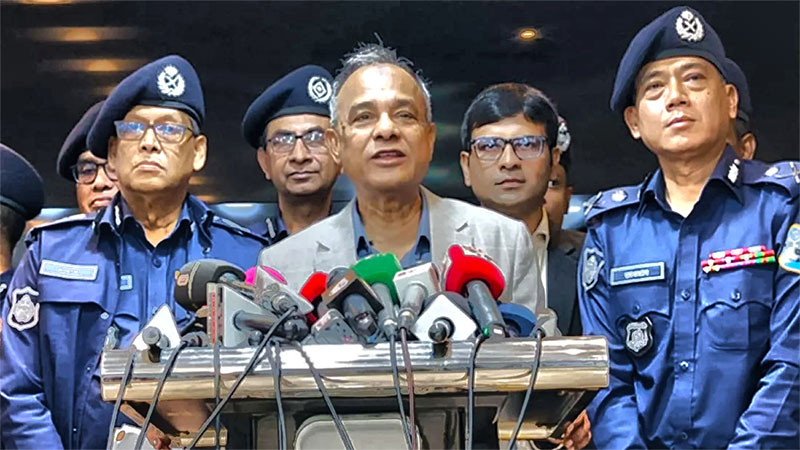
In the new political reality, after the change of government, the demand to return to the previous uniform has become strong. The Bangladesh Police Service Association has already said in a statement that the previous uniform carries the tradition of the force. After the statement, it is known that the issue has come up for discussion at the highest level of the government.
A DIG-rank official said that the police headquarters also held a separate meeting on the issue. He claimed that verbal instructions were given from the highest levels of the government to return to the previous uniform.
There has also been dissatisfaction within the force with the current uniform. According to many members, the new uniform looks like that of private security personnel. A section of officers, from constables to senior officers, feel that it is undermining the force’s identity and negatively impacting morale, according to an internal report.
The official also said that two influential advisors to the former government and a former police officer who served in the Ministry of Home Affairs directly intervened in the process of changing the dress code. In addition, at least a dozen police officers played an active role from behind the scenes, four of whom have already retired.
There are allegations that they are leading an influential syndicate. Preparations are underway to inform the higher echelons of the government, including the Home Minister, about breaking up this syndicate.
It is worth noting that as part of the force reform, the interim government introduced a new ‘iron-colored’ uniform for the police in November last year. However, since its introduction, there have been mixed reactions. Questions have also been raised about the similarity of the new uniform with the uniforms of the Narcotics Control Department and various private security agencies.
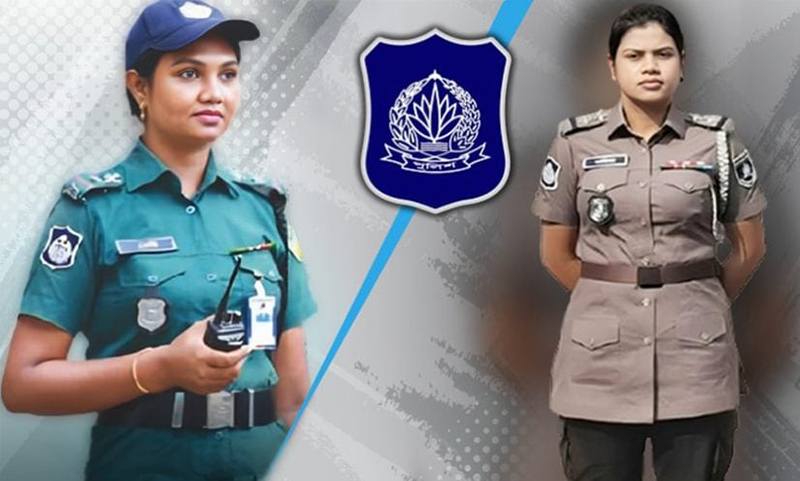
The issue has come to the attention of officials in the new government, and they are reportedly considering the possibility of returning to the old uniforms.
The interim government led by Dr. Yunus formed a high-level committee to determine the new uniform for the police. Based on the recommendations of the committee, the government approved the specific color of the uniform. As per the decision, all the metropolitan police started wearing the new ‘iron-colored’ uniform from November 14 last year.
Gradually, the country’s district-level police also started using the same uniform. However, the Armed Police Battalion (APBN) and the Special Protection Battalion (SPBN) retained their previous uniforms.
After the uniforms were finalized, then Home Affairs Advisor Jahangir Alam Chowdhury said that the selection of new uniforms for the police, RAB and Ansar forces had been completed and that this would also bring about changes in the behavior of the forces.
However, allegations have been made from various quarters that despite the change in uniform, the expected change in police behavior has not occurred.
Critics say the new uniforms make many members look like private security guards; the general public is often unable to easily identify them as police.
After the change in the police uniform, security analysts and administrative experts opined that the desired reform is not possible by changing the clothes alone. If there is no change in the mentality, professionalism and accountability of the members, only changing the color will not yield effective results. They also reminded that uniforms have been changed several times in the past, but the structural or behavioral transformation of the force has not been very visible.
Former Inspector General of Police Noor Mohammad said, “It’s not enough to just change the color of the clothes; a change in mentality is necessary.” According to him, the recent situation has brought the police directly face to face with the public.
He believes that the tradition of the force lies in the previous uniform and that clothing does not change the mentality. If professional training is strengthened and an independent working environment is ensured like in other countries of the world, there can be a positive change in the attitude of the police.

During the July riots, police were killed and hanged in this way to provoke the police to increase violence in the movement.
The opinion of the concerned quarters is that the desired results will not be achieved by just changing the uniform. In order to build a people-friendly and professional police, effective guarantees against political interference are necessary. At the same time, the ability to say ‘no’ to illegal orders and an institutional culture must be developed. Only then will the prestige of the uniform increase; otherwise, even if the clothes are changed, there is a risk that the old trend in behavior will persist.
In 2004, during the BNP-Jamaat coalition government, major changes were made to the police uniform. At that time, the Metropolitan Police were given light olive-colored uniforms, and the District Police were assigned dark blue. At the same time, black uniforms were assigned to the RAB, a combination of khaki, purple and blue for the Armed Police Battalion (APBN), and gray for the shirt of the Special Protection Battalion (SPBN). The color of the pants of different units also differed.
Then, in three phases—2004, 2016, and 2021—the colors of the uniforms of various police units were changed. The latest change was made to the APBN uniform.
However, allegations of irregularities and corruption in procurement surrounding the change in the army’s uniforms during the interim government’s tenure have come to light.
According to police headquarters sources, information has also been received that an influential group has coordinated (through a syndicate) to control the production of clothing.
The demand to reconsider the new uniform of the Bangladesh Police is now gaining strength from within the force. On Monday night, February 23, the Bangladesh Police Service Association issued a statement urging the government to reconsider the decision to change the uniform.
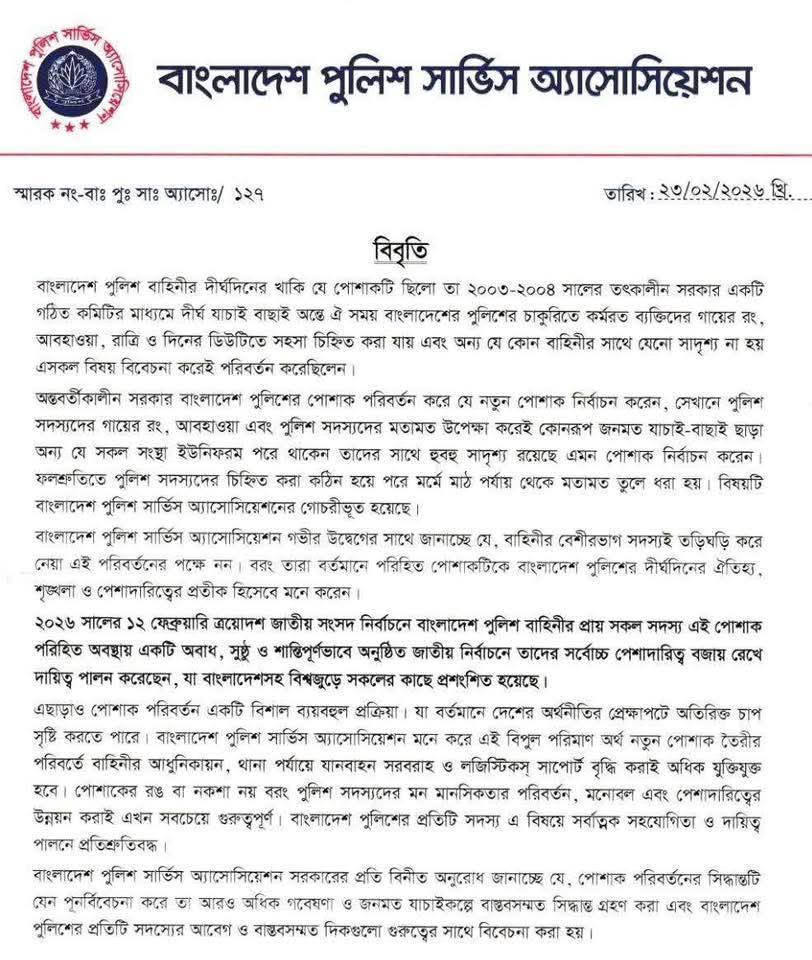
The statement signed by the organization’s general secretary and Comilla District Superintendent of Police Md. Anisuzzaman said that the long-standing khaki uniform was decided after extensive scrutiny based on the recommendations of a committee formed by the then government in 2003-2004.
At that time, the skin color of police members, the country’s climate, the issue of being easily identifiable during day and night duty, and avoiding similarity with the uniforms of other forces were given great importance.
The statement further claimed that the new uniform selected by the interim government did not properly reflect these issues. It was alleged that the uniform was finalized without examining field-level opinions or public opinion.
The organization also said that opinions have emerged from the field that the similarity of the new uniforms with those of other uniformed organizations is making it difficult to easily identify police members in many cases.
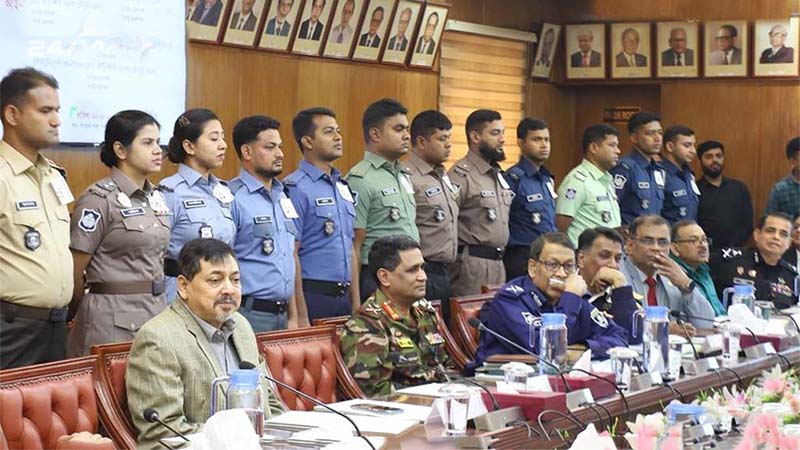
Several colored clothes were selected
Law enforcement uniforms around the world
According to police sources, law enforcement uniforms around the world are generally determined by two main considerations—the historical context of the country and the geographical-climatic realities. In most countries, climate plays an important role in determining the color, fabric type, and design of clothing.
In cold countries, dark or black colors are often seen in police uniforms. Since maintaining temperature is important, thick fabrics and designs that help retain heat are used. On the other hand, in countries with hot or temperate climates, white, brown, or light-colored uniforms are more common, as these colors absorb relatively less heat and provide comfort for long periods of outdoor duty.
There are historical reasons behind the introduction of khaki in the context of South Asia. During the British colonial period, khaki uniforms were introduced in administrative and law enforcement forces, which later remained common in various countries of the Indian subcontinent. As a result, the uniforms of many service organizations in the region, including India, still reflect that tradition.

https://stapravda.ru/20221228/reyting_samyh_populyarnyh_hostingov_v_rossii_196445.html, рейтинг хостингов России подтверждает, что выбор надежного провайдера важен для бизнеса.