
Manjurul Haque
is a writer, columnist and political analyst.
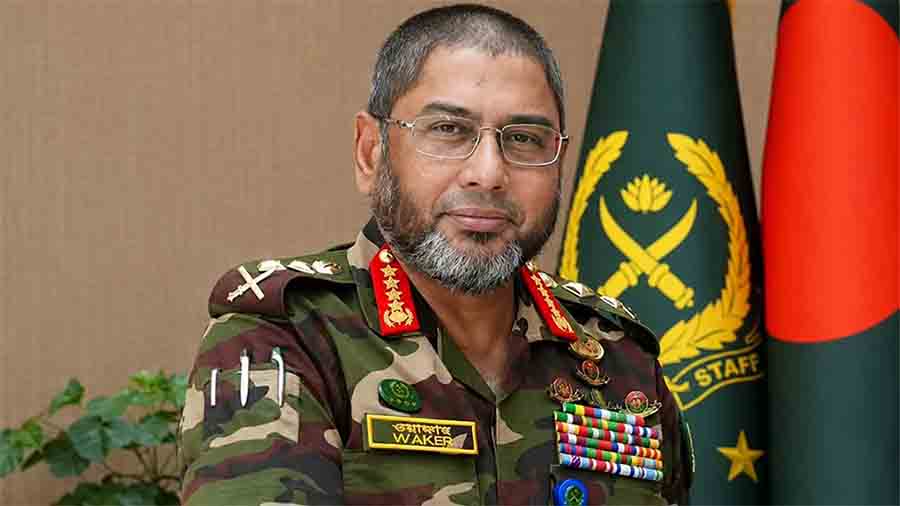
The Army Chief’s message is circulating all over the newsfeed. The message could have been a direction on what the military’s duty is in this turbulent time for the country as the head of the force, which was established with a vow to uphold the country’s constitution in the overall situation of the country. It did not. He said at one point in his speech inaugurating the ARMY INTERNATIONAL ISLAMIC INSTITUTE, “Without receiving proper education, the country has sought innovation.”
The statement would not have been taken seriously if it had been made by an Islamic thinker, because it is not the responsibility of the army to spread the teachings of a particular religion while wearing a uniform. An army member or the army chief himself may be a fan or follower of a particular religion, that is not his religious belief or duty. His duty is to obey the army law while serving and to fulfill the responsibility given by the constitution of the country, that is, to protect the country. For that work, the state ensures them the highest facilities of the country. The state is funded by the people who own the state and their tax money.
There may be no ulterior motive behind this statement. He said it to please the sentiments of the Muslim majority population, but even though many people in Bangladesh do not understand how serious the aftershocks are, many understand them. That is why the statement has started being discussed on social media. Let’s try to see why this ‘symptom’ is serious in the light of history:
Throughout history, the military forces of several Muslim countries have been influenced, in whole or in part, by Muslim fundamentalist extremist or Islamist ideologies, which have subsequently led to long-term political instability, civil wars, and extreme crises in those countries. The first name on this list is Pakistan.
1. Pakistan: During the military dictatorship of General Zia-ul-Haq in the 1970s and 1980s, a well-planned policy of “Islamization” was imposed on the Pakistan Army. This policy was further accelerated during the Soviet-Afghan War, as the Pakistani public was deceived into believing that the Soviet Union was a communist and atheist country. Fighting against that country meant ‘jihad’ on behalf of Islam.
The policy of using state-sponsored extremist groups, such as Lashkar-e-Taiba and Jaish-e-Mohammad, later led to major conflicts within the country. Extremist groups such as the Tehreek-e-Taliban Pakistan (TTP) declared war on the state itself, resulting in thousands of deaths and a devastating economic collapse in Pakistan.
2. Sudan: In 1989, General Omar al-Bashir seized power in Sudan through a military coup with the support of radical Islamist leader Hassan al-Turabi. This military-fundamentalist coalition imposed strict Sharia law in Sudan and sheltered international terrorists including Osama bin Laden. As a result, Sudan split in 2011 due to a protracted civil war and a new state called ‘South Sudan’ was born. After three decades of dictatorship, the country is still experiencing extreme political and military instability.
3. Afghanistan: Since the late 1970s, internal conflicts and radical ideology have spread within parts of the Afghan military and later the Mujahideen groups. After the withdrawal of Soviet troops, Afghanistan fell into the clutches of a civil war between fundamentalist groups in the 1990s, leaving Afghanistan in complete ruins. Later, the breakdown of the military structure and the rise of the extremist Taliban group turned the country into a breeding ground for global terrorism for decades.
4. Algeria: After the extremist Islamic Salvation Front (FIS) party was almost certain to win the 1991 general election, Algeria’s secular military annulled the election and seized power. This led to an armed uprising by a section of the military and extremists. The bloody civil war (known as the “Dark Decade”), which lasted from 1992 to 2002, killed about 200,000 people and completely destroyed the country’s law and order system.
5. Iraq: After the US invasion in 2003, Saddam Hussein’s secular Baath Party army was disbanded. These unemployed and disgruntled military officers later turned to radical Sunni fundamentalism. These skilled military commanders of Saddam’s army later became the main driving force of the infamous militant group ISIS. They seized large areas of Iraq and Syria, causing a terrible civil war, genocide and global instability.
6. Yemen: After the 2011 Arab Spring, a large part of the Yemeni military became politically divided and allied with the Houthis, a Shiite Zaidi extremist group in northern Yemen. This military defection led to the Houthis seizing the capital, Sanaa, and plunging Yemen into a devastating and protracted civil war. As a result, Yemen is facing one of the worst humanitarian crises of the century.
The brief picture given of these six countries is not a comprehensive picture of the countries. The real situation is even more dire.
Now let’s see what happens in the exact opposite case if the powerful military ruler or army chief or the top leadership of the revolution is secular, progressive, and modern.
Mustafa Kemal Ataturk, after the fall of the Ottoman Empire, took strict military and legal measures to suppress the evil circles of Muslim fundamentalists and conservatives and turned Turkey into a secular state. Inspired by the ideals of the European Enlightenment, he implemented a policy of completely removing the political influence of religion from the state, society, law, and education system. He contributed completely to the emergence of modern Turkey.

https://stapravda.ru/20221228/reyting_samyh_populyarnyh_hostingov_v_rossii_196445.html, рейтинг хостингов России подтверждает, что выбор надежного провайдера важен для бизнеса.